


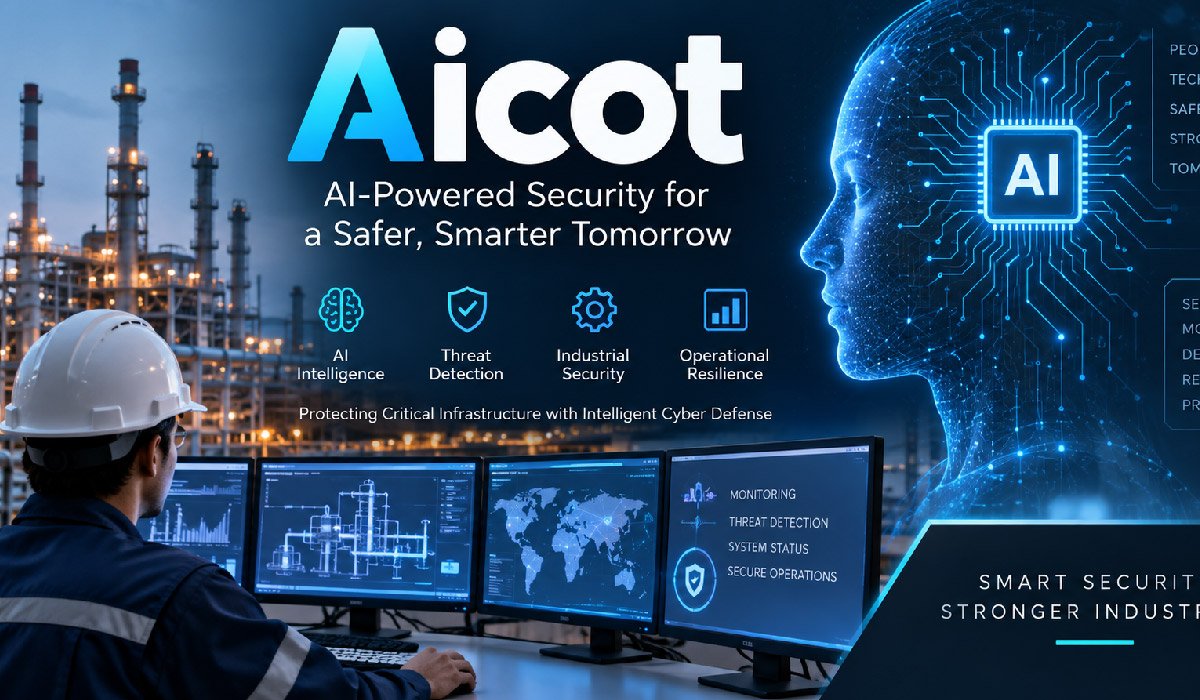
Aicot is an AI-driven cybersecurity concept focused on improving the protection of Operational Technology, commonly called OT. Operational Technology includes the hardware and software used to monitor or control physical equipment. These systems can be found in factories, energy facilities, water networks, transportation systems, and other forms of critical infrastructure.
Unlike ordinary office computers, OT environments interact directly with machines and physical processes. A cybersecurity incident in such an environment can therefore create problems beyond lost files or unavailable websites. It may interrupt production, affect equipment, or reduce the availability of an important service.
Aicot focuses on bringing artificial intelligence, cybersecurity monitoring, threat analysis, and OT knowledge together. The broader idea is to identify suspicious behavior early and provide useful information that helps security teams understand potential threats. This approach recognizes that protecting industrial systems requires knowledge of both digital networks and the physical processes those networks control.
Understanding the Main Purpose of Aicot
The main purpose of Aicot is to strengthen cybersecurity in environments where digital technology controls important physical operations. Traditional cybersecurity products are often designed around computers, servers, cloud platforms, and business networks. Industrial environments can have very different requirements because availability, safety, and continuous operation are major priorities.
Aicot approaches cybersecurity with these industrial requirements in mind. An OT network can contain sensors, controllers, engineering workstations, industrial machines, communication systems, and specialized software. Security monitoring needs to consider how all of these components normally communicate and operate.
The aim is not simply to collect large amounts of security information. Useful cyber defense requires turning that information into understandable signs of risk. Artificial intelligence can potentially assist with this process by examining activity, identifying unusual patterns, and helping analysts concentrate on events that deserve closer investigation. Human expertise remains important when interpreting those findings and deciding how to respond.
Why Operational Technology Cybersecurity Matters
Operational Technology plays an important role in modern society. Electricity generation and distribution, manufacturing, water treatment, transportation, and many other essential activities rely on computerized industrial equipment. As these environments become increasingly connected, their exposure to cybersecurity risks can also increase.
Many industrial systems were originally created for reliability and long operating lives rather than constant exposure to modern network threats. Some equipment may remain in service for years or decades. Replacing it can be expensive, technically difficult, or disruptive to operations. This creates cybersecurity challenges that cannot always be solved by applying ordinary IT security methods.
Aicot is relevant to this problem because an OT-focused security approach needs to understand industrial conditions. Security measures should protect systems without unnecessarily interrupting essential processes. Monitoring, threat detection, contextual analysis, and carefully planned responses therefore become particularly important. Cybersecurity in OT is ultimately connected with operational continuity as well as the protection of digital information.
How Aicot Uses Artificial Intelligence
Artificial intelligence can support cybersecurity by processing large amounts of information and looking for patterns that would be difficult to examine manually. Aicot applies this general capability to the cybersecurity challenges associated with Operational Technology. AI can help analyze network behavior, system activity, alerts, and other relevant information.
One important application is anomaly detection. Industrial processes frequently follow recognizable operating patterns. Machines communicate in expected ways, processes operate within established ranges, and particular actions happen at particular stages. When activity moves significantly outside those patterns, it may deserve investigation. However, unusual activity does not automatically mean that a cyberattack has occurred.
Aicot therefore represents a form of AI-assisted defense rather than the replacement of cybersecurity professionals. Artificial intelligence can help identify potentially important events, while analysts provide context and judgment. This distinction matters because industrial environments are complex. Maintenance work, configuration changes, equipment failures, and normal operational changes can sometimes produce behavior that appears unusual to automated monitoring systems.
How Aicot Can Support Threat Detection
Threat detection involves finding signs that a system may be experiencing unauthorized or harmful activity. In large industrial environments, this can be challenging because many devices may continuously exchange information. Security teams need ways to separate ordinary communication from activity that could indicate a genuine security problem.
Aicot can support this process by examining activity across an OT environment and highlighting anomalies or suspicious patterns. Instead of treating every unusual event as equally dangerous, an intelligent monitoring approach can help organize information and provide context that analysts can investigate further.
Effective detection also depends on understanding what normal operation looks like. A sudden communication pattern, unexpected connection, unusual command, or unexplained system behavior may deserve attention when it differs from an established baseline. The purpose of Aicot-style analysis is therefore not simply to produce more alerts. The more useful objective is to make security information easier to interpret so professionals can recognize important events and investigate them before problems become more serious.
Aicot and Threat Intelligence
Threat intelligence provides information about cybersecurity threats, attack techniques, vulnerabilities, malicious activity, and indicators that security teams can use during investigations. When combined with information from an industrial environment, threat intelligence can provide additional context about activity that might otherwise be difficult to understand.
Aicot brings threat-focused information together with OT monitoring. For example, an unusual event becomes more meaningful when analysts can compare it with known attack behavior or information about threats affecting similar technologies. This contextual approach can help teams determine which events require immediate examination and which may have less significance.
Threat intelligence is most useful when it is relevant, current, and connected to the systems being protected. Large amounts of unrelated information can create additional work rather than improve security. Aicot therefore highlights an important cybersecurity principle: collecting information is only part of the task. Security teams also need methods for connecting that information with real operational activity and turning it into useful knowledge.
Aicot and Critical Infrastructure Protection
Critical infrastructure includes systems and services that support essential social and economic activity. Energy, water, transportation, manufacturing, and related sectors increasingly depend on digital technology. A successful cyber incident affecting these environments can potentially interrupt operations and create consequences that extend beyond an individual computer or organization.
Aicot is designed around the security requirements of these sensitive environments. Industrial networks cannot always be treated like standard business networks because their priorities are different. A production system, electricity network, or water facility may need to operate continuously, making poorly planned security changes potentially disruptive.
Protection therefore requires visibility as well as caution. Operators need to understand which devices are communicating, how processes normally behave, and where suspicious activity is occurring. Aicot aims to support that understanding through monitoring, artificial intelligence, and cybersecurity analysis. The objective is to improve awareness while respecting the operational requirements of industrial environments, where cybersecurity decisions may need to consider reliability, availability, and physical processes simultaneously.
Important Components of an Aicot Approach
A useful Aicot cybersecurity approach depends on several connected capabilities rather than one isolated technology. Monitoring is fundamental because security analysis requires visibility into what is happening within an environment. Information about communications, devices, system behavior, and operational events can help establish a picture of normal activity.
Artificial intelligence can then assist in examining this information for anomalies and meaningful patterns. Threat intelligence adds another layer by providing knowledge about known cyber risks and attack behavior. OT-specific knowledge is equally important because an event that seems suspicious in a normal IT environment may have a legitimate operational explanation inside an industrial facility.
These components become more useful when they work together. Aicot is therefore best understood as an integrated approach to industrial cyber defense. Monitoring provides observations, AI helps process those observations, threat information supplies external context, and OT expertise connects cybersecurity findings with real industrial operations. Human professionals can then use these combined insights during investigation and response.
Benefits of Aicot for Industrial Organizations
One potential benefit of Aicot is improved visibility. Industrial networks may contain numerous devices, communication paths, control systems, and machines. Without effective monitoring, security professionals can struggle to understand what is happening across the environment. Better visibility can make suspicious behavior easier to identify and investigate.
Another benefit is the ability to process security information efficiently. Cybersecurity teams can face large numbers of events and alerts. AI-assisted analysis can help organize this information and highlight patterns that deserve attention. This may reduce some of the manual work involved in examining routine activity, although automated results still require appropriate validation.
Aicot can also support a more OT-aware approach to cybersecurity. Industrial environments have operational requirements that ordinary enterprise security tools may not fully understand. Combining cybersecurity analysis with knowledge of industrial processes can produce more useful context. The value comes from helping human teams understand risks more clearly, rather than assuming automation can independently solve every cybersecurity problem.
Challenges and Limitations of Aicot
Artificial intelligence has limitations, and Aicot should not be understood as an automatic solution to every industrial cybersecurity problem. AI systems depend heavily on the information available to them. Incomplete, poor-quality, or unrepresentative data can reduce the usefulness of automated analysis and may result in incorrect conclusions.
False positives are another important consideration. An industrial process can change because of maintenance, equipment replacement, production adjustments, software updates, or ordinary operational events. Automated monitoring might identify some of these changes as unusual even when they are legitimate. Security teams therefore need sufficient context before taking action.
Integration can also be difficult in older industrial environments. Legacy equipment may use specialized protocols and technologies that were never designed for modern security monitoring. Organizations must balance improved cybersecurity with reliability and operational continuity. Aicot can assist detection and analysis, but strong industrial cybersecurity still requires skilled personnel, secure architecture, appropriate policies, asset management, access controls, maintenance, and well-tested incident-response procedures.
Is Aicot Safe and Reliable?
The reliability of Aicot should be considered in terms of how AI-assisted cybersecurity is implemented and used. No cybersecurity technology can guarantee complete protection. Attack methods continue to change, systems can contain unknown weaknesses, and automated tools can sometimes interpret activity incorrectly. A layered security approach remains necessary.
In an industrial environment, reliability is especially important because an incorrect security response could affect physical operations. Detection systems therefore need to provide useful evidence and context rather than encouraging automatic action without understanding the operational consequences. Human oversight remains an important safeguard when security decisions could influence critical processes.
Aicot can contribute to security by improving monitoring and supporting threat analysis, but organizations still need established cybersecurity controls. Network segmentation, controlled access, secure configurations, backups, asset inventories, vulnerability management, staff training, and incident-response planning all remain important. AI should complement these practices rather than replace them. The effectiveness of the overall approach depends on responsible implementation and continuous evaluation.
Aicot and Human Cybersecurity Experts
A common misunderstanding about artificial intelligence is that advanced automation can remove the need for human cybersecurity professionals. In practice, industrial cyber defense requires expertise that automated systems cannot fully reproduce. Analysts need to understand technical evidence, operational context, organizational priorities, and the possible consequences of different responses.
Aicot can support professionals by processing information and drawing attention to potentially important activity. This can be particularly valuable when an environment generates more events than a team can realistically examine manually. Automation can assist with prioritization while allowing specialists to spend more time investigating significant incidents.
Human judgment becomes especially important when an alert involves operational equipment. A cybersecurity analyst may need to work with engineers, operators, and other technical staff before deciding what action is appropriate. Shutting down a device, isolating equipment, or changing a configuration could affect production or safety. Aicot is therefore most useful as a decision-support capability that strengthens human analysis rather than replacing it.
The Role of Aicot in Future OT Security
Industrial digitalization continues to connect operational environments with modern networks, software platforms, remote services, sensors, and data systems. These connections can improve efficiency and visibility, but they also create additional cybersecurity considerations. Organizations therefore need security approaches that can keep pace with increasingly complex industrial environments.
Aicot illustrates how artificial intelligence could become an important part of that evolution. As monitoring technologies improve, AI can potentially help security teams understand larger and more complicated collections of operational data. Better contextual analysis may also help distinguish routine industrial changes from behavior that deserves immediate investigation.
However, the future of OT security will not depend on AI alone. Secure system design, network architecture, access management, trained personnel, threat intelligence, incident planning, and cooperation between cybersecurity and engineering teams will continue to matter. Aicot represents one part of this broader development: using intelligent analysis to help people protect systems where digital security and physical operations increasingly depend on each other.
What Organizations Should Consider Before Using Aicot
Before adopting an Aicot-style approach, an organization first needs to understand its own environment. A clear inventory of devices, systems, communication paths, software, and critical processes provides the foundation for effective monitoring. It is difficult to recognize abnormal behavior without first understanding what equipment exists and how normal operations work.
Organizations should also determine how AI-generated findings will be reviewed. Alerts need responsible owners, investigation procedures, escalation rules, and communication between cybersecurity teams and operational staff. A technically suspicious event may have an ordinary engineering explanation, so cooperation between these groups is essential.
Another consideration is how new security technology will interact with existing industrial systems. Monitoring should be introduced carefully, particularly where older or sensitive equipment is involved. Organizations should assess compatibility, security requirements, data handling, operational impact, and response procedures. Aicot can provide additional analytical capability, but its implementation should fit into a broader cybersecurity program rather than operating as an isolated solution.
Why Aicot Is Important for Modern Cyber Defense
The importance of Aicot comes from the growing relationship between digital networks and physical infrastructure. Cybersecurity is no longer limited to protecting documents, websites, email accounts, and business databases. Digital systems increasingly control machines and processes that support manufacturing, transportation, energy, water, and other important activities.
This changes what cybersecurity teams must understand. They need to identify malicious digital activity while also considering the physical process behind the technology. An alert affecting an industrial controller, for example, can have different implications from an alert involving an ordinary office computer. Context is therefore essential.
Aicot addresses this challenge by connecting artificial intelligence with OT-focused monitoring and cybersecurity analysis. Its broader significance is the move toward security systems that understand behavior instead of relying only on isolated alerts. As industrial environments become more connected, organizations will need better ways to identify suspicious changes while maintaining stable operations. Intelligent analysis can support that objective when combined with strong security practices.
Final Thoughts
Aicot represents an AI-driven approach to cybersecurity for Operational Technology and critical infrastructure. Its central idea is to combine monitoring, artificial intelligence, threat information, and industrial context so cybersecurity professionals can identify and understand suspicious activity more effectively. This is particularly relevant in environments where digital systems directly interact with machines and physical processes.
The technology should not be viewed as a replacement for experienced cybersecurity analysts or industrial engineers. Artificial intelligence can process information, detect anomalies, and support investigations, but people still need to determine what an event means and choose an appropriate response. Industrial cybersecurity requires technical understanding as well as awareness of operational consequences.
As OT environments become increasingly connected, approaches such as Aicot demonstrate how AI may support the next generation of industrial cyber defense. Its practical value ultimately depends on accurate monitoring, appropriate implementation, human oversight, reliable threat information, and integration with a broader cybersecurity strategy.
(FAQs)
What is Aicot?
Aicot is an AI-driven cybersecurity approach focused on Operational Technology environments. It combines artificial intelligence, security monitoring, threat analysis, and OT knowledge to help identify suspicious activity within industrial and critical infrastructure systems.
What is Aicot used for?
Aicot is designed to support cybersecurity monitoring and threat detection in OT environments. It can help security professionals analyze unusual behavior and better understand potential cyber threats affecting industrial equipment and processes.
How does Aicot use artificial intelligence?
Aicot uses artificial intelligence to analyze system and network activity for unusual patterns. AI can help highlight anomalies and organize security information, while human cybersecurity professionals investigate findings and determine appropriate responses.
Can Aicot help protect critical infrastructure?
Aicot focuses on cybersecurity challenges associated with Operational Technology and critical infrastructure. Its approach can support threat detection and security awareness in environments such as energy, water, manufacturing, and transportation systems.
Does Aicot replace cybersecurity professionals?
No. Aicot is intended to support cybersecurity professionals rather than replace them. AI can assist with monitoring and analysis, but human expertise remains important for understanding alerts, operational conditions, and appropriate incident responses.
