


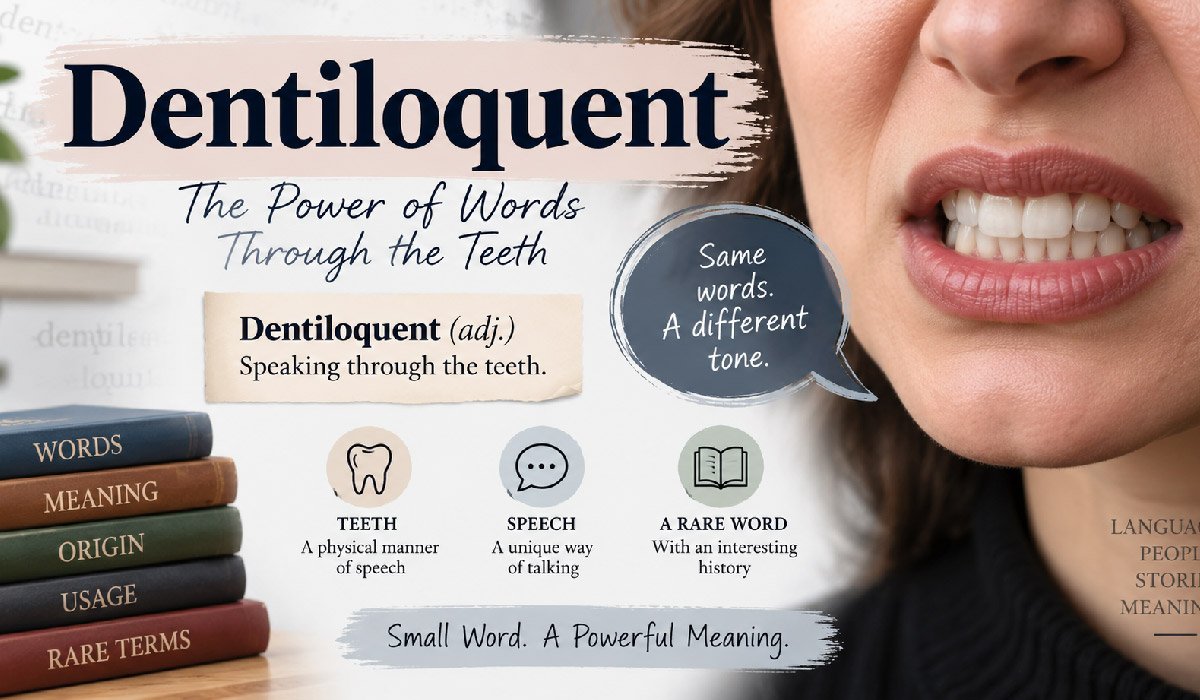
Dentiloquent is a rare English adjective used to describe speech produced through or between the teeth. It usually refers to a person speaking while keeping the jaw tight and the teeth close together. Because the mouth does not open normally, the resulting voice may sound narrow, restrained, tense, or slightly muffled.
The word is uncommon in everyday conversation. Most people would simply say that someone was “speaking through clenched teeth.” Dentiloquent expresses a similar idea in a single descriptive word. For this reason, it is more likely to appear in discussions about unusual vocabulary, creative writing, language articles, and collections of rare English words.
Understanding Dentiloquent is easier when its meaning, word roots, grammatical role, and possible uses are examined together. It is mainly a description of how speech is physically produced. It does not automatically explain the speaker’s feelings, intentions, personality, or reason for speaking that way.
Dentiloquent Meaning and Definition
Dentiloquent means speaking through the teeth or describing speech produced while the teeth are held close together. The word focuses mainly on the physical manner in which someone speaks. A speaker may keep the jaw relatively still, leave only a small space between the teeth, and produce words without opening the mouth as widely as usual.
This limited movement can affect the quality of the voice. Speech may sound tight, pressed, controlled, or somewhat unclear. However, Dentiloquent does not necessarily mean that the listener cannot understand what is being said. Someone can speak through nearly clenched teeth while still pronouncing words clearly enough to be understood.
The adjective should also not be treated as another word for anger. People often associate clenched teeth with frustration or anger, but those emotions come from context. The central definition concerns the physical production of speech. Emotion, purpose, volume, and meaning are separate details that a sentence or scene must establish.
Dentiloquent Meaning in Simple
In simple English, Dentiloquent means talking through your teeth. Imagine a person keeping their jaw tight and their teeth almost together while continuing to speak. Their lips may move, but their mouth does not open as freely as it normally would during relaxed conversation. That physical picture captures the basic meaning of the word.
A common everyday phrase with a similar meaning is “speaking through clenched teeth.” This phrase will usually be easier for an average reader to recognize. Dentiloquent provides writers with a compact adjective when they specifically want to describe this manner of speech without using a longer phrase.
A simple example would be a person trying to remain controlled during a difficult argument. Instead of opening the mouth normally, the person tightens the jaw and pushes the words through the teeth. The speech could then be described as Dentiloquent. The situation explains the emotion, while the adjective describes the person’s manner of speaking.
Origin and Etymology of Dentiloquent
The structure of Dentiloquent becomes easier to understand when it is divided into its classical elements. The beginning of the word is associated with teeth. The Latin word dens, with forms connected to dent-, means tooth. The same root can be recognized in familiar English words related to teeth, including dental, dentist, dentition, and dentistry.
The latter part is associated with speech. It is connected with the Latin verb loqui, meaning “to speak.” This Latin root has contributed to several English words associated with speaking and language. Words such as eloquent, loquacious, colloquy, and soliloquy demonstrate how this old speech-related element survives in modern vocabulary.
When the ideas represented by these elements are considered together, the meaning becomes logical: teeth combined with speaking. Dentiloquent therefore describes a way of speaking associated specifically with the teeth. Knowing these roots provides a useful memory aid because the word’s construction reflects its narrow descriptive meaning.
How to Pronounce Dentiloquent
Dentiloquent may initially appear difficult to pronounce because most readers have never encountered it in ordinary conversation. A useful pronunciation guide is den-TIL-uh-kwunt. Breaking the term into smaller sound units makes it much easier to approach than attempting to pronounce the entire unfamiliar spelling at once.
The beginning, “den,” connects naturally with dental vocabulary. The middle contains the strongly noticeable “TIL” sound, followed by a lighter unstressed sound. The ending resembles the sound found in words containing the familiar -loquent element. Because the word is extremely uncommon, readers may encounter slight differences in pronunciation guides from different vocabulary sources.
Interestingly, a person does not need to speak through clenched teeth when pronouncing Dentiloquent itself. The term describes a type of speech rather than providing instructions for saying the word. Normal mouth movement will make its pronunciation clearer. Practicing each sound separately and then joining the parts together is the easiest approach for unfamiliar readers.
Is Dentiloquent a Real English Word?
Dentiloquent is encountered as a rare vocabulary term, but its status should be understood carefully. A word can exist in vocabulary collections, historical discussions, user-submitted dictionary material, or specialist language sources without having the widespread use associated with common dictionary vocabulary. Dentiloquent belongs to the uncommon end of the English lexicon rather than normal daily speech.
Collins has presented Dentiloquent in its submitted new-word material with the meaning of talking through one’s teeth and indicated that evidence of usage is monitored. This is different from saying that the term has the same established status and frequency as ordinary words such as speaking, whispering, or shouting.
Its rarity does not prevent readers from understanding or discussing it. English contains many uncommon, literary, historical, specialist, and experimental terms. When using Dentiloquent, however, writers should remember that many readers will not immediately recognize it. Providing clear context can therefore be more useful than assuming that an audience already knows its meaning.
Why Is Dentiloquent So Rare?
One major reason Dentiloquent remains rare is that English already has an easy phrase for the same basic physical action. Saying that somebody “spoke through clenched teeth” is natural, immediately understandable, and requires no special vocabulary knowledge. As a result, most speakers have little practical reason to replace that phrase with an unfamiliar adjective.
Rare words often survive because they describe a narrow action or quality with unusual precision. They can attract people interested in language, word origins, creative writing, quizzes, dictionaries, and unusual vocabulary. This gives a term a place in language discussions even when it is seldom heard in everyday conversations.
Frequency and usefulness are also different ideas. A word does not need to appear frequently to represent a meaningful concept. Dentiloquent offers a compact description of a recognizable physical manner of speaking. Its limitation is familiarity rather than precision. Writers therefore need to decide whether that precision is worth introducing an unfamiliar word to their particular audience.
What Does Dentiloquent Speech Sound Like?
Dentiloquent speech can be imagined as words being produced while normal jaw movement is restricted. During ordinary speech, the jaw, tongue, lips, and other parts of the vocal tract work together to shape different sounds. If the teeth remain close and the jaw moves less freely, articulation may sound different from relaxed, open-mouth conversation.
The exact sound will depend on the speaker. It may seem pressed, narrow, restrained, quiet, tense, or slightly muffled. Some sounds can be harder to form naturally when mouth movement is restricted. However, this does not mean that all speech produced through close teeth becomes impossible to understand. A person may still articulate sufficiently for listeners to follow the message.
Dentiloquent therefore describes a manner of delivery rather than one fixed sound. Two people could speak with tightly held teeth and sound quite different. Their volume, accent, speed, vocal control, and degree of jaw restriction could all affect the result.
Why Might Someone Speak Through Clenched Teeth?
People can speak with a tight jaw for several reasons, so Dentiloquent speech should not automatically be linked to one emotion. Anger is probably the most familiar example. Someone irritated but trying to maintain control may tighten the jaw while speaking. This physical behavior can make otherwise ordinary words sound more forceful or restrained.
Stress, fear, discomfort, secrecy, or deliberate performance may produce a similar effect. An actor, for example, might restrict jaw movement intentionally to create a particular character voice. In fiction, a writer might describe this type of delivery to communicate emotional restraint without directly stating that the character feels angry, frightened, or uncomfortable.
Context remains essential. Dentiloquent identifies the manner in which speech is produced but does not diagnose the reason behind it. A writer should provide other information if the speaker’s emotional state matters. Body language, situation, dialogue, facial expression, and surrounding events can explain why the person is speaking through close or clenched teeth.
Dentiloquent vs. Mumbling
Dentiloquent and mumbling can both describe speech that sounds unusual or less open than ordinary conversation, but their meanings are different. Mumbling generally refers to speaking quietly or unclearly, often with insufficient articulation. A person who mumbles does not necessarily keep the teeth together or maintain a tight jaw while speaking.
Dentiloquent is more physically specific. Its central feature is speech associated with the teeth being held close together. A Dentiloquent speaker could theoretically remain understandable if the words are articulated clearly enough. Likewise, someone could mumble with a relaxed jaw and no noticeable clenching of the teeth. This difference makes the two descriptions unsuitable as exact synonyms.
The distinction becomes clearer through an example. A student looking down and giving an unclear, low response may be mumbling. A character maintaining a tight jaw while carefully forcing out a clearly understandable warning fits Dentiloquent more closely. One description emphasizes general lack of clarity, while the other emphasizes how the mouth and teeth are positioned.
Dentiloquent vs. Muttering, Whispering, and Ventriloquism
Muttering usually refers to speaking in a low voice, sometimes because a person does not want others to hear clearly or is expressing dissatisfaction quietly. Teeth position is not a required part of muttering. A person can mutter with a relaxed mouth, making it different from the specific physical idea represented by Dentiloquent.
Whispering is different again. A whisper is produced using a special low, breathy manner of speech rather than ordinary voiced speech. Someone could theoretically whisper while holding the teeth close, but whispering itself does not require this position. The two descriptions concern different aspects of speech production and can occasionally overlap without meaning the same thing.
Ventriloquism should also be separated from Dentiloquent speech. Ventriloquists deliberately control visible mouth and lip movements while creating the impression that a voice comes from another source, often a puppet. Dentiloquent simply describes speech through close or clenched teeth. It does not involve creating an auditory illusion or performing the specialized techniques associated with ventriloquism.
How Dentiloquent Works Grammatically
Dentiloquent functions as an adjective, meaning its job is to describe a noun. In practical writing, it can describe nouns connected with speaking, such as voice, speech, reply, warning, delivery, comment, or tone. A writer might therefore refer to a “Dentiloquent reply” or a “Dentiloquent delivery” when the surrounding sentence makes the physical manner of speech clear.
Because the adjective is uncommon, sentence construction matters. Placing it next to a clear description can prevent readers from becoming confused. For example, writing that a character gave a Dentiloquent response “with his jaw locked and his teeth barely apart” supplies immediate contextual information. Even readers unfamiliar with the adjective can infer its approximate meaning.
Writers should also remember that Dentiloquent describes the delivery rather than the content of speech. It does not tell readers whether the statement is polite, threatening, humorous, truthful, or dishonest. Those qualities must come from the words spoken and the surrounding context rather than from the adjective itself.
Dentiloquent Example Sentences
Original example sentences are useful because Dentiloquent is easier to understand in context than as an isolated definition. A writer could say, “She gave a Dentiloquent answer, keeping her jaw tight while carefully forming each word.” The additional description immediately shows readers how the character is speaking and prevents the rare adjective from becoming confusing.
Another example is, “His Dentiloquent warning remained perfectly understandable despite the narrow movement of his mouth.” This sentence demonstrates an important point: speaking through close teeth does not automatically mean mumbling. A third example could read, “The actor adopted a Dentiloquent delivery during the tense scene, allowing the character’s physical restraint to become part of the performance.”
The word can also appear outside emotional scenes. For example: “The unusual Dentiloquent speaking exercise required participants to limit jaw movement while reading the sentence.” In every case, surrounding details improve clarity. Context is especially important whenever writers introduce vocabulary their audience may not already recognize.
Using Dentiloquent in Creative and Descriptive Writing
Dentiloquent has its strongest practical value in descriptive writing where physical details about speech matter. Fiction writers often use voice, facial expression, posture, and movement to reveal how a character reacts to a situation. Describing a character’s tightly controlled speech can provide information that dialogue alone may not communicate.
The adjective may be particularly useful in scenes involving restraint. A character can speak polite words while maintaining a tight jaw, allowing the physical delivery to suggest tension beneath the surface. It can also describe an actor’s performance, a fictional voice, or an intentionally unusual speaking style. In these settings, Dentiloquent provides a compact descriptive option.
However, unusual vocabulary should serve the sentence rather than distract from it. If readers have to stop repeatedly to look up rare terms, the story can lose momentum. Writers should therefore provide contextual clues or choose the familiar phrase “through clenched teeth” when immediate understanding is more important than lexical variety.
Other Rare Words Related to Speech and -loquent
Dentiloquent belongs to an interesting family of terms containing elements associated with speech. One more familiar example is grandiloquent, which describes language or a speaking style that sounds lofty, elaborate, pompous, or overly impressive. Unlike Dentiloquent, grandiloquent describes the style or character of language rather than the physical position of the teeth.
Other uncommon examples include melliloquent, associated with sweet or pleasing speech, and somniloquent, associated with speaking during sleep. Fatiloquent is another rare term connected historically with prophetic speech or speaking about fate. These words demonstrate how speech-related classical elements have been combined with other roots to produce precise meanings.
Learning the common element can make unfamiliar vocabulary easier to decode. When readers recognize that loquent and related forms have associations with speaking, they can examine the beginning of an unfamiliar word for additional clues. Dentiloquent becomes particularly memorable because its tooth-related beginning combines logically with its speech-related ending.
When Should You Use Dentiloquent?
Dentiloquent is most useful when a writer wants a precise adjective for speech made through close or clenched teeth. It can work effectively in vocabulary articles, language discussions, literary descriptions, scripts, character studies, and certain forms of creative writing. In these situations, the unusual term may provide both precision and stylistic variety.
The audience should still influence the decision. In instructions, business communication, educational material for beginners, or ordinary conversation, “speaking through clenched teeth” will generally communicate the meaning faster. Familiar vocabulary reduces the risk of readers misunderstanding an otherwise simple idea. Using a rarer word does not automatically make writing stronger or more professional.
Good word choice depends on precision, context, audience, and purpose. Dentiloquent earns its place when its exact meaning adds something valuable to a description. When it only makes a simple sentence harder to understand, plain language is usually more effective. Clarity remains more important than displaying unusual vocabulary.
Why Dentiloquent Is Worth Knowing
Dentiloquent may never become part of most people’s everyday vocabulary, but learning it provides a useful example of how specific English can be. Instead of using several words to describe speech produced through clenched teeth, a single adjective can represent the same central physical idea. That precision is one reason rare vocabulary continues to interest language enthusiasts.
The word also demonstrates the value of understanding classical roots. Recognizing the connection between dent- and teeth makes the first part familiar, while knowledge of speech-related forms derived from Latin loqui helps explain the second. Root knowledge can therefore turn an apparently difficult word into something logical and memorable.
Most importantly, learning Dentiloquent does not mean it must replace simpler language. Vocabulary gives writers choices. Knowing both the rare adjective and the familiar phrase allows a writer to select whichever version suits the audience, tone, and context. That flexibility is more useful than using uncommon words simply because they sound unusual.
Final Thoughts
Dentiloquent is a rare adjective describing speech produced through or with the teeth held close together. Its meaning becomes easier to remember when the word is connected with its tooth-related and speech-related roots. It describes the physical manner of speaking rather than automatically identifying anger, fear, secrecy, or any other emotion.
The term also differs from mumbling, muttering, whispering, and ventriloquism. Each of those concepts describes a different feature or technique of speech. Dentiloquent is narrower because the relationship between speaking and the position of the teeth is central to its meaning.
For everyday communication, “speaking through clenched teeth” will usually be the clearer expression. Dentiloquent becomes more useful in discussions of rare vocabulary and carefully contextualized descriptive writing. Its value lies in its precision: it gives a concise name to a recognizable but highly specific manner of speech.
(FAQs)
What does Dentiloquent mean?
Dentiloquent means speaking through or between the teeth, usually while keeping the jaw tight and the teeth close together. It describes the physical manner of speaking rather than the meaning of the words.
Is Dentiloquent a real English word?
Dentiloquent appears as a rare English vocabulary term meaning “talking through one’s teeth.” It is not commonly used in everyday conversation, so most people use the phrase “speaking through clenched teeth” instead.
How do you pronounce Dentiloquent?
Dentiloquent can be pronounced approximately as den-TIL-uh-kwunt. Breaking the word into smaller sound units makes it easier to say, especially because it is an uncommon term that many English speakers rarely encounter.
Does Dentiloquent mean speaking angrily?
Not necessarily. Dentiloquent describes speech made through close or clenched teeth. Although this manner of speaking can occur during anger or frustration, it may also appear during tension, restraint, discomfort, or deliberate performance.
What is the difference between Dentiloquent and mumbling?
Dentiloquent specifically relates to speaking through clenched teeth. Mumbling generally means speaking quietly or unclearly and does not require clenched teeth. A Dentiloquent speaker may therefore still produce words that listeners can clearly understand.
