


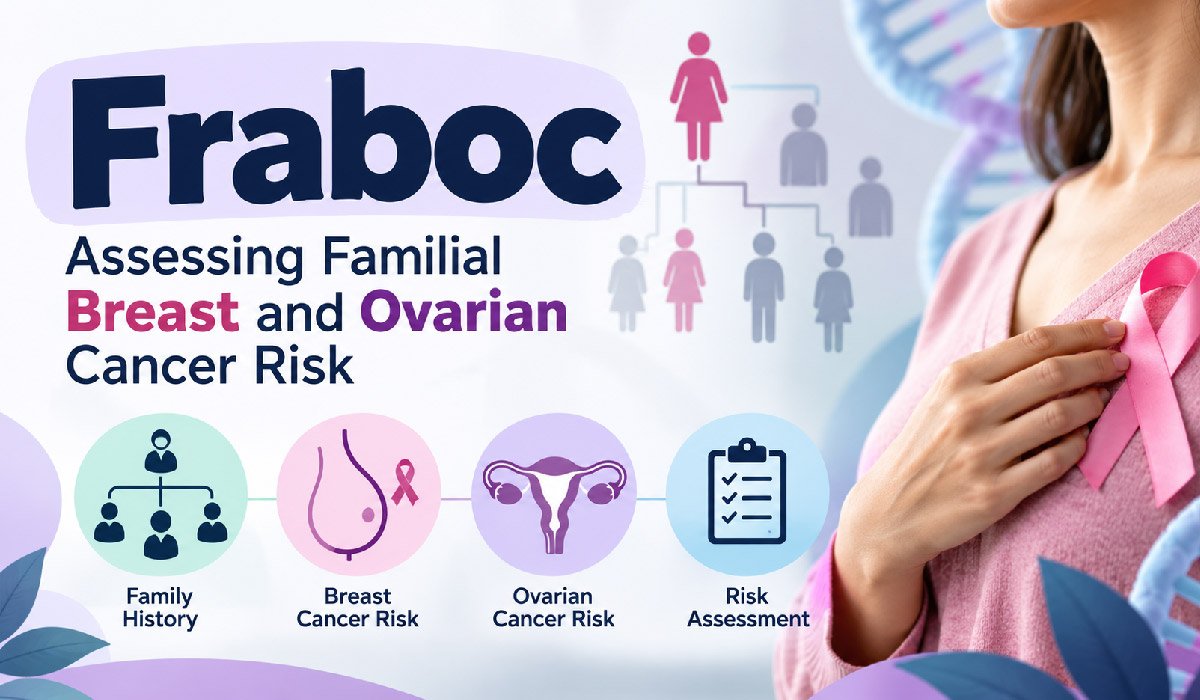
Fraboc is a term connected with an older Australian approach to understanding family-related breast and ovarian cancer risk. More formally written as FRA-BOC, it stands for Familial Risk Assessment – Breast and Ovarian Cancer. The tool helped healthcare professionals examine cancer patterns within a family and identify women who might need further assessment.
Fraboc was not designed to diagnose cancer or detect a genetic mutation. Instead, it used information about relatives, cancer types, and ages at diagnosis to help professionals understand possible familial risk. This distinction is important because having cancer in a family does not automatically mean another relative will develop the disease.
Although the original Fraboc tool is no longer available through Cancer Australia, people may still find the term in older healthcare documents and online resources. Understanding what it meant can therefore help readers make sense of historical medical information while recognizing that current cancer-risk assessments use newer approaches.
What Does Fraboc Mean?
Fraboc commonly refers to FRA-BOC, short for Familial Risk Assessment – Breast and Ovarian Cancer. It was associated with Australian healthcare and was intended to help health professionals assess whether patterns of breast and ovarian cancer within a family suggested an increased level of risk.
The word “familial” is important. It means the assessment focused heavily on family medical history. Healthcare professionals could consider which relatives developed cancer, what type of cancer they had, their relationship to the patient, and how old they were when the disease was diagnosed.
Fraboc should therefore be understood as a risk-assessment resource, not as the name of a disease or medical treatment. It did not prove that cancer was present and could not tell with certainty whether someone would develop cancer later in life.
Why Was Fraboc Used?
Family cancer history can be difficult to interpret without considering the full pattern. Having one relative diagnosed with breast cancer later in life may have different implications from having several close relatives diagnosed with breast or ovarian cancer at unusually young ages.
Fraboc provided healthcare professionals with a structured way to examine these differences. Instead of treating every family cancer history in the same way, the assessment could help identify patterns that deserved closer attention and potentially a more detailed clinical evaluation.
This information could then support decisions about what should happen next. Depending on the person’s circumstances, a healthcare professional might provide general advice, consider further risk assessment, or discuss referral to a family cancer service or another appropriate specialist.
How Did Fraboc Assess Cancer Risk?
The Fraboc process started with family medical history. Healthcare professionals collected information about relatives who had developed relevant cancers. Details such as the cancer type, family relationship, and age at diagnosis could all contribute to understanding the overall pattern.
Both sides of the family mattered. Cancer-related genetic variants can be inherited through either parent, so a history of relevant cancers on the father’s side should not automatically receive less attention than similar information from the mother’s side.
Historical FRABOC guidance used broad categories such as at or slightly above average risk, moderately increased risk, and potentially high risk. These classifications supported further decision-making, but they were estimates based on available information rather than predictions of what would definitely happen.
Why Family Cancer History Is Important
A family medical history can provide clues about inherited cancer susceptibility. When several relatives have related cancers, particularly when cancers develop at younger ages, healthcare professionals may consider whether an inherited factor could be contributing to the pattern.
Other details can also attract attention. Historical familial-risk assessments considered patterns involving breast and ovarian cancer in the same family, male breast cancer, cancer affecting both breasts, and known cancer-related genetic variants within a family.
However, family history is only part of cancer-risk assessment. A person can develop breast or ovarian cancer without having a strong known family history. Similarly, having several relatives with cancer does not prove that a person carries an inherited cancer-related genetic variant.
Which Relatives Were Important in Fraboc?
Family-risk assessments can include information from close relatives across several generations. First-degree relatives generally include parents, siblings, and children. Second-degree relatives can include grandparents, aunts, uncles, nieces, nephews, and other relatives depending on the assessment being performed.
Healthcare professionals were interested in more than simply counting affected relatives. They also needed to understand how closely those people were related, which cancers occurred, whether cases appeared on the same side of the family, and the ages when diagnoses occurred.
For this reason, accurate family information can be useful during a modern cancer-risk discussion as well. Someone preparing for an assessment can try to learn which relatives had cancer, what cancer they had, their approximate age at diagnosis, and whether genetic testing was performed.
What Were the Fraboc Risk Groups?
Historical Fraboc guidance divided breast cancer familial risk into three broad categories. The lowest category was described as at or slightly above average risk. Older guidance suggested that the large majority of women assessed under that framework belonged to this group.
A second category covered moderately increased risk, while the highest category was known as potentially high risk. Stronger family patterns, such as several affected relatives or certain unusually early diagnoses, could contribute to consideration of a higher familial-risk category.
These old classifications should be treated as historical information rather than a calculator for determining someone’s current risk. Cancer-risk modelling and clinical practice have developed since FRABOC was used, and present-day decisions should be based on current assessment methods and professional medical guidance.
Was Fraboc a Cancer Test?
No. Fraboc did not test a person’s body for cancer. It was not a mammogram, ultrasound, biopsy, blood test, or other diagnostic procedure. Its purpose was to assess information associated with possible future cancer risk rather than identify an existing tumour.
This difference is essential. Risk assessment and cancer diagnosis are separate processes. A risk assessment estimates the likelihood or level of risk based on available factors, while diagnostic procedures investigate whether cancer is actually present.
Someone placed in a higher familial-risk group did not automatically have breast or ovarian cancer. Likewise, being considered at lower familial risk did not guarantee that a person would never develop cancer. Risk tools describe probabilities and patterns rather than individual certainties.
Was Fraboc a BRCA Genetic Test?
Fraboc was also different from genetic testing. Genetic tests examine DNA for particular variants that may affect disease risk. Fraboc instead relied primarily on family-history information to recognize cancer patterns that could warrant closer professional evaluation.
BRCA1 and BRCA2 are well-known genes associated with inherited breast and ovarian cancer susceptibility. Certain harmful variants in these genes can increase cancer risk and can be inherited from either the mother or the father.
Fraboc itself could not determine whether someone carried a BRCA1, BRCA2, or another cancer-related genetic variant. Instead, a significant family pattern could help a healthcare professional decide whether genetic counselling, specialist assessment, or appropriate genetic testing deserved consideration.
How Did Fraboc Consider Ovarian Cancer?
Although breast cancer features prominently in discussions of FRABOC, ovarian cancer was also part of the assessment. Healthcare professionals could consider ovarian cancer among relatives and examine how those cases fitted into the wider family cancer history.
A family containing ovarian cancer together with breast cancer, particularly certain patterns of multiple or younger diagnoses, could warrant more detailed evaluation. A known inherited cancer-related genetic variant within the family could also be highly relevant to a professional assessment.
One ovarian cancer diagnosis within a family, however, did not automatically prove that an inherited cancer syndrome was present. Healthcare professionals needed to examine the wider clinical and family context rather than drawing conclusions from one piece of information alone.
What Happened After a Higher-Risk Assessment?
Being classified in a higher Fraboc risk category was not the same as receiving a cancer diagnosis. The result was intended to help guide what healthcare professionals might consider next based on the person’s individual and family circumstances.
A clinician could decide that more detailed risk evaluation was appropriate. Some people might be referred to a family cancer service or specialist, where their family history could be examined in greater detail and genetic counselling or testing could be discussed when relevant.
The appropriate next step was not identical for everyone. Family structure, cancer types, ages at diagnosis, existing genetic information, personal medical history, and other factors could influence professional decisions about assessment, screening, counselling, or risk-management options.
Why Is Fraboc No Longer Available?
The original Fraboc resource is no longer available through Cancer Australia. People may nevertheless continue to encounter its name because older medical records, healthcare documents, referral material, archived resources, and webpages can remain accessible for many years.
Cancer-risk assessment has also become more individualized. Modern approaches can incorporate a wider range of information and use updated models to estimate risk. This provides healthcare professionals with options beyond the broad familial-risk categories associated with older assessment frameworks.
The disappearance of the original tool does not mean family history has stopped being important. Instead, current assessments should rely on contemporary clinical resources and guidance. An old FRABOC result may provide historical context but should not automatically determine present-day healthcare decisions.
What Is Used Instead of Fraboc Today?
Modern breast cancer risk assessment can involve tools and models such as iPrevent, CanRisk, and IBIS (Tyrer-Cuzick). These are not simply renamed versions of Fraboc. They have their own methodologies, intended uses, inputs, and limitations.
iPrevent is associated with the Peter MacCallum Cancer Centre and supports breast cancer risk assessment and risk-management discussions. CanRisk uses BOADICEA models and can incorporate detailed family and other risk information. IBIS is another model used for estimating breast cancer risk.
Modern tools may provide more individualized estimates than the broad categories associated with FRABOC. However, an estimate remains an estimate. No risk calculator can state with certainty whether a particular person will eventually develop breast cancer or another disease.
Fraboc and iPrevent Are Not the Same
Fraboc primarily represented a structured approach to assessing familial breast and ovarian cancer risk. Family history played a central role, and historical guidance grouped women into broad categories according to the patterns identified through that information.
iPrevent takes a more individualized approach to breast cancer risk. It can consider family history alongside other relevant factors and support discussions about risk management. Its purpose and methodology therefore differ from the historical FRABOC framework.
Neither approach should be confused with genetic testing or cancer diagnosis. A risk-assessment tool can provide information that supports a healthcare discussion, but diagnostic testing, genetic testing, screening, and risk estimation are distinct processes with different clinical purposes.
What If Fraboc Appears in an Old Medical Record?
Seeing “Fraboc” or “FRA-BOC” in an old medical document should not be interpreted as evidence that you have cancer. It may simply show that familial breast and ovarian cancer risk was assessed, discussed, or considered by a healthcare professional.
Look at the surrounding information if the record belongs to you. The document may contain a historical risk category, referral recommendation, family-history notes, or other details explaining why FRABOC was mentioned at that particular time.
If the information remains relevant to your health, discuss the old record with a qualified healthcare professional. Family histories change as relatives receive new diagnoses or genetic results, so an assessment made many years ago may not represent the information available today.
How to Prepare for a Current Family Risk Assessment
Before discussing familial cancer risk with a healthcare professional, collect as much reliable family information as reasonably possible. Useful details include which relatives developed cancer, how they are related to you, what type of cancer occurred, and the age at diagnosis.
Information from both sides of the family should be considered. It can also be useful to know whether anyone had breast cancer in both breasts, whether a male relative developed breast cancer, or whether a family member underwent genetic testing and received a relevant result.
Do not delay seeking professional advice simply because some family details are missing. Family histories are often incomplete. Tell the healthcare professional what you know and identify uncertain information clearly. The clinician can then determine what additional assessment, if any, is appropriate.
Why Fraboc Still Matters
Fraboc is mainly important today because it helps explain older Australian approaches to familial breast and ovarian cancer risk. Someone reading historical healthcare material may encounter the term and need to understand why it appeared in a medical assessment.
Its central principle remains relevant: family history can provide useful information about cancer risk. Recognizing patterns across generations can sometimes help identify people who may benefit from closer evaluation, genetic counselling, or other professional assessment.
At the same time, Fraboc should not be treated as a current self-assessment system. Historical categories cannot capture every aspect of an individual’s present risk. Modern healthcare decisions should rely on current evidence, appropriate assessment tools, and advice from qualified healthcare professionals.
Final Thoughts
Fraboc, or FRA-BOC, stands for Familial Risk Assessment – Breast and Ovarian Cancer. It was used in Australia to help healthcare professionals interpret family cancer history and identify patterns that could indicate a need for more detailed assessment.
The most important point is that Fraboc was neither a cancer diagnosis nor a genetic test. It organized family-history information to support risk assessment and clinical decisions. A higher familial risk did not mean that cancer was present or guaranteed to develop.
Although the original Fraboc tool is no longer available through Cancer Australia, family history continues to play an important role in cancer-risk discussions. People concerned about breast or ovarian cancer in their family should use current assessment methods and discuss their individual circumstances with a qualified healthcare professional.
(FAQs)
What does Fraboc stand for?
Fraboc refers to FRA-BOC, meaning Familial Risk Assessment – Breast and Ovarian Cancer. It was an Australian clinical resource used to help healthcare professionals evaluate possible familial cancer risk using information about cancer diagnoses within a person’s family.
Is Fraboc still available?
The original FRABOC tool is no longer available through Cancer Australia. The term can still appear in older healthcare documents and online resources. Current cancer-risk decisions should use appropriate modern assessment methods and current professional medical guidance.
Could Fraboc diagnose cancer?
No. Fraboc was a risk-assessment resource rather than a diagnostic test. It could not detect breast or ovarian cancer. Diagnosis requires appropriate clinical investigations, while Fraboc used family-history information to help healthcare professionals understand possible familial risk.
Was Fraboc a genetic test?
No. Fraboc did not analyze DNA and could not identify BRCA1, BRCA2, or other genetic variants. It examined patterns in family cancer history that could sometimes help professionals decide whether further assessment or genetic counselling was appropriate.
Does breast cancer in my family mean I am high risk?
Not necessarily. Cancer risk depends on the wider family pattern and other individual factors. The number of affected relatives, their relationships, cancer types, ages at diagnosis, genetic information, and personal health factors can all influence professional assessment.
What can be used instead of Fraboc today?
Current breast cancer risk assessment can involve resources and models such as iPrevent, CanRisk, and IBIS, depending on the clinical situation. These approaches differ from historical FRABOC and should be interpreted according to their intended use and current medical guidance.
