


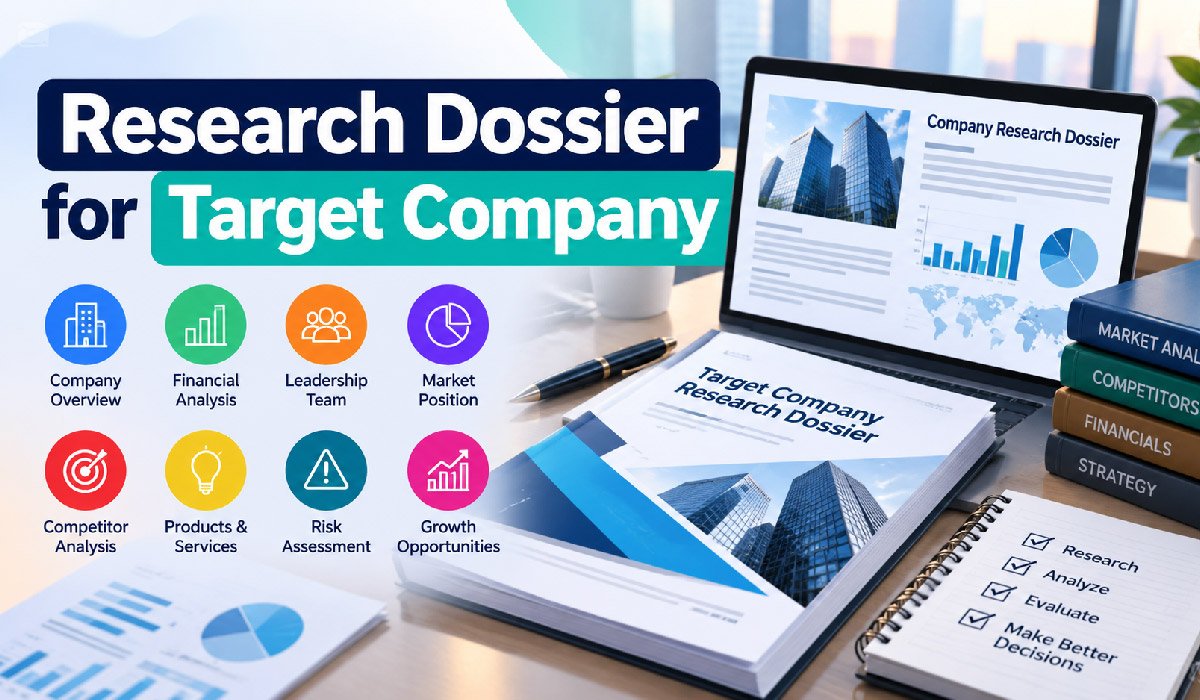
Researching a business before making an important decision can reveal details that are easy to miss at first glance. A research dossier for target company brings those details together, helping investors, business owners, sales teams, consultants, and analysts understand the organization they are evaluating.
Instead of collecting random facts, a useful dossier connects company identity, products, customers, leadership, finances, competitors, market conditions, digital presence, and business risks. This creates a more complete picture of how the organization operates and where its strengths or weaknesses may exist.
Good company research also separates verified information from estimates and assumptions. That distinction matters when the dossier will support an investment, partnership, acquisition, sales strategy, supplier agreement, competitive study, or another decision involving money and business resources.
What Is a Research Dossier for Target Company?
A research dossier for target company is an organized collection of facts, evidence, and analysis about a business being evaluated. The target might be a potential investment, acquisition candidate, customer, competitor, supplier, employer, strategic partner, or company entering a particular market.
Unlike a basic company profile, a dossier explores how different parts of the business connect. It may examine ownership, products, customers, revenue model, leadership, competitors, market conditions, funding, reputation, technology, regulatory exposure, and recent business developments.
The final document should make research easier to use. A reader should be able to understand what the company does, how it creates value, what supports its position, which risks deserve attention, and what additional questions require investigation.
Start by Defining the Research Purpose
Before collecting information, define why the company is being researched. An investor studying a startup needs different information from a sales team preparing an account strategy. Without a clear purpose, researchers can spend hours collecting details that never influence the final decision.
For investment research, financial performance, growth potential, management, competitive advantages, and risk may receive greater attention. Sales research may focus more heavily on company needs, technology, decision-makers, expansion plans, operational problems, and signals that indicate potential demand.
Create several research questions before starting. For example, ask how the business earns revenue, who buys its products, how it differs from competitors, what could threaten its growth, and which evidence supports its claims. These questions keep the dossier focused.
Build a Clear Company Profile
The company profile establishes the foundation of the dossier. Record the official business name, primary website, headquarters or principal operating location, industry, founding information, ownership type, main products, important markets, and other basic corporate details that can be reasonably verified.
Company descriptions require more care than they appear to. Marketing language such as “leading,” “revolutionary,” or “fastest-growing” should not automatically become a research conclusion. Describe what the business actually provides and identify the evidence behind significant company claims.
The profile should remain concise because deeper sections will explain the business in detail. Its purpose is to give readers enough context to understand the organization before moving into its commercial model, products, customers, market position, leadership, and financial information.
Research the Official Website and Digital Footprint
The official website is an important first-party source. Review the homepage, About section, product pages, pricing information, case studies, resources, careers, contact pages, legal documents, documentation, support areas, and other sections that reveal how the company presents its business.
Website structure can provide useful clues. Separate pages for enterprises, small businesses, developers, industries, integrations, or geographic markets can indicate different customer segments. Documentation, API pages, partner directories, and customer stories may provide additional evidence about how products are positioned and used.
A company’s wider digital footprint can include official social profiles, app listings, press releases, regulatory records, industry directories, interviews, reviews, and reputable news coverage. Compare these sources instead of treating the corporate website as the complete story.
Understand How the Company Makes Money
Business model analysis explains how an organization converts its products or services into revenue. Determine whether it relies on direct sales, subscriptions, transaction fees, advertising, commissions, licensing, professional services, usage-based charges, marketplaces, memberships, or a combination of different revenue streams.
Next, study the economics surrounding those revenue sources. Consider who pays, what customers receive, whether purchases are recurring, how pricing changes between customer groups, and whether additional products can increase the value generated from an existing customer relationship.
Avoid assuming that visible pricing explains the entire business. Enterprise contracts, custom agreements, channel partnerships, service fees, and other arrangements may not appear publicly. When exact revenue composition cannot be established, clearly separate confirmed information from reasonable analytical observations.
Examine Products and Customer Value
Product research should explain more than a list of features. Identify the main product or service, the problem it addresses, its intended users, how customers interact with it, and the practical benefit customers receive from choosing the company.
Look at product tiers, integrations, delivery methods, support options, geographic availability, warranties, technical requirements, and related services where relevant. For technology businesses, documentation and release information can also help researchers understand product maturity and the direction of development.
Most importantly, identify the value proposition. A company may compete through convenience, specialized technology, lower costs, better service, speed, brand strength, integrations, industry expertise, or another advantage. The dossier should explain which benefits appear meaningful rather than repeating promotional claims.
Identify the Target Customers
Understanding customers helps explain nearly every other part of the business. Determine whether the company primarily serves consumers, small businesses, large enterprises, government organizations, professionals, developers, educational institutions, or customers within particular industries and geographic markets.
Useful evidence may appear in product pages, pricing, case studies, customer logos, testimonials, documentation, advertising, events, and sales materials. Language is also revealing. Content written for procurement teams or technical developers usually indicates a different buying process from content aimed at individual consumers.
Consider who uses the product and who makes the purchasing decision. They are not always the same person. In business-to-business markets, end users, managers, finance teams, technical reviewers, procurement departments, and executives may all influence a single purchase.
Analyze the Competitive Landscape
A research dossier for target company should place the organization within its competitive environment. Start with direct competitors offering similar solutions to similar customers. Then consider indirect alternatives that solve the same underlying problem through a different product, service, or process.
Compare important factors such as pricing, functionality, customer focus, geographic reach, positioning, distribution, partnerships, integrations, reputation, and service. The objective is not simply to produce a long competitor list but to understand where meaningful differences exist.
Competition should also be considered dynamically. A strong position today does not guarantee the same position tomorrow. New technology, changing customer behavior, lower-cost entrants, regulation, consolidation, and substitute products can change an industry and weaken advantages that once appeared secure.
Evaluate Competitive Advantages and Market Moats
Competitive advantage describes the characteristics that may help a company perform differently from rivals. Possible advantages include proprietary technology, trusted branding, intellectual property, distribution, economies of scale, specialized expertise, customer relationships, network effects, data, switching costs, or efficient operations.
Not every strength creates a durable moat. A feature that competitors can reproduce quickly may provide a temporary advantage but little long-term protection. Researchers should therefore ask how difficult, expensive, or time-consuming it would be for another business to reproduce the advantage.
Evidence is particularly important here. High customer retention, strong distribution relationships, difficult technical integration, patents, regulatory approvals, or network effects may support a moat argument. Marketing statements alone are not enough to establish that a defensible competitive position exists.
Review Leadership and Company Organization
Leadership research helps explain who makes important decisions and what experience they bring to the organization. Review founders, senior executives, board members, and other leaders whose responsibilities materially affect strategy, finance, operations, technology, sales, or product development.
Professional backgrounds can provide useful context, especially when executives have experience in the same industry or have managed similar stages of business growth. However, previous achievements should not be treated as proof that a current strategy will succeed.
Organizational information can provide additional signals. Hiring activity, department expansion, senior appointments, office changes, and employee trends may indicate strategic priorities. These indicators require careful interpretation because workforce growth or hiring alone does not establish financial strength or future success.
Study Financial Health and Funding
Financial analysis depends heavily on whether the target is public or private. Public companies generally provide more standardized financial disclosures, while reliable financial information for private companies can be limited. Researchers should never present third-party revenue estimates as audited company results.
Where credible information is available, examine revenue, revenue growth, gross margin, operating expenses, profitability, cash generation, debt, liquidity, capital expenditure, and other metrics relevant to the industry. A single number rarely explains financial health, so trends and relationships matter.
For funded businesses, examine disclosed financing rounds, investors, acquisitions, and other capital events. Funding can provide resources for expansion, but money raised is not the same as revenue or profit. The dossier should preserve these distinctions to avoid misleading conclusions.
Check Reputation and External Signals
Reputation research can reveal information that official company material does not emphasize. Customer reviews, industry discussions, professional coverage, regulatory information, product feedback, and credible media reports can help identify recurring strengths, complaints, disputes, or service problems.
Individual reviews should be interpreted carefully. One extremely positive or negative review may not represent the typical customer experience. Repeated patterns across multiple credible sources are generally more informative, particularly when similar issues appear consistently over a meaningful period.
External signals should still be verified whenever possible. News reports can contain errors, online discussions can lack context, and reviews may be biased. Important allegations, legal matters, regulatory issues, and financial claims deserve stronger evidence before they influence a business decision.
Look for Recent Business Developments
Companies change continuously, so a useful dossier needs dates. Search for product launches, acquisitions, partnerships, funding events, geographic expansion, leadership appointments, restructuring, regulatory developments, major contracts, strategic changes, and other events that could materially change the company picture.
Recent developments should be connected with the broader analysis. For example, launching an enterprise product may indicate movement toward larger customers. Opening operations in another country may signal expansion, but researchers should still examine whether the company has meaningful commercial traction there.
Always distinguish an announcement from a completed result. A company may announce a partnership, expansion plan, or future product without immediately generating material business value from it. Recording both the announcement date and subsequent evidence produces a more accurate dossier.
Identify Major Business Risks
Risk analysis prevents a research dossier from becoming an overly positive company profile. Consider competitive, financial, operational, technological, legal, regulatory, cybersecurity, supply-chain, reputational, and market risks according to the nature of the company and its industry.
Concentration deserves special attention. Dependence on one major customer, supplier, distribution platform, geographic market, product, founder, or technology provider can increase vulnerability. The importance of each concentration risk depends on how easily the company could replace that dependency.
Separate existing problems from potential risks. Evidence of declining revenue is different from a hypothetical risk that revenue could decline. A professional dossier explains what has happened, what could happen, why it matters, and how strong the supporting evidence is.
Find Realistic Growth Opportunities
After examining risks, consider the company’s potential growth paths. Opportunities may include entering new geographic markets, serving additional customer groups, introducing complementary products, improving distribution, forming partnerships, increasing customer spending, acquiring competitors, or using technology to improve efficiency.
Growth opportunities should connect with actual capabilities. Entering a large market sounds attractive, but market size alone does not prove that a company can compete successfully. Distribution, capital, product fit, brand awareness, regulation, pricing, and competitive intensity can all affect expansion.
A strong dossier therefore distinguishes theoretical opportunities from credible ones. Existing customer demand, successful product extensions, established partnerships, improving unit economics, or demonstrated traction in a new segment can provide stronger support for a growth thesis than general market optimism.
Verify Sources and Separate Facts From Analysis
Research quality depends on source quality. Give greater weight to primary materials such as official filings, regulatory databases, company reports, product documentation, legal disclosures, and clearly attributable corporate announcements. Credible independent reporting can provide important external context.
Every important number should have a source and date whenever possible. Revenue, customer counts, employee estimates, website traffic, market share, funding, and valuations can quickly become outdated. Third-party estimates should be labeled as estimates instead of presented as confirmed facts.
Finally, keep facts and analysis separate. “The company launched a new product in June” is a factual statement when properly sourced. “The launch may help it reach enterprise customers” is interpretation. Making this distinction improves transparency and makes conclusions easier to challenge or verify.
Turn the Research Into a Useful Dossier
A completed research dossier for target company should prioritize decisions rather than information volume. Start with an executive summary containing the most important findings. Follow it with company identity, business model, customers, products, competitors, leadership, financial information, developments, risks, and opportunities.
Consider adding a source register showing the source, publication date, access date, information collected, and confidence level. This makes future updates easier and allows another researcher to understand where important conclusions originated without repeating the entire investigation.
Finish with unresolved questions and recommended next steps. These could include requesting financial statements, interviewing management, validating customer concentration, examining contracts, conducting technical due diligence, checking legal records, or researching a particular competitor before a final decision is made.
Final Thoughts
A research dossier for target company becomes valuable when it turns scattered information into a structured business picture. The strongest dossiers explain not only what a company does but also how it makes money, who it serves, how it competes, and what evidence supports those conclusions.
Accuracy is more important than filling every section. When reliable financial, ownership, customer, or market information is unavailable, saying that evidence is limited is better than converting an estimate into a fact. This approach protects the quality of the entire analysis.
Whether the research supports investment, sales, acquisition, partnership, supplier selection, or competitive intelligence, the same principle applies: collect relevant evidence, verify important claims, separate fact from interpretation, identify uncertainties, and connect the findings directly to the decision being considered.
(FAQs)
What is a research dossier for target company?
A research dossier for target company is a structured report containing verified information and analysis about a business. It can cover the company’s products, customers, business model, competitors, leadership, finances, market position, risks, opportunities, and recent developments.
What should be included in a target company dossier?
A useful dossier normally includes company identity, official website information, products and services, revenue model, target customers, leadership, competitors, financial signals, funding, reputation, recent developments, business risks, growth opportunities, sources, and final research conclusions.
How do you research a target company?
Begin with a clear research objective and the company’s official sources. Then compare important information with regulatory records, reputable publications, industry sources, customer evidence, and other credible material. Record dates and distinguish verified facts from estimates or analysis.
Why is competitor analysis important in a company dossier?
Competitor analysis shows how the target company compares with alternative providers. Studying products, customers, pricing, positioning, distribution, technology, and other differences can reveal competitive strengths, weaknesses, market gaps, and threats that a basic company profile may miss.
How can you verify information in a company research dossier?
Cross-check important claims using multiple reliable sources where possible. Give greater weight to regulatory filings, official documentation, financial reports, and credible independent reporting. Clearly label company-reported numbers, external estimates, opinions, and analytical conclusions so readers understand their reliability.
How often should a target company research dossier be updated?
There is no universal schedule. Update the dossier whenever material changes occur, such as new funding, acquisitions, leadership changes, financial results, product launches, regulatory action, or major partnerships. Active investment, sales, or competitive research may require more frequent reviews.
