


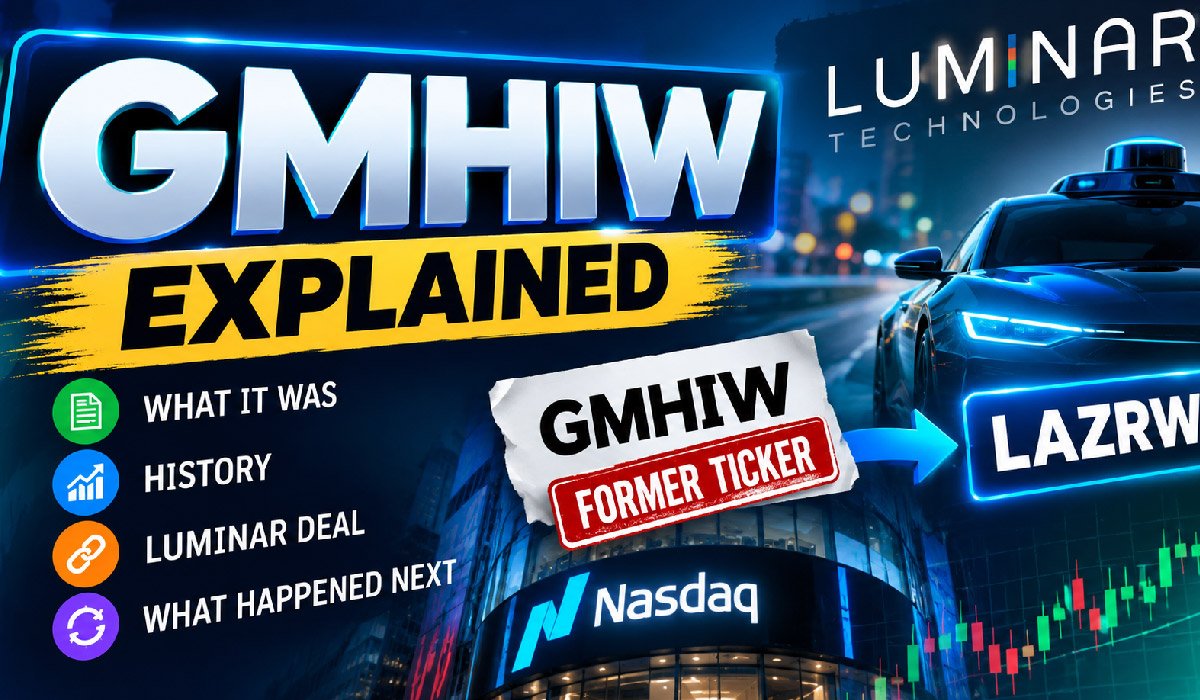
GMHIW can be confusing when it appears in an old stock chart, brokerage record, financial database, or SPAC discussion. Although people often search for “GMHIW stock,” the symbol actually represented publicly traded warrants connected with Gores Metropoulos, Inc.
Gores Metropoulos was a special purpose acquisition company, commonly called a SPAC. Its securities traded on Nasdaq before the company completed a business combination with automotive technology company Luminar Technologies in December 2020. That transaction changed the names and symbols investors followed.
Understanding GMHIW therefore requires looking at the SPAC’s original structure, its warrants, and the Luminar transaction. This guide explains what GMHIW was, how the security worked, why its ticker changed, and why investors can still encounter the symbol today.
What Is GMHIW?
GMHIW was the Nasdaq trading symbol used for warrants issued by Gores Metropoulos, Inc. It should not be confused with the company’s Class A common stock. SEC records identify GMHI as the common-stock symbol and GMHIW as the warrant symbol.
A warrant is different from an ordinary share. Instead of representing the same direct equity interest as common stock, a warrant provides a contractual right to purchase stock under specified conditions, including an exercise price, exercise period, and other terms.
This distinction matters when researching GMHIW. Treating historical GMHIW data as ordinary stock data can lead to incorrect conclusions about prices, ownership, and performance. The ticker belongs to an old SPAC warrant security rather than a currently active standalone stock.
What Was Gores Metropoulos?
Gores Metropoulos, Inc. was created as a blank check company designed to complete a merger, acquisition, stock purchase, reorganization, or similar business combination. It was sponsored by affiliates associated with The Gores Group and veteran investor Dean Metropoulos.
The company completed a $400 million initial public offering in February 2019 after selling 40 million units at $10 each, including units issued through the underwriter’s partial exercise of its over-allotment option. The units initially traded as GMHIU.
Like other SPACs, Gores Metropoulos entered public markets before operating as the business investors would ultimately own. Its purpose was to identify and combine with another company, making the later selection of Luminar Technologies the defining development in GMHIW’s history.
GMHI, GMHIU, and GMHIW Explained
Three related ticker symbols can appear when researching Gores Metropoulos. GMHI represented its Class A common stock. GMHIW represented separately traded warrants, while GMHIU represented units containing one Class A share together with one-third of one warrant.
The units began Nasdaq trading under GMHIU in February 2019. Starting March 25, 2019, investors were permitted to trade the underlying shares and warrants separately. The separated shares used GMHI, while the separated warrants used GMHIW.
This structure explains why several symbols appear in historical databases for what seems like the same company. They were connected to Gores Metropoulos but represented different securities. Investors researching old transactions should therefore check the complete ticker before interpreting historical information.
How Did GMHIW Warrants Work?
Each whole public warrant originally gave its holder the right to purchase one share of Gores Metropoulos Class A common stock for $11.50 per share, subject to the terms and adjustments established by the warrant agreement.
The original units did not contain one full warrant each. Instead, every unit included one-third of one warrant alongside one Class A share. This structure allowed investors to separate the securities after separate trading became available in March 2019.
SEC disclosures stated that the warrants would generally become exercisable on the later of 30 days after completion of a business combination or 12 months after the IPO closing. They were also subject to expiration, redemption, and other conditions.
Why GMHIW Was Different From Ordinary Stock
Buying common stock normally gives an investor an equity security whose value moves with the market’s assessment of the company. A warrant behaves differently because its value also depends heavily on its exercise price, remaining life, redemption provisions, and underlying share price.
That made GMHIW fundamentally different from GMHI. Someone who owned GMHI held Class A common stock, while a GMHIW holder owned a security providing the right to acquire common shares according to the warrant agreement. The two positions carried different economics.
This difference is especially important when viewing historical price charts. A low GMHIW price cannot simply be compared with the GMHI share price as though both represented identical assets. Warrants contain additional conditions and risks that ordinary common shares do not.
How Luminar Technologies Entered the Story
The direction of Gores Metropoulos became clear in August 2020 when it entered into a business combination agreement with Luminar Technologies. Luminar was developing lidar hardware and software technology for automotive applications, giving the SPAC an operating business to bring public.
Lidar uses laser-based sensing to help systems understand the distance and position of surrounding objects. Luminar focused its technology on the automotive industry, including applications connected with driver-assistance and autonomous-vehicle development. This became the operating business behind the combined company.
The transaction marked an important change for GMHIW holders. Instead of owning warrants tied to a SPAC still seeking its long-term identity, investors now knew which operating company would become associated with their securities once the proposed combination successfully closed.
What Happened to GMHIW After the Merger?
Gores Metropoulos completed its business combination with Luminar Technologies on December 2, 2020. The combined business retained the Luminar Technologies name, while its common shares began trading on Nasdaq under LAZR on December 3, 2020.
The warrants also moved into the post-combination Luminar structure. The public warrants were subsequently listed under LAZRW rather than the old GMHIW symbol. This means GMHIW should be understood as part of Luminar’s pre-business-combination market history.
For researchers, the relationship can be remembered simply: GMHI was associated with Gores Metropoulos common stock before the transaction, while GMHIW represented its warrants. After completion, Luminar common stock used LAZR and the corresponding public warrants used LAZRW.
What Happened to LAZRW?
The successor public warrants did not continue trading indefinitely. In February 2021, Luminar announced the redemption of its outstanding public warrants. At that time, the company reported 13,333,309 outstanding public warrants and established an exercise process for holders.
Luminar later reported that nearly 99% of the public warrants had been exercised and that approximately $154 million in gross proceeds had been received from those exercises. It also extended the redemption date to March 16, 2021, for remaining holders.
Luminar’s later SEC filings state that LAZRW was delisted from Nasdaq on March 5, 2021 upon exercise and redemption. Remaining unexercised public warrants were ultimately subject to the applicable redemption terms rather than continuing as a permanently traded Nasdaq security.
Is GMHIW Still Trading Today?
No. GMHIW should not be presented as an active Nasdaq stock or warrant today. Its role as the Gores Metropoulos warrant ticker ended with the Luminar business combination, after which the relevant public warrants were associated with the LAZRW symbol.
LAZRW itself later ended its Nasdaq trading life as the public warrants went through exercise and redemption. Luminar’s SEC filings specifically identify the public warrants as formerly listed under LAZRW and record their March 2021 delisting.
Therefore, websites describing a “current GMHIW stock price,” present-day GMHIW trading trends, or new GMHIW investment opportunities should be treated carefully. Historical ticker pages can remain searchable long after a security has changed symbols, merged, expired, or been delisted.
Why Does GMHIW Still Appear in Searches?
Old ticker symbols remain scattered across financial databases, archived articles, regulatory filings, investor discussions, brokerage records, and historical charts. Search engines can continue indexing these records for years, even when the underlying security no longer trades under its former symbol.
GMHIW is particularly searchable because the Gores Metropoulos transaction formed part of the SPAC activity surrounding Luminar’s public-market debut. Anyone researching Luminar’s history can eventually encounter GMHI, GMHIU, or GMHIW in documents published before the December 2020 combination.
The important step is checking the date and security type before using the information. A historical GMHIW quote describes an old warrant market, not the present price of Luminar common stock and certainly not the price of a currently traded security named GMHIW.
GMHIW Timeline Made Simple
The GMHIW story began in early 2019. Gores Metropoulos completed a $400 million IPO, with its units trading under GMHIU. In March 2019, separate trading began, allowing Class A common shares to trade as GMHI and warrants as GMHIW.
The next major event arrived in 2020. Gores Metropoulos agreed to combine with Luminar Technologies, and the transaction was completed on December 2. The combined company retained Luminar’s name, with its common stock beginning Nasdaq trading as LAZR the following day.
The related public warrants continued under LAZRW before going through an exercise and redemption process in early 2021. Luminar later reported LAZRW as delisted on March 5, 2021. This completed the public-market journey that originally included GMHIW.
Why Historical Tickers Need Careful Research
Searching a ticker alone does not always reveal what the security represented. Companies merge, reorganize, change names, switch symbols, redeem warrants, and leave exchanges. Automated financial pages can nevertheless preserve old ticker information without explaining these important corporate events.
GMHIW demonstrates this problem clearly. Calling it a current “stock” ignores two facts: it represented warrants rather than Gores Metropoulos Class A shares, and its original symbol belongs to the period before the company completed its combination with Luminar Technologies.
Investors researching an unfamiliar ticker should therefore check SEC filings, exchange records, corporate-action announcements, and dates. These primary sources help separate an active investment from an obsolete symbol and prevent historical price information from being mistaken for current market data.
What GMHIW Can Teach Investors About SPAC Warrants
GMHIW provides a useful example of how SPAC securities evolve. Investors may initially receive units containing shares and fractions of warrants. Those components can later trade separately, producing multiple ticker symbols connected with the same SPAC but representing different financial instruments.
A completed business combination can then change the picture again. The operating company may adopt new ticker symbols, while existing warrants can become warrants for the combined company. Redemption provisions may eventually force holders to exercise, sell, or face the consequences specified by the agreement.
For investors, the broader lesson is simple: always identify exactly what a ticker represents before studying its price. Common shares, units, and warrants have different rights and risk profiles. Understanding the security itself should come before interpreting charts, predictions, or historical returns.
How to Research GMHIW Correctly
The best starting point is the SEC’s EDGAR database. Gores Metropoulos filings identify GMHIW as the warrant ticker and distinguish it from GMHI and GMHIU. They also provide details about the IPO, warrant terms, business combination, and subsequent corporate structure.
Exchange and company announcements provide another useful layer. Nasdaq records confirm the completion of the Luminar transaction and the beginning of LAZR trading in December 2020, while Luminar filings document what subsequently happened to its LAZRW public warrants.
Anyone investigating an actual historical investment should also review original brokerage statements and transaction records. Those documents can show whether the position involved GMHI common shares, GMHIW warrants, GMHIU units, or a successor security and can help establish the relevant dates and transactions.
Final Thoughts
GMHIW is best understood as a historical Nasdaq warrant ticker rather than a current stock. It represented public warrants connected with Gores Metropoulos, Inc., while GMHI represented the SPAC’s Class A common stock and GMHIU represented its units.
The story changed when Gores Metropoulos completed its combination with Luminar Technologies in December 2020. Luminar emerged as the publicly traded operating company under LAZR, while the related public warrants were listed as LAZRW before their later exercise, redemption, and delisting.
For anyone finding GMHIW in an old chart or search result, the main takeaway is straightforward: do not interpret it as an active modern stock. Understanding its SPAC history and warrant structure provides the context needed to read historical GMHIW information correctly.
(FAQs)
What Does GMHIW Mean?
GMHIW was the Nasdaq trading symbol for warrants of Gores Metropoulos, Inc. The company’s Class A common shares traded separately as GMHI, while units traded as GMHIU. Therefore, GMHIW referred specifically to a warrant security.
Was GMHIW a Stock?
Not technically. GMHIW represented warrants rather than ordinary Class A common stock. The common shares used the GMHI ticker. Each whole warrant provided the right to purchase one Class A share for $11.50, subject to the warrant terms.
What Company Was Connected With GMHIW?
GMHIW belonged to Gores Metropoulos, Inc., a blank check company sponsored by affiliates associated with The Gores Group and Dean Metropoulos. The SPAC later completed a business combination with automotive lidar technology company Luminar Technologies in December 2020.
What Happened to GMHIW?
Following the Gores Metropoulos and Luminar business combination, the public warrants became associated with Luminar and traded under LAZRW. The former GMHI common-stock structure likewise transitioned into Luminar, whose common shares traded under the LAZR ticker.
Is GMHIW Still Available to Buy?
No. GMHIW is a historical ticker rather than a currently traded Nasdaq security. The successor Luminar public warrants traded as LAZRW before being exercised and redeemed, with SEC filings recording the LAZRW Nasdaq delisting in March 2021.
Why Do People Still Search for GMHIW?
GMHIW remains visible because historical tickers continue appearing in SEC filings, old brokerage records, archived charts, SPAC discussions, and financial databases. Researchers studying Gores Metropoulos or Luminar’s public-market history may therefore encounter GMHIW even though the ticker is no longer active.
