


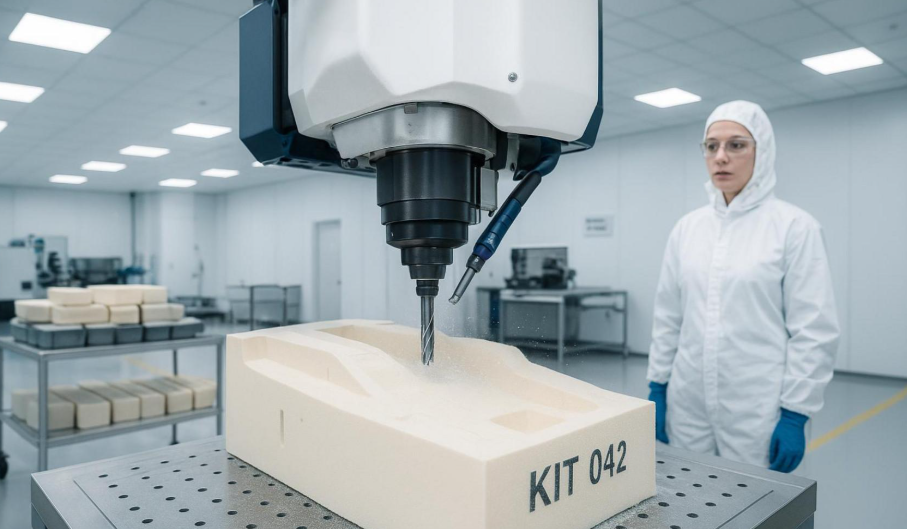
PMI structural foam offers a strong mix of low weight, high stiffness, stable processing at high temperatures, and similar mechanical strength in every direction. When Chem-Craft supplies and machines it, polymethacrylimide (PMI) foam becomes more than a basic polymer sheet. It becomes a precise structural core ready for production. This service removes manufacturing delays, lowers part weight, and makes complex composite processes easier, including autoclave curing, resin transfer molding, and prepreg consolidation.
Composite engineers often need to increase stiffness without adding weight or expensive extra assembly steps. By working with specialist suppliers and machinists, teams can use PMI foam by Chem-Craft to obtain custom core shapes that are ready for molding. This reduces internal material waste, limits resin movement, and speeds up production for aerospace, motorsport, marine, and industrial parts.
What Is PMI Structural Foam and Why Does It Matter?
Polymethacrylimide (PMI) foam is a rigid, high-performance polymer core with a special chemical structure. Its main chain is made from carbon and hydrogen atoms, with cyclic imide groups added to improve heat resistance and structural stiffness. This structure gives PMI properties that standard polymer foams cannot match. A solid foaming process creates a uniform, closed-cell material with similar mechanical behavior in every direction.
PMI foam matters because engineers need light structures that can withstand demanding production cycles and harsh service conditions. Many traditional cores have weak directions or become soft when heated. PMI gives engineers more predictable results. They can calculate stress across the part with greater confidence and avoid adding unnecessary material as a safety margin.
How polymethacrylimide foam supports lightweight sandwich structures
Sandwich panels work on a principle similar to an I-beam. Strong composite outer skins act as the top and bottom flanges, carrying bending tension and compression. The lightweight core acts as the web between them and carries shear loads. PMI foam supports this design by keeping a firm bond line and resisting shear loads that act out of the panel’s plane. This keeps the skins at the correct distance from each other during heavy bending.
PMI has a fully closed-cell structure, so it resists compression when outside forces try to buckle the laminate skins. This strength helps prevent common sandwich-panel failures such as skin wrinkling, shear crimping, and local core crushing. Engineers can also make panels much deeper, increasing their resistance to bending without adding much weight.
What makes PMI foam different from PVC and PET core materials?
Cross-linked polyvinyl chloride (PVC) and polyethylene terephthalate (PET) cores are widely used in industrial composite parts. However, their molecular structures soften at lower temperatures. Standard PVC cores can creep and become plastic when exposed to autoclave temperatures above about 80°C to 90°C. PMI keeps its elastic modulus and compressive strength at temperatures reaching about 180°C to 200°C, so it works well with aerospace prepreg systems.
PET foam has a low raw-material cost and can be made from recyclable thermoplastic material. However, at the same density, it usually has lower specific shear strength and modulus than PMI. PMI contains small, even cells with strong resistance to damage. This helps prevent cell-wall breaks and sudden shear failure that may occur in coarser plastic cores. The even cell structure also limits resin movement into the core during vacuum infusion, helping control final part weight.
Typical PMI foam density ranges from 30 to 200 kg/m³
Manufacturers produce PMI structural foam in a range of densities. Each grade balances weight against the loads that the part must carry. Very light grades, from 30 to 52 kg/m³, are often used for interior panels, fairings, and covers that do not carry major structural loads. These parts still need a smooth shape and very low weight.
Medium-density grades from 71 to 110 kg/m³ are common in structural parts such as aircraft control surfaces, automotive monocoques, and radomes. They provide strong shear resistance and good local compression strength. Heavy grades from 150 to 200 kg/m³ are used around hard points, inserts, and edge ends where bolts and metal fasteners send concentrated loads into the core.
What Benefits Can PMI Structural Foam Deliver Through Chem-Craft?
Buying PMI structural foam through Chem-Craft gives manufacturers access to a complete material and machining service instead of untreated foam blocks. Chem-Craft combines high-performance ROHACELL® product families with accurate conversion, four- and five-axis CNC shaping, and technical support. This reduces the trial and error often involved in working with structural foam.
This support can lower operating costs. Chem-Craft supplies formed contours and closely machined core packages that let production teams move directly to lay-up. This reduces machine-shop queues, dust-control problems, and the waste created when large raw blocks must be cut down on site.
Reduces component weight without sacrificing stiffness
PMI foam provides some of the strongest strength-to-weight and stiffness-to-weight results available from standard structural cores. Engineers can use a low-density PMI core and make the sandwich panel thicker. This creates a large increase in bending stiffness while adding only a small amount of core mass.
For parts where weight matters, replacing a solid laminate or a heavier core with a high-modulus PMI design can often reduce total part weight by 15% to 30%. The weight saving does not require a loss of torsional stiffness or impact-energy control. It can improve fuel use, payload capacity, and battery range.
Resists heat during high-temperature processing
One major production benefit of PMI is its ability to keep its shape during high-temperature curing. Ordinary polymer cores may distort, expand too much, or release gas during prepreg cycles. PMI structural grades can withstand cure conditions of about 180°C to 200°C, while special grades can operate at temperatures up to 220°C.
This heat resistance makes single-step co-curing possible. Manufacturers can cure the prepreg skins and the core together in an autoclave or heated press. They do not need to make the skins separately and join them later with heavy adhesive paste. This saves time and gives the finished structure a more consistent bond.
Limits moisture absorption and maintains dimensional stability
Water entering a composite can cause long-term problems. Freeze-thaw cycles may separate the skins, moisture can contribute to delamination, and metal inserts may corrode. PMI’s fully closed-cell structure blocks liquid water from moving deep into the material. Panels can keep their planned weight during long outdoor exposure.
PMI also has very low dimensional expansion when humidity changes. The foam keeps its shape through repeated humidity cycles, helping prevent skin distortion, oil-canning, and shear stress at the bond line. This is useful for aircraft control surfaces and accurate radar housings.
Supports fatigue resistance and long service life
Repeated loading can create small cracks and shear movement in lower-grade core materials. Over time, this can make a panel softer. PMI structural foam has strong resistance to repeated loading. It can handle alternating tension and compression without crumbling or permanently deforming its cell walls.
This resistance can extend the service life of parts exposed to strong vibration, including helicopter rotor blades, high-speed rail spoilers, and wind-turbine roots. Since the foam has similar properties in all directions, complex loads from several directions do not find a weak orientation that would make internal cracks easier to start.
Enables efficient machining and composite fabrication
PMI’s solid, uniform structure makes it well suited to accurate machining. Honeycomb can fray, form burrs, or collapse along its ribbon direction during cutting. PMI cuts cleanly, allowing four- and five-axis CNC machines to create chamfers, changing thicknesses, and recessed pockets with very high accuracy.
With Chem-Craft’s conversion service, production teams can receive core kits that are already prepared for lay-up. The kits can be delivered to the cleanroom workstation, reducing dust on the laminating floor and shortening production time. They also provide clean contact areas for strong bonding between the skins and the core.
How Does PMI Foam Perform in Composite Manufacturing?
In production, a core must withstand fluid pressure, heat cycles, and chemical contact during resin consolidation. PMI foam performs well in several composite processes and remains chemically stable with epoxy, vinyl ester, polyester, cyanate ester, and bismaleimide (BMI) resin systems.
The foam does not release volatile plasticizers during curing. This reduces bubbling at the interface and prevents the porous bond lines that can occur with weaker polymers. The laminate skins can bond securely to the core without extra barrier films or special gas-removal treatments.
Supports prepreg, autoclave, compression molding, and RTM processes
PMI structural foam works in several manufacturing settings. In autoclave prepreg production, it can withstand consolidation pressure up to 0.7 MPa (7 bar) at high temperatures without losing its shape. This allows manufacturers to produce composite laminates with very low void content.
In low-pressure liquid molding processes such as Vacuum-Assisted Resin Transfer Molding (VARTM) and High-Pressure RTM, the foam’s even cell structure acts as a stable internal support. Resin moves across the surface through planned flow paths instead of soaking deeply into the core. This helps preserve the planned fiber volume fraction in the outer skins.
Maintains core integrity at processing temperatures up to approximately 180-200°C
PMI structural foam has one of the highest heat-distortion limits among polymer foams. Grades such as ROHACELL® WF, HERO, and XT keep their resistance to compression creep during continuous use at temperatures that would soften ordinary PVC and polyurethane materials.
This heat limit keeps the core from softening during the highest temperatures of a cure. Thick laminates can create substantial internal heat as the resin hardens. PMI helps keep its shape during this heat release and through the later cooling stage.
Improves bonding between carbon fiber, glass fiber, and aramid skins
The bond between the outer skin and the core has a major effect on the strength of a sandwich panel. Mechanical cutting exposes many small half-cells across the PMI surface. These tiny openings give liquid resin and adhesive films shallow points where they can grip the foam.
During curing, resin forms many small mechanical anchors inside the surface cells without traveling far into the foam. This creates strong shear and peel bonds with carbon fiber, fiberglass, and aramid skins. The result is more consistent than the small areas of adhesive contact often found at the edges of open honeycomb cells.
What machining and surface preparation steps affect bond quality?
A reliable bond depends on good preparation before lay-up. PMI cuts cleanly, but high-speed CNC milling can leave a fine layer of electrostatic dust inside the surface cells. If this dust stays in place, it can block the adhesive and stop it from gripping the cell openings.
Clean compressed air or vacuum cleaning should be used to remove dust before lay-up. Standard PMI grades can also take in small amounts of moisture from the air during long storage. Drying the core at 80°C to 100°C before high-temperature resin infusion helps remove this moisture. It prevents water from turning into expanding steam bubbles during the cure.
How Does PMI Structural Foam Compare with Other Core Materials?
Choosing a core means balancing mechanical performance, processing limits, and total production cost. Lower-cost materials can work well in low-temperature marine hulls and standard building panels. PMI structural foam is often chosen for high-value parts where a core failure would have serious results.
A direct comparison with PVC, PET, and metal or aramid honeycomb shows why polymethacrylimide is widely used in advanced composite structures.
| Core Material | Density Range (kg/m³) | Max Processing Temp (°C) | Moisture Ingress Risk | Machining Complexity |
| PMI Foam | 30 – 200 | 180 – 220 | Negligible (Closed Cell) | Low (Isotropic, 5-Axis CNC ready) |
| Cross-linked PVC | 40 – 250 | 80 – 90 | Low (Closed Cell) | Low to Moderate |
| PET Foam | 65 – 300 | 130 – 150 | Low (Closed Cell) | Moderate |
| Nomex / Aluminum Honeycomb | 24 – 144 | 200+ | High (Open Cell Ingress / Corrosion) | High (Fraying, Requires Potting) |
PMI foam versus PVC foam for temperature and structural performance
Cross-linked PVC has been used for many years in marine and industrial sandwich panels because its purchase price is low. Its heat tolerance and resistance to creep are limited, however. During high-pressure autoclave cycles, PVC can soften from heat, become thinner, and distort the laminate. PMI keeps more of its compressive strength during the same type of process.
At the same density, PMI also provides greater compressive strength and modulus than cross-linked PVC. Engineers can use a lower-density PMI grade to reach the same structural target. The finished part can weigh less, helping balance the higher price of the raw material.
PMI foam versus PET foam for processing and sustainability considerations
Polyethylene terephthalate (PET) foam is used more often in wind-turbine production because it costs less and can include post-consumer recycled plastic. These environmental and cost benefits are useful, but PET is less suited to some high-end structural parts. It may require greater density and can deform in shear during demanding cure cycles.
PMI offers much higher shear stiffness for its weight and stronger resistance to repeated loading than PET. In aircraft and other parts where every gram affects emissions, range, or operating cost, PMI can provide a more efficient structural core.
PMI foam versus honeycomb cores for geometry and load transfer
Honeycomb cores made from aluminum foil or aramid paper such as Nomex® can carry high compression along their open cell channels. They are highly directional, though. Their properties can fall quickly away from the ribbon direction, and their thin cell walls make it hard to machine smooth three-dimensional shapes.
PMI foam has similar properties in all three directions, so it spreads loads more evenly and does not depend on bonded honeycomb nodes. Honeycomb parts also need edge potting compounds to block water. This adds labor and extra weight, which can reduce the mass advantage of the honeycomb core.
When does the higher cost of PMI foam create lifecycle value?
PMI foam costs more per kilogram than basic foam cores. Looking only at the sheet price, however, does not show the full cost of the finished part. PMI can support single-step co-curing, reducing labor, extra curing cycles, and the multi-stage tooling often needed for honeycomb and lower-grade cores.
In an aircraft landing gear door project studied by the Composite Technology Center (CTC), replacing an autoclaved honeycomb design with an out-of-autoclave PMI sandwich reduced the total component cost by 25%. The new process removed honeycomb edge potting and several cure stages. Production time fell by 43%, saving 18 hours per part, while the finished component became 19% lighter.
Where Is PMI Structural Foam Used?
PMI structural foam can meet demanding load requirements and work with complex production methods, so it is used in many advanced industries. It is selected for parts that need high stiffness for their weight, stable dimensions during heating, and long-term resistance to the surrounding environment.
Chem-Craft’s distribution and conversion services bring these materials to many fields, from deep-sea vessels to high-altitude launch vehicles.
Aerospace and unmanned aerial vehicle components
Aerospace is one of the best-known uses for PMI foam. Parts such as wing ribs, trailing edges, rudder skins, engine cowlings, and landing gear doors use PMI to handle vibration and wide temperature changes during high-altitude flight.
Unmanned aerial vehicles (UAVs) and Urban Air Mobility (UAM) aircraft need very light primary structures to stay in the air longer. PMI allows thin carbon fiber skins to reach high aerodynamic stiffness without the weight of many internal ribs and stringers.
Automotive and motorsport body structures
Formula 1 monocoques, Le Mans prototype crash boxes, and supercar splitters place heavy demands on their core materials. PMI foam can absorb impact energy and crush in a controlled way, spreading kinetic loads and helping protect the passenger safety cell.
Electric vehicle (EV) makers also use shaped PMI cores in battery enclosures and floor pans. The foam can stiffen the structure, reduce vibration, and provide some thermal insulation. It also helps protect battery packs from road debris and outside temperature changes.
Wind energy blades and high-performance sporting equipment
Modern offshore wind-turbine blades can be more than 100 meters long. Their size creates large bending and repeated gravity loads. PMI cores are used in blade shear webs, root sections, and aerodynamic tips, where shear stiffness and fatigue resistance help limit flutter and delamination.
High-end sports equipment uses PMI cores to improve response and reduce vibration. Competitive hockey sticks, rowing shells, tennis racquets, skis, and lightweight bicycle rims can all use PMI to create a stiff, predictable feel without adding unnecessary swing weight.
Marine panels and lightweight transportation interiors
High-speed ferries, naval ships, and luxury yachts use PMI panels in superstructure bulkheads, radar arches, and structural bridge floors. The closed-cell core blocks seawater movement, reducing freeze-thaw damage in cold conditions and helping the panel withstand repeated wave impacts.
High-speed rail vehicles can use flame-retardant PMI grades in interior partitions and nose cones. Materials that meet strict fire, smoke, and toxicity (FST) standards, including FAR 25.853 and EN 45545-2, help operators meet safety rules while reducing axle weight.
Radomes, antennas, and electromagnetic applications
Pure PMI foam has a low dielectric constant, usually between 1.05 and 1.13, and a very low loss tangent across a wide range of frequencies, including 2 to 26 GHz and above. Grades such as ROHACELL® HF allow radio-frequency signals to pass through with very little interference, making them well suited to commercial and military radomes.
These electrical properties limit signal loss, phase changes, and beam movement in satellite communications, aircraft weather radar, and 5G antenna arrays. The foam protects the antenna structure without blocking or weakening incoming and outgoing electromagnetic signals.
How Should Engineers Select PMI Structural Foam with Chem-Craft?
Choosing the right PMI grade requires a review of the complete sandwich panel. Engineers need to examine the outer laminate, resin chemistry, consolidation cycle, and final service environment. Using a general foam specification without matching it to these conditions can add unnecessary cost or cause the core to crush during production.
Chem-Craft works with engineering teams to review CAD models, stress diagrams, and production methods. The company can then match the project with a suitable core density, grade, and machined shape.
Match foam density to stiffness, strength, and weight targets
Foam density has a direct effect on the mechanical behavior of the finished sandwich. A higher density usually brings greater compressive strength, tensile modulus, and shear resistance, but it also adds weight.
Engineers should define the main load paths first. If the part will face out-of-plane impacts or heavy point loads, a medium or high density, such as 71 to 110 kg/m³, may be needed. Large panels carrying moderate, evenly spread aerodynamic pressure can often use a lower density, such as 31 to 52 kg/m³, to keep mass down.
Specify thickness, sheet dimensions, and core geometry
Core thickness affects the panel’s moment of inertia. A thicker core can greatly increase bending stiffness with only a small increase in weight. Thick sections can be harder to drape over a mold and wet with resin, so relief cuts may be needed for complex shapes.
Core dimensions also depend on the part shape. Flat rectangular sheets can work for gentle curves, while tight curves may need pre-shaped three-dimensional kits. Chem-Craft can machine variable-thickness cores with four- and five-axis CNC edge chamfers, so workers do not need to bevel the material on the cleanroom floor.
Check compressive, shear, tensile, and thermal performance requirements
Data sheet values must be checked against the actual production and service conditions. The compressive strength must be high enough to handle the highest autoclave or press pressure at the planned temperature. A room-temperature rating alone is not enough.
Shear strength and tensile strength through the panel affect resistance to skin separation. Engineers should compare these values with expected vibration, temperature changes, and impact loads. The core must be able to carry energy at the bond line without causing adhesive shear failure.
Confirm resin compatibility and the intended curing cycle
Resin systems interact with cores in different ways because they have different cure temperatures, solvent levels, and heat-release patterns. Engineers should check that the selected PMI grade matches the planned resin, whether it is epoxy, phenolic, bismaleimide, or cyanate ester.
For a high-temperature prepreg cured at 180°C under 0.7 MPa autoclave pressure, an aerospace grade such as ROHACELL® WF or HERO is needed. For low-temperature vacuum infusion at 80°C to 120°C, an industrial grade such as IG-F can provide strong performance at a lower material cost.
What Risks Can Affect PMI Foam Performance?
PMI structural foam has strong mechanical properties, but sandwich structures can still be damaged by production mistakes, poor handling, or incorrect assumptions about the service environment. Finding these possible problems during design helps improve production reliability and long-term service life.
Risk control requires clear handling rules, accurate vacuum debulking, and full material tracking from the original billet to the final inspection.
Prevent core crushing during handling and vacuum consolidation
PMI has high compressive strength for its weight, but local crushing can occur if high pressure is applied before the core reaches an even curing temperature. Sudden vacuum increases, fast autoclave pressure changes, or uneven clamping can permanently deform the material.
During shop-floor handling, dropped sheets and tight transport straps can damage thin chamfers. Protective packaging around pre-machined core kits helps keep the profiles intact until the parts are placed in the mold.
Control resin uptake, voids, and incomplete bonding
During VARTM and other liquid infusion processes, excess resin can enter surface cells and add unexpected weight. PMI’s closed cells stop resin from traveling deep into the foam, but rough or coarse cuts can still pull too much resin into the open surface pores.
Micro-cell grades such as IG-F or RIMA limit resin movement mainly to the outer surface cells. On the other hand, too little resin or an uneven vacuum can leave air at the bond line. These unbonded areas can become starting points for skin delamination during repeated loading.
Avoid selecting density by weight alone
A common design mistake is choosing the lightest available core only to meet a part-weight target. If the density is too low, the cells may collapse under prepreg compaction pressure. This can create uneven thickness and wavy outer skins.
Design teams should size the core for the minimum compressive, shear, and local impact loads before comparing possible weight savings. Matching density to the actual loads helps the panel withstand peak service forces and sudden impacts.
Verify temperature, pressure, and chemical exposure limits
PMI grades do not all behave the same way at extreme temperatures. An industrial grade rated for 130°C may fail quickly if used in a 190°C aerospace BMI cure. The foam may lose strength, its cells may collapse, and the panel may be damaged.
PMI works with many common thermoset resins, but strong industrial solvents, concentrated acids, and long periods in boiling water can soften its cell walls. Engineering teams should check the chosen grade against every chemical and temperature it may face during production and service.
Choose PMI Structural Foam for the Performance Target
Moving from an early design idea to a finished composite sandwich part requires an early decision about the core. PMI structural foam can reduce weight, raise panel stiffness, and simplify several production steps in demanding applications.
Chem-Craft’s technical team can help engineers select a grade, plan CNC machining, and develop a core solution that matches the required performance.
Request a project-specific recommendation from Chem-Craft
Each sandwich component has its own balance of aerodynamic shape, skin design, cure cycle, and dynamic loading. Chem-Craft reviews project information such as 3D CAD files, laminate ply schedules, cure targets, and service conditions before recommending a core package.
Getting this technical review early can prevent expensive tool changes and production redesigns later. Chem-Craft can also match core deliveries to the production schedule and supply CNC-machined, inspected kits that fit directly into the manufacturing process.
Compare verified material data before final design approval
Reliable composite design depends on measured material data rather than general estimates. Before approving final tools and design drawings, engineering teams should compare stress, shear, and creep calculations with formal qualification data sheets.
Chem-Craft supplies physical, thermal, and dielectric test records for each ROHACELL® product batch. This traceability shows that the material delivered to the cleanroom meets the required aerospace, naval, and automotive standards and performs as expected throughout the part’s service life.
Future core development will address more than load transfer. It will also focus on recycling, easier repair, and added functions. Research into removable bonding primers, including thermally expandable microsphere coatings that activate above 170°C, may allow composite skins to be separated from PMI cores at the end of a part’s life without major damage. New non-destructive inspection (NDI) methods, such as high-frequency ultrasonic phased arrays and terahertz scanning, are also making it faster to check core condition in complex shapes without cutting the part apart.
As automated tape laying and rapid compression molding reduce production times, combining accurately machined, heat-stable PMI cores with automated processes will remain important for producing light, high-performance structures at larger volumes.
