


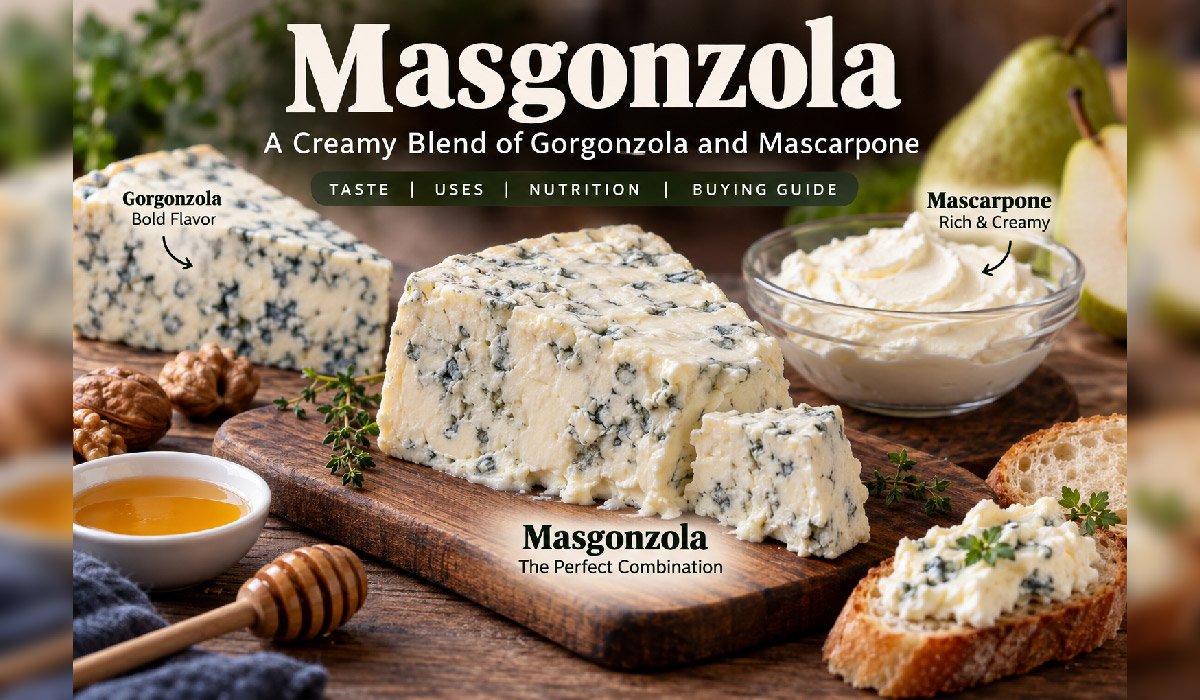
Masgonzola sounds like the name of an old Italian cheese with a long history, but its meaning is much simpler. The term generally describes a creamy combination of Gorgonzola and mascarpone. Gorgonzola brings the familiar blue-cheese taste, while mascarpone adds a smooth, buttery texture. Together, they create a rich cheese specialty that is usually softer and milder than Gorgonzola alone. The unusual name has created plenty of curiosity because it sounds like an independent cheese variety. Understanding what the word actually describes helps shoppers know what they are buying and prevents confusion caused by unclear online descriptions.
The interest in Masgonzola goes beyond its unusual name. This creamy combination can be used in pasta, risotto, bread, appetizers, pizza, and cheese boards. Its softer flavor can also appeal to people who find traditional blue cheese too sharp or salty. However, Masgonzola does not have one universal recipe, so different products can vary in their proportions, texture, flavor, nutrition, and appearance. This guide explains what Masgonzola is, what goes into it, how it is prepared, and how it compares with Gorgonzola. It also covers nutrition, serving ideas, shopping advice, storage, and common misunderstandings surrounding the name.
What Is Masgonzola?
Masgonzola is generally a cheese specialty that combines Gorgonzola with mascarpone. Its name appears to come from joining parts of the words mascarpone and Gorgonzola. The combination brings together two dairy products with very different qualities. Gorgonzola provides salty, tangy, earthy blue-cheese notes, while mascarpone provides a mild, creamy, and buttery base. The result is normally soft, rich, and easy to spread. Some versions mix the two components together, while others keep them in visible layers. Because there is no single universal Masgonzola formula, the balance between creaminess and blue-cheese intensity can change considerably between individual products.
The term is useful because it gives consumers a simple way to describe a Gorgonzola-and-mascarpone combination. However, packages may not always use the word “Masgonzola.” Similar products can appear under descriptions such as Gorgonzola with mascarpone, Gorgonzola e mascarpone, or Gorgonzola-mascarpone. This difference in naming is one reason people searching for Masgonzola sometimes receive confusing information. The important point is the composition rather than the exact marketing name. When Gorgonzola is combined with rich mascarpone, the finished food develops the creamy texture and softened blue-cheese character commonly associated with Masgonzola, regardless of the precise wording printed on its package.
Is Masgonzola a Real Cheese or Just an Internet Food Term?
Masgonzola should not simply be dismissed as a fake cheese because the food behind the term is real. Gorgonzola and mascarpone are genuinely combined in commercially available cheese specialties and culinary preparations. What causes confusion is whether Masgonzola should be considered its own formally recognized cheese variety. It is better understood as a convenient culinary or commercial term for a combination rather than a separate protected cheese with one official recipe. This distinction explains why descriptions can differ widely. One product may contain roughly equal amounts of both components, while another can use a different balance to create a stronger or milder finished flavor.
Gorgonzola has a much more clearly defined identity. It is an Italian cheese protected under the Protected Designation of Origin system, commonly shown as PDO or DOP. Its name, production, and geographical connection therefore have formal importance. Masgonzola does not have a separate protected identity of the same kind based on the information available in the supplied material. This means shoppers should avoid assuming that every product called Masgonzola follows an identical Italian production standard. The name can still describe a genuine and enjoyable food, but understanding the difference between a recognized cheese designation and a descriptive blend name provides a more accurate picture of what Masgonzola actually represents.
What Is Masgonzola Made From?
The two main components of Masgonzola are Gorgonzola and mascarpone. Gorgonzola is an Italian blue cheese traditionally associated with cow’s milk. Its recognizable blue or blue-green veining contributes much of the stronger character found in the finished combination. Depending on the Gorgonzola used, its flavor can be salty, tangy, earthy, creamy, and noticeably sharp. Mascarpone is much milder. It has a smooth consistency, high richness, and gentle dairy flavor. When these ingredients meet, mascarpone softens the intensity of the Gorgonzola without completely hiding its blue-cheese character. This contrast is the main reason the combination develops such a distinctive balance.
There is no universal proportion that defines every Masgonzola product. Some documented commercial versions use equal amounts of Gorgonzola and mascarpone, creating a balanced mixture with considerable creaminess and noticeable blue-cheese flavor. Other producers may use different proportions. More mascarpone generally makes the finished product milder, softer, richer, and more spreadable. A larger amount of Gorgonzola creates stronger salty and tangy notes and makes the blue-cheese character easier to notice. Additional ingredient details can also vary according to the individual cheeses and manufacturer. For this reason, shoppers interested in allergens, nutrition, salt, or exact composition should always examine the ingredient information on the specific package.
How Masgonzola Is Made
Masgonzola does not have one official production process that every maker must follow. Instead, preparation begins with finished or prepared Gorgonzola and mascarpone, which can then be brought together in different ways. One straightforward approach is blending. The cheeses are combined until they form a relatively even, creamy mixture. Small areas of blue veining may remain visible depending on how thoroughly the components are mixed. This method creates a product that can spread easily and melt smoothly into warm foods. Changing the ratio provides a simple way to control its character, with mascarpone increasing creaminess and Gorgonzola producing a stronger and more savory result.
Another common presentation involves layering instead of fully blending the cheeses. Alternating sections of pale mascarpone and blue-veined Gorgonzola create an attractive visual contrast and allow the two textures to remain more distinct. Each bite can therefore taste slightly different depending on how much of each layer it contains. Importantly, this combination process should not be confused with making Gorgonzola itself. Gorgonzola has its own cheesemaking and maturation process before it becomes part of the specialty. Masgonzola does not need a separate invented aging tradition. Understanding this distinction prevents the common mistake of describing it as an independent blue cheese that develops its own veins through a unique Masgonzola aging process.
What Does Masgonzola Taste and Look Like?
Masgonzola usually has a rich taste that combines creamy dairy sweetness with recognizable blue-cheese notes. The mascarpone forms a mild, buttery foundation, while the Gorgonzola introduces saltiness, tanginess, earthiness, and varying degrees of sharpness. This combination can make the overall flavor noticeably gentler than eating Gorgonzola by itself. The exact strength depends on the proportions and the type of Gorgonzola used. A mascarpone-heavy version can taste especially soft and mild, while a product containing more Gorgonzola can deliver a much clearer blue-cheese bite. This balance makes Masgonzola approachable while still retaining the distinctive personality associated with blue cheese.
Its appearance depends largely on whether it has been blended or layered. Layered Masgonzola can show pale white or cream-colored mascarpone alongside blue-veined sections of Gorgonzola, creating an obvious contrast. A blended product usually looks more uniform, although blue or green pieces may remain visible throughout the creamy mixture. Texture is generally soft, moist, rich, and spreadable because mascarpone adds substantial smoothness. Masgonzola also melts readily, making it useful in warm dishes. Its aroma can carry some of Gorgonzola’s recognizable blue-cheese character, but the mascarpone can make the complete experience feel softer. Flavor, aroma, and appearance will therefore differ somewhat between brands and recipes.
Masgonzola vs Gorgonzola: What Is the Difference?
The main difference between Masgonzola and Gorgonzola is straightforward: Gorgonzola is an established Italian blue cheese, while Masgonzola generally combines that cheese with mascarpone. This addition changes almost every sensory quality of the finished product. Gorgonzola normally delivers a clearer salty, tangy, and blue-cheese flavor. Its texture and intensity vary according to its particular style and maturity. Masgonzola tends to be softer and richer because mascarpone adds fat, moisture, and creaminess. The mild dairy flavor also reduces the apparent sharpness of the blue cheese, making Masgonzola a useful option for people who enjoy some Gorgonzola character without wanting its full intensity.
The two products can also serve different purposes in cooking. Gorgonzola is useful when a recipe needs a concentrated blue-cheese flavor, and a relatively small amount can provide considerable character. Masgonzola works particularly well when both flavor and creamy consistency are required. It can melt smoothly into pasta or risotto and spread easily across bread without requiring much additional preparation. Their formal identities are also different. Gorgonzola has protected PDO status and defined production requirements, whereas Masgonzola does not have an equivalent separate protected designation. Therefore, Masgonzola should not be viewed as another variety of protected Gorgonzola but as a specialty that uses Gorgonzola as one of its central components.
Masgonzola Nutrition and Health Considerations
There is no single nutritional profile for Masgonzola because recipes and ingredient ratios can differ. A supplied example of a commercial 50-percent Gorgonzola and 50-percent mascarpone product contains about 369 calories, 35 grams of fat, 23 grams of saturated fat, 1.5 grams of carbohydrates, 12 grams of protein, and 0.7 grams of salt per 100 grams. By comparison, the supplied nutritional figures for Gorgonzola PDO are approximately 314 calories, 27 grams of fat, 19 grams of saturated fat, 18 grams of protein, and 1.6 grams of salt per 100 grams. These figures illustrate how adding mascarpone can significantly change the nutritional balance.
Masgonzola can provide protein and dairy nutrients, but it is also a calorie-dense food that may contain substantial amounts of total and saturated fat. Portion size is therefore important. In the example above, a 30-gram portion would provide approximately 111 calories and 10.5 grams of fat. Lactose also deserves attention. Although authentic Gorgonzola PDO can contain very little lactose, adding mascarpone means a Masgonzola product should not automatically be considered lactose-free. People with lactose intolerance should check the individual label. Masgonzola also contains milk proteins, meaning it is unsuitable for anyone with a milk allergy regardless of how little lactose a particular product contains.
Best Ways to Eat and Use Masgonzola
Masgonzola is especially useful in dishes that benefit from both creaminess and a savory blue-cheese taste. Pasta is one of the simplest examples. The cheese can melt into hot pasta, while a little pasta water helps loosen it into a smooth coating. It can work with gnocchi, ravioli, penne, pappardelle, and similar dishes. Mushrooms, spinach, walnuts, pear, and black pepper can complement its rich flavor. Masgonzola also works well in risotto when stirred in toward the end of cooking. Because mascarpone is already present, the cheese can add creaminess and blue-cheese depth without always requiring a separate heavy cream-based sauce.
Cold and baked uses are equally practical. Gorgonzola can be spread across crostini, crackers, or toasted bread and served with honey, pear, apple, figs, dates, walnuts, or hazelnuts. Sweet fruit creates contrast with the salty and tangy Gorgonzola component. Small portions can also be placed on pizza or flatbread alongside mushrooms, onions, pumpkin, or pears. On a cheese board, Masgonzola offers a creamy alternative to stronger blue cheeses and can be served beside fresh fruit, dried fruit, nuts, and bread. Its richness means large quantities are rarely necessary. Starting with a modest amount helps other ingredients remain noticeable instead of allowing the cheese to dominate the entire dish.
How to Buy, Store, and Serve Masgonzola
Finding Masgonzola can require looking beyond the exact keyword because many packages use different descriptions. Shoppers can search for Gorgonzola and mascarpone, Gorgonzola e mascarpone, Gorgonzola-mascarpone, or Gorgonzola with mascarpone. These products are most likely to appear in refrigerated cheese sections, specialty food shops, or stores carrying Italian cheeses. Examine whether the product is blended or layered and check the ingredient ratio when it is provided. More mascarpone usually means greater creaminess and a milder blue flavor, while more Gorgonzola generally creates stronger character. The nutrition panel, allergen statement, storage instructions, use-by date, and lactose information should also be checked before purchasing.
Once purchased, Gorgonzola should remain refrigerated because it contains soft dairy components. The package instructions should take priority because shelf life and recommended temperatures can vary among manufacturers. One supplied commercial example recommends storage at no more than 5°C. After opening, keeping the cheese properly covered can help prevent drying and reduce the transfer of strong aromas to nearby foods. Avoid leaving it in warm conditions longer than necessary. Blue-green veins within the Gorgonzola component are normal and should not automatically be treated as spoilage. However, unusual changes in smell, appearance, or texture that clearly differ from the original product should be treated cautiously.
Why Masgonzola Is Often Misunderstood
Much of the confusion surrounding Masgonzola comes from how convincing its name sounds. Because mascarpone and Gorgonzola are both associated with Italian food, combining their names creates a word that seems traditional and established. Someone seeing “Masgonzola” without context might reasonably imagine a regional cheese produced in Italy for generations. Repeated use of the term on recipe pages, food articles, and search results can strengthen this impression. Eventually, descriptions may start treating the word as though it represents a completely independent cheese. This shows why food terminology can become confusing online, particularly when a memorable commercial or culinary expression begins circulating without a clear explanation of its origin.
The most useful way to remove that confusion is to separate the product from the name. The food itself does not need to be fictional simply because Masgonzola lacks the same formal identity as Gorgonzola. Real producers can combine genuine Gorgonzola with mascarpone to create layered or blended specialties. What should be avoided is adding an unsupported history, geographical origin, fixed aging period, or universal production standard to the Masgonzola name. Consumers can instead judge each product through its ingredients and labeling. This approach gives Masgonzola a clear identity: a rich Gorgonzola-and-mascarpone specialty whose exact recipe can differ rather than a separate protected cheese with one mandatory formula.
Final Thoughts
Masgonzola is much easier to understand once its two main components are separated. Gorgonzola supplies the tangy, salty, earthy, and distinctly blue-cheese character. Mascarpone adds a mild dairy taste, softness, richness, and a creamy mouthfeel. Combining them creates a product that is generally gentler and more spreadable than Gorgonzola by itself. It can be blended into a relatively uniform mixture or presented in attractive layers. Since there is no universal Masgonzola recipe, individual products can differ considerably. Their exact ingredient proportions influence everything from flavor and texture to calories, protein, saturated fat, salt, and potentially lactose content.
For everyday cooking, Masgonzola is particularly useful because it can move easily between simple snacks and complete dishes. It can enrich pasta and risotto, melt over pizza, spread onto crostini, accompany fruit and nuts, or provide a mild blue-cheese element on a cheese board. The main thing for shoppers to remember is that the name alone does not define an exact recipe. Reading the ingredient list and nutritional information provides a better understanding of the product than relying on the word Mascarpone. In simple terms, it is best understood as a creamy Gorgonzola-and-mascarpone specialty rather than a separate protected Italian cheese variety.
(FAQs)
What is Masgonzola?
Masgonzola generally refers to a creamy combination of Gorgonzola and mascarpone. Gorgonzola provides the tangy blue-cheese flavor, while mascarpone adds a mild, buttery taste and smooth texture.
Is Masgonzola a real cheese?
Masgonzola describes a real cheese specialty, but it is not generally considered a separate protected cheese variety. It is better understood as a product or preparation combining Gorgonzola with mascarpone.
What does Masgonzola taste like?
Masgonzola usually tastes creamy, buttery, mildly salty, and tangy. The mascarpone softens the stronger blue-cheese character of Gorgonzola, making the overall flavor gentler and richer.
What is the difference between Masgonzola and Gorgonzola?
Gorgonzola is a protected Italian blue cheese, while Masgonzola generally combines Gorgonzola with mascarpone. As a result, Masgonzola is usually softer, creamier, richer, and milder than Gorgonzola alone.
How can you use Masgonzola?
Masgonzola works well in pasta, risotto, pizza, crostini, sauces, appetizers, and cheese boards. It also pairs nicely with pears, figs, honey, walnuts, mushrooms, and toasted bread.
