


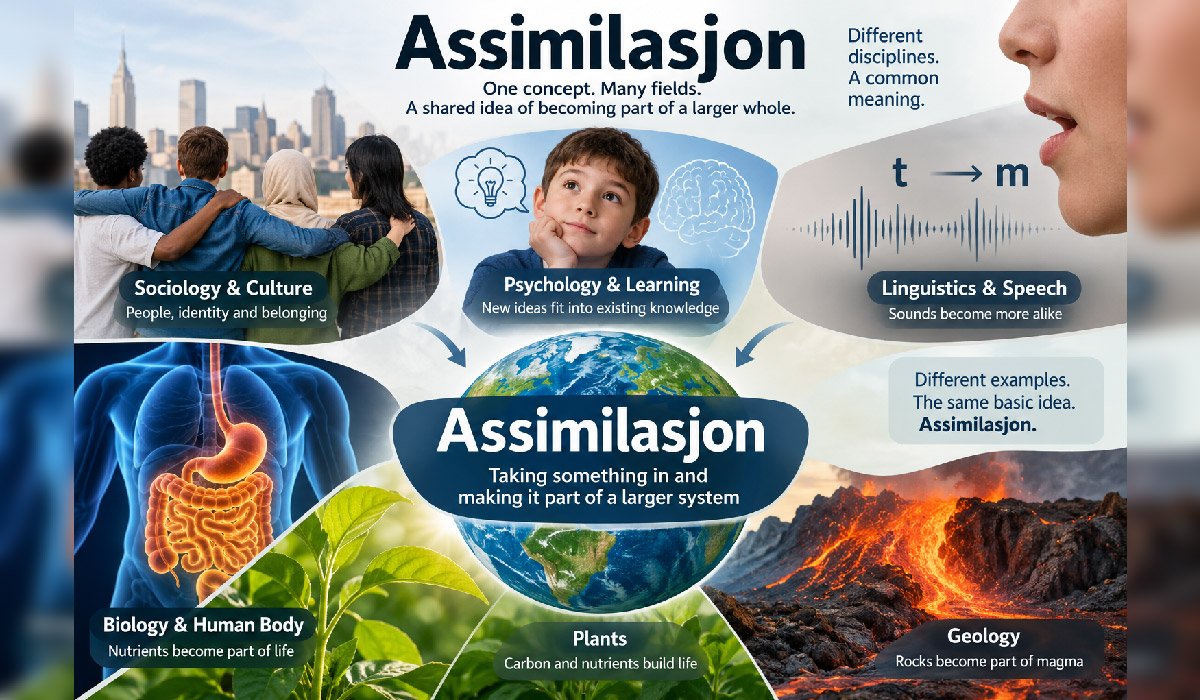
Assimilasjon is a Norwegian term that means “assimilation” in English, but its exact meaning depends on context. The general idea is that something new enters an existing system and becomes part of it, often changing in the process. This idea appears in sociology, psychology, linguistics, biology, plant science, and geology. In society, it can describe cultural change and adaptation. In psychology, it explains how people understand new experiences through existing knowledge. In language, nearby sounds can become more similar. Biology uses the term to refer to nutrients and other substances becoming part of living organisms. Understanding these different meanings makes the concept much easier to recognize and use correctly.
What Is Assimilasjon?
Assimilasjon describes a process in which something is taken into a larger system and becomes more similar to, or incorporated within, that system. The word comes from the same linguistic roots as the English word “assimilation.” Its meaning can therefore change according to context. A social scientist may use it when discussing how cultural groups change after long contact. A psychologist may use it to explain how the mind handles new information. A linguist may describe one sound becoming similar to another. In biology, the word can refer to absorbed substances being converted into useful biological material. Although these processes are very different, they share the basic ideas of intake, adjustment, incorporation, and change.
Assimilasjon in Sociology and Culture
In sociology, assimilasjon usually refers to a process through which individuals or groups become increasingly similar to a larger or dominant cultural group. The changes may involve language, clothing, food, values, behavior, education, work patterns, and social relationships. Cultural assimilation often develops gradually rather than happening at one moment.
A person may first learn the main language of a country to communicate at school or work. Later, everyday habits and social connections may also change. The process can continue across generations, with children experiencing the surrounding culture differently from their parents. However, assimilation does not always mean that every part of an earlier identity disappears. People can adopt many features of another culture while continuing to maintain important family traditions.
How Cultural Assimilasjon Happens
Cultural assimilasjon can develop through repeated contact between people from different backgrounds. Schools are especially important because children learn a common language, social expectations, history, and everyday behavior alongside classmates. Workplaces, universities, neighborhoods, friendships, marriage, television, music, and social media can also influence cultural habits. Language is often one of the most visible changes because regular use of a majority language can make communication and participation easier.
However, cultural change is rarely completely uniform. Someone may use one language professionally and another at home. A family may adopt local clothing and work habits while maintaining traditional celebrations, food, beliefs, and family relationships. Assimilation is therefore better understood as a gradual process that can occur differently across separate parts of life.
Voluntary and Forced Assimilasjon
An important distinction exists between voluntary and forced assimilasjon. Voluntary assimilation occurs when people choose to adopt certain cultural practices because they believe doing so will help them communicate, study, work, form relationships, or participate more easily in society. Forced assimilation is fundamentally different because people face institutional pressure or coercion to abandon their language, customs, names, beliefs, or identity.
Historically, governments and colonial systems in different parts of the world have used education, laws, religious institutions, and other policies to pressure minority and Indigenous communities into changing their cultures. Such policies can create effects that continue across generations, particularly when language and cultural knowledge stop passing from older people to children. Consent, choice, social power, and freedom therefore matter when discussing cultural assimilation.
Assimilasjon vs Integration vs Acculturation vs Multiculturalism
Assimilasjon, integration, acculturation, and multiculturalism describe related but different social processes. Assimilation generally involves becoming increasingly similar to a larger cultural group, sometimes with a reduction in distinctive cultural practices. Integration means participating in shared institutions and public life while still maintaining important parts of an original cultural identity. Acculturation is a broader process of cultural change resulting from continued contact between different groups.
It does not necessarily require one group to lose its identity completely. Multiculturalism emphasizes the continued presence of different cultural communities within the same society. People may share laws, workplaces, schools, and public institutions while maintaining different languages, foods, traditions, religions, or identities. Understanding these distinctions prevents the different terms from being incorrectly treated as interchangeable.
Assimilasjon in Psychology and Learning
In psychology, assimilasjon is strongly associated with developmental psychologist Jean Piaget and his explanation of cognitive development. Piaget proposed that people organize knowledge through mental structures commonly called schemas. When a person experiences something new, the mind may interpret that experience through a schema that already exists.
Imagine a young child who has learned what a dog is. When the child later sees a different breed of dog, its size, color, and shape may be unfamiliar, but the child can still place it within the existing “dog” category. This is assimilation because new information has been understood through existing knowledge. The process makes learning more efficient because people do not need to create an entirely new mental category for every new object or experience.
Assimilasjon vs Accommodation
Assimilation and accommodation work together in Piaget’s theory, but they describe different ways of handling new information. Assimilation occurs when a new experience can be understood through an existing schema without greatly changing that schema. Accommodation happens when existing knowledge must be adjusted because the new experience does not fit properly.
For example, a small child who knows dogs may initially call a cat a dog because both animals have fur, four legs, and a tail. That first response uses an existing schema. As the child learns that cats have their own characteristics, the original understanding must change and a separate category develops. This is accommodation. Together, assimilation and accommodation allow knowledge to remain useful while also becoming more detailed and accurate through experience.
Assimilasjon in Linguistics and Speech
In linguistics, assimilasjon is a phonological process in which one speech sound becomes more similar to another nearby sound. It commonly occurs because connected speech requires the tongue, lips, vocal cords, and other speech organs to move rapidly between different positions. Instead of producing every sound completely separately, speakers naturally adjust pronunciation to make transitions easier.
For instance, the word “handbag” can sometimes sound closer to “hambag” in rapid English speech because the mouth begins preparing for the following “b” sound. Assimilation may affect the place where a sound is produced, whether vocal-cord vibration occurs, or the way airflow is controlled. These pronunciation changes are not necessarily mistakes. They are normal patterns found in natural spoken languages and can develop systematically over time.
Assimilasjon in Biology and the Human Body
In biology, assimilation refers to the incorporation and use of absorbed substances by a living organism. In humans, food must first be digested into smaller molecules before nutrients can be absorbed and used. Carbohydrates can be broken into simple sugars such as glucose, while proteins are broken into amino acids and fats into smaller components. After absorption, these substances become available for metabolism, growth, maintenance, energy storage, and tissue formation.
Assimilation should therefore not be confused with digestion or absorption. Digestion breaks larger food molecules into smaller forms, while absorption transfers usable substances from the digestive system into the body. Assimilation concerns their subsequent incorporation and use. Through these connected processes, material originally obtained from food contributes to the maintenance and functioning of living cells and tissues.
Assimilasjon in Plants and Carbon Assimilation
Plants also perform important forms of biological assimilation. Carbon assimilation is closely connected with photosynthesis, through which plants incorporate carbon from atmospheric carbon dioxide into organic compounds. Plants take carbon dioxide through tiny openings in their leaves, while roots provide water and minerals from the soil. Light-dependent processes provide energy that supports the conversion of carbon into organic molecules.
These compounds can later contribute to glucose, starch, cellulose, and many other substances required for plant growth and metabolism. Plants also assimilate nutrients such as nitrogen after obtaining them in usable forms from their environment. These processes are important far beyond an individual plant. Because plants form the base of many food chains, carbon incorporated into plant matter can eventually pass to animals, microorganisms, soil, and other parts of ecosystems.
Assimilasjon in Geology
Geologists use assimilasjon in a very different context. Here, assimilation describes the incorporation of surrounding rock material into magma. Magma moving through or remaining within Earth’s crust can come into contact with rocks that have a different chemical composition. Heat from the magma may partially melt or otherwise interact with this surrounding material, allowing some of it to become incorporated into the magma.
The extent of assimilation depends on several factors, including temperature, magma composition, the characteristics of the surrounding rock, and the duration of contact. Incorporating foreign rock material can alter the magma’s chemical composition and influence the minerals that eventually form as it cools. Geologists can examine minerals, textures, and chemical patterns in igneous rocks to investigate evidence of these processes.
Real-Life Examples of Assimilasjon
Real-life examples make the different meanings of assimilasjon easier to separate. In society, a family moving to another country may learn the main language and adopt local workplace habits while continuing traditional celebrations at home. In psychology, a child may recognize an unfamiliar breed as a dog by connecting it with an existing mental category.
In linguistics, a speaker may unconsciously alter one consonant because the mouth is already preparing to pronounce the next sound. Biological assimilation happens after nutrients have been absorbed and are used in metabolism or incorporated into body materials. Plants incorporate carbon into organic compounds, while geological assimilation can occur when magma interacts with surrounding rocks. Each example involves incorporation or adjustment, but the system and consequences are different.
Why Context Changes the Meaning of Assimilasjon
Context is essential because assimilasjon does not describe one identical process in every subject. In sociology, it involves relationships between people, cultures, institutions, identity, and social power, so questions about freedom and cultural preservation can become important. Psychological assimilation is different because it describes a normal cognitive mechanism through which existing knowledge helps people interpret new experiences.
Linguistic assimilation concerns sound patterns and the physical process of pronunciation. Biological assimilation relates to the incorporation and use of substances within living systems, while plant carbon assimilation explains an essential part of how carbon becomes incorporated into organic matter. Geological assimilation deals with interactions between magma and surrounding rock. Recognizing the academic field therefore prevents misunderstandings and makes the intended definition of the word much clearer.
Final Thoughts
Assimilasjon is a broad concept connected by one central idea: something enters an existing system and becomes incorporated into it, often through some form of adjustment or transformation. In sociology, the term can explain cultural change and raises important questions about identity, choice, integration, and social power. In psychology, it describes how new experiences can fit existing schemas, while accommodation explains how those schemas change when necessary.
Linguistics uses assimilation to describe neighboring speech sounds becoming more alike. Biology applies the concept to the use and incorporation of absorbed materials, and plants perform important forms such as carbon assimilation. Geology gives the term another technical meaning involving magma and surrounding rocks. Knowing the context is therefore the key to understanding exactly what assimilasjon means.
(FAQs)
What does Assimilasjon mean?
Assimilasjon means assimilation in English. It describes a process in which something new is taken into an existing system and becomes part of it. Its exact meaning depends on whether the subject is culture, psychology, language, biology, or geology.
What is cultural Assimilasjon?
Cultural assimilasjon happens when individuals or groups gradually adopt features of another, often larger, culture. These changes may involve language, social habits, clothing, values, education, food, or behavior while some original traditions may still remain.
What is the difference between Assimilasjon and integration?
Assimilasjon generally involves becoming increasingly similar to the surrounding or dominant culture. Integration focuses on participating in society while maintaining important parts of an original cultural identity, such as language, traditions, religion, food, or family customs.
What does Assimilasjon mean in psychology?
In psychology, assimilasjon describes fitting new experiences into existing mental structures called schemas. Jean Piaget used this concept to explain learning. For example, a child may recognize an unfamiliar dog breed by using an existing idea of what dogs are.
What is Assimilasjon in biology?
In biology, assimilasjon involves absorbed substances being incorporated or used by an organism. After nutrients are digested and absorbed, the body can use them for metabolism, growth, tissue formation, repair, energy production, and other essential biological processes.
