


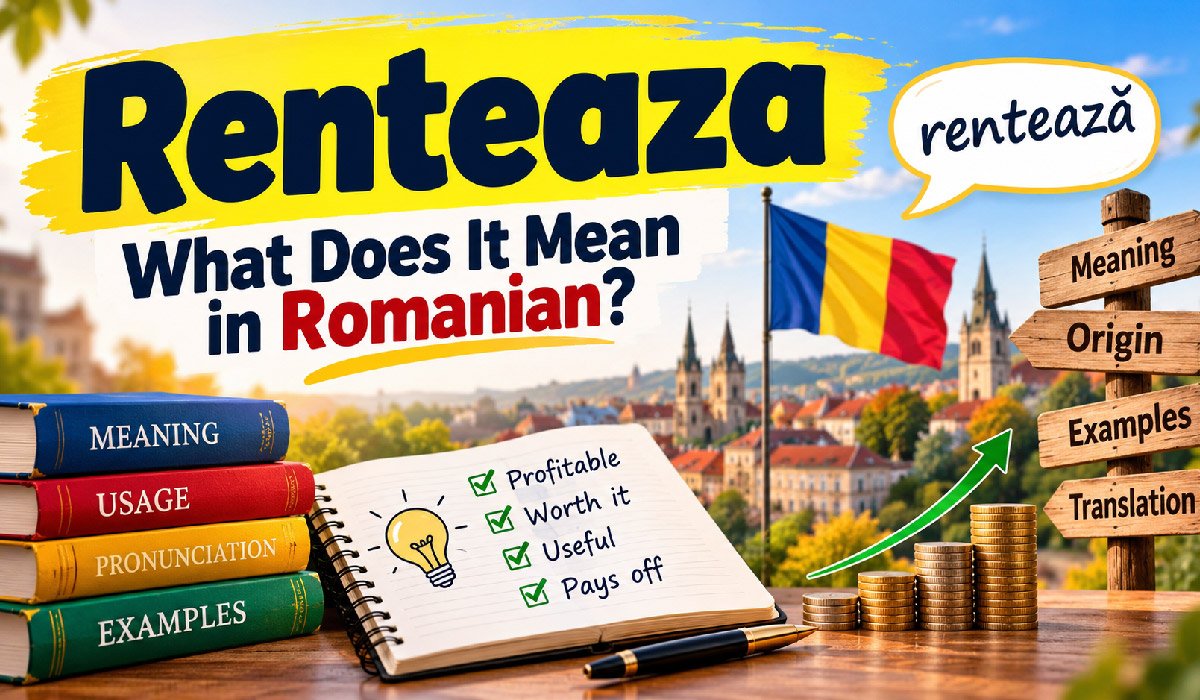
Renteaza is a Romanian word you may notice in business discussions, financial content, online searches, or everyday conversations. The standard Romanian spelling is rentează, and its meaning is closely connected with profit, return, productivity, usefulness, and whether something is worth the effort.
For English speakers, the word can be confusing because “renteaza” looks similar to the English word “rent.” However, the Romanian meaning is different. Depending on context, rentează can naturally mean “it is profitable,” “it pays,” “it pays off,” or “it is worth it.”
Understanding Renteaza becomes easier when you focus on one central idea: return compared with input. The input might be money, time, work, or another resource. If the result provides enough benefit to justify that input, a Romanian speaker may use rentează to express that judgment.
What Does Renteaza Mean?
Renteaza is the spelling commonly typed without Romanian diacritics, while rentează is the standard Romanian form. It comes from the verb “a renta,” which Romanian dictionary sources define around producing income, resulting in profit, bringing a return, or being productive.
The word also has a familiar everyday sense. It can express the idea that an activity is useful or deserves the effort required. Because of this broader meaning, translating rentează as “profitable” in every sentence would sometimes make the English translation sound too narrow.
A simple way to understand the word is to ask: Does the result justify the cost or effort? In financial situations, that may mean making enough money. In ordinary situations, it can simply mean receiving enough practical benefit for something to be worthwhile.
Renteaza or Rentează: What Is the Correct Spelling?
The correct Romanian spelling is rentează. The final character “ă” is part of the Romanian alphabet and should be retained in standard Romanian writing. The version “renteaza” normally appears when people search or type without using Romanian diacritics.
Removing diacritics is common in search queries, domain names, usernames, older digital systems, and informal messages. Therefore, someone searching Google for “Renteaza meaning” and someone searching for “rentează meaning” are generally trying to understand the same Romanian word.
For professionally written Romanian, rentează is the form to use. For an English article targeting the keyword Renteaza, however, it is reasonable to mention both forms. This allows readers to recognize the popular search spelling while also learning the linguistically correct version.
Where Does the Word Renteaza Come From?
The Romanian verb behind rentează is a renta. Romanian dictionary sources trace the verb to French renter. This origin also helps explain why the word is strongly associated with income, financial returns, profit, and productivity rather than the everyday English meaning of renting something.
Romanian is a Romance language, so connections with French and other Romance languages are not unusual. The same general word family includes Romanian terms associated with profitability and income. Recognizing that relationship can make several economic and business expressions easier for Romanian learners to understand.
Still, origin should not replace modern meaning. Words can develop different meanings after entering another language. The safest approach is therefore to understand rentează according to its established Romanian usage: something produces a return, brings a benefit, or is worthwhile enough to justify what is invested.
What Does Renteaza Mean in English?
There is no single English translation that works perfectly in every situation. In a business discussion, “it is profitable” can be an accurate translation. When discussing the result of an action, “it pays off” may sound better. In casual conversation, “it is worth it” may be most natural.
Imagine that someone evaluates a business activity after comparing revenue with its expenses. If the operation generates a satisfactory return, rentează can communicate profitability. The English translation should therefore emphasize money because the Romanian sentence is making an economic judgment.
Now imagine someone considering whether a difficult task deserves several hours of work. The question may still involve whether it “rentează,” but “Is it profitable?” could sound unnatural in English. In that situation, “Is it worth it?” communicates the intended meaning more clearly.
How Renteaza Works in Romanian Grammar
Rentează is a present-tense form of the Romanian verb a renta. Dictionary information identifies the verb as intransitive and records rentează as its third-person present form. That grammatical detail helps explain why the word frequently appears when describing whether a business, activity, investment, or decision produces worthwhile results.
This means that rentează is not simply an adjective describing an object. It functions as a verb. That distinction becomes useful when comparing it with related Romanian vocabulary such as rentabil, an adjective associated with something profitable, advantageous, or productive.
For learners, understanding the word as a verb prevents several common mistakes. Instead of memorizing renteaza as an isolated internet keyword, connect it with its infinitive a renta. That makes its grammatical role, related vocabulary, and different English translations considerably easier to remember.
How Renteaza Is Used in Business
Business is one of the easiest settings in which to understand rentează because the idea of return is clear. Companies spend money on employees, equipment, marketing, property, software, transportation, and other resources with the expectation that those costs will support useful economic results.
A business owner can therefore evaluate whether a particular activity rentează. The question is essentially whether the financial outcome is good enough to justify the resources being committed. If costs remain high while the return stays weak, the owner may conclude that the activity does not rentează.
The word itself does not calculate profitability or provide a specific financial ratio. Instead, it communicates a judgment about economic value. Exact business decisions still require numbers such as revenue, expenses, margins, cash flow, and expected returns before someone can determine whether an activity truly makes financial sense.
How Renteaza Can Apply to Investments
Investment decisions also revolve around the relationship between resources committed and results received. An investor may put money into property, a business, equipment, or another opportunity because they expect future income, growth, savings, or some other measurable benefit.
In this context, asking whether something rentează focuses attention on its return. A project that requires substantial capital but produces very little benefit may not justify the investment. A different project with stronger expected returns may appear more attractive when its risks and costs are considered.
However, rentează should not be confused with a technical investment metric. It is not the Romanian name for ROI, interest rate, or profit margin. It expresses the broader concept that something produces enough value to be worthwhile, while formal financial analysis determines exactly how strong that return is.
Renteaza Can Also Mean “Worth the Effort”
Money is important to the traditional meaning, but rentează is not limited to purely financial situations. Romanian dictionary sources also recognize a familiar sense connected with something being useful or worth the effort. This makes the word relevant to many practical everyday decisions.
Suppose one option takes considerably more work but provides almost the same result as an easier alternative. Someone might question whether the additional effort rentează. The most natural English interpretation would probably be “Is it worth the effort?” rather than a sentence involving financial profit.
This wider meaning gives the word considerable flexibility. The “return” can sometimes be convenience, saved time, improved results, or another practical advantage. What remains consistent is the comparison between what someone puts into an activity and the benefit that comes from doing it.
Simple Examples of Renteaza
A useful example is “Afacerea rentează.” In a suitable business context, this can be understood as “The business is profitable” or “The business pays.” The important idea is that the business produces a satisfactory economic result instead of simply consuming money.
Another useful expression is “Nu rentează.” Depending on the surrounding discussion, this could mean “It isn’t profitable,” “It doesn’t pay,” or “It isn’t worth it.” Translators should choose the English phrase that best reflects what is actually being evaluated in the conversation.
A question involving whether an action rentează can similarly carry the meaning “Is it worth doing?” These examples demonstrate why context matters. English often changes the wording depending on whether the expected return involves money, effort, time, usefulness, or another practical benefit.
Does Renteaza Mean “To Rent”?
Renteaza should not normally be translated as the English verb “to rent.” Their visual similarity makes this an understandable mistake, especially for English speakers encountering the Romanian term for the first time, but their standard modern uses are different.
Romanian uses a închiria for the ordinary act of giving or taking movable or immovable property for temporary use in exchange for rent. Therefore, renting an apartment, vehicle, or another item should not automatically be described using a renta simply because the English word “rent” looks similar.
The distinction is straightforward: think of rentează in terms of return, profitability, productivity, or worthwhile results. Think of a închiria when the subject is renting or letting something for temporary use. Remembering this difference prevents one of the most common misunderstandings surrounding the keyword Renteaza.
Renteaza and Rentabil Are Related but Different
Another useful Romanian word is rentabil. Romanian dictionaries define rentabil around something that produces a return and is advantageous or productive. In English, “profitable,” “cost-effective,” or “economically worthwhile” may work depending on the situation.
The grammatical difference matters. Rentează is a verb form, whereas rentabil is an adjective. In simple terms, one can express that something pays or produces a worthwhile return, while the other can describe something as profitable or advantageous.
Learners sometimes understand the general financial concept but choose the wrong grammatical form. Remembering the distinction between verb and adjective solves much of this problem. It also helps readers recognize related Romanian vocabulary when they encounter financial reports, business discussions, investment content, or ordinary conversations about value.
Renteaza and Rentă Are Different Meanings
Rentă is another related term, but it should not be treated as identical to rentează. Romanian dictionary definitions describe rentă as a form of regular income or profit associated with property, land, capital, and certain other economic arrangements.
The relationship is easier to understand by looking at grammar. Rentă is a noun, whereas rentează is a verb form. Their meanings belong to a related economic family, but they perform different jobs within a sentence and should not be freely exchanged.
This distinction also shows why translating Romanian solely by visual similarity can create errors. Rentă, rentează, rentabil, and the English word “rent” may look connected, yet their modern grammatical roles and practical meanings differ. Learning each term in context produces far more reliable translations.
Is “Se Rentează” Correct Romanian?
You may sometimes encounter “se rentează” in conversation or online writing. However, language guidance explains that a renta is an intransitive, non-reflexive verb, so adding the reflexive “se” in this usage is not recommended. The standard construction uses rentează without “se.”
This is particularly helpful for learners because repeated informal usage online can make a nonstandard construction appear correct. Seeing many search results for a phrase does not necessarily mean that the phrase follows recommended Romanian grammar.
For careful writing, use rentează. For example, when expressing that a business produces a worthwhile return, the verb can stand without the reflexive addition. Knowing this small grammatical point makes your Romanian more precise and helps you recognize informal constructions without automatically copying them.
Why Context Changes the Translation
Good translation communicates meaning rather than mechanically replacing individual words. Renteaza demonstrates this principle well because its best English equivalent changes according to what the speaker is evaluating. Business, money, effort, usefulness, and time can all influence the translation.
If revenue and expenses are being discussed, “profitable” or “pays” may be suitable. If someone is considering whether additional work will produce enough benefit, “worth it” or “worth the effort” may sound more natural. “Pays off” can work especially well when the meaning falls between these situations.
Before translating rentează, examine the surrounding sentence. Ask what kind of return is being discussed and what resources are being compared with that return. This simple approach usually produces clearer English than trying to force the same dictionary translation into every context.
Common Mistakes With Renteaza
The first common mistake is treating renteaza as the preferred Romanian spelling. It is understandable without diacritics, especially as an online search term, but rentează is the standard spelling. Writers producing proper Romanian text should retain the letter “ă.”
The second mistake is translating it directly as “to rent.” Romanian dictionary evidence connects a renta with income, profit, productivity, usefulness, and worthwhile effort, while a închiria covers ordinary renting. A third issue is assuming that “profitable” is always the best English translation.
Finally, learners may encounter “se rentează” and repeat it because it sounds familiar. Language guidance recommends the non-reflexive rentează instead. Remembering these differences in spelling, translation, context, and grammar covers most of the problems an English-speaking learner is likely to face.
Why Renteaza Is Useful to Learn
Renteaza is valuable vocabulary because its basic idea appears frequently in real decisions. Individuals and businesses regularly compare cost with benefit, work with results, and resources with returns. The word provides a compact Romanian way of expressing that relationship.
It is also useful because learning it introduces several broader language lessons. You see why Romanian diacritics matter, why words that resemble English terms should not automatically receive the same translation, and why grammatical context can be as important as a basic dictionary definition.
The word also leads naturally to related vocabulary such as rentabil and rentă. Instead of memorizing isolated terms, learners can understand a group of words connected with returns and economic value. That approach is particularly helpful for anyone reading Romanian business, finance, or investment material.
Final Thoughts
Renteaza, correctly written rentează, is a Romanian word centered on the idea of receiving a worthwhile return. The verb a renta can describe producing income, making a profit, or being productive, while familiar usage can extend to something being useful or worth the effort.
The most suitable English translation depends on context. “It is profitable,” “it pays,” “it pays off,” and “it is worth it” are all possible. What matters is identifying whether the return being discussed involves money, time, work, convenience, or another practical benefit.
Most importantly, do not confuse rentează with the ordinary English verb “to rent.” Romanian normally uses a închiria for renting property or objects. Remember the ideas of return, benefit, and worthwhile effort, and the meaning of Renteaza becomes much easier to recognize.
FAQs
What does Renteaza mean?
Renteaza, correctly spelled rentează, is a Romanian verb form connected with producing income, making a profit, being productive, or providing a worthwhile result. Depending on context, it can mean “it is profitable,” “it pays off,” or “it is worth it.”
Is Renteaza a Romanian word?
Yes. The standard Romanian form is rentează, from the verb a renta. Romanian dictionary sources trace a renta to French renter and define it as producing income, profit, or useful returns.
Is it Renteaza or Rentează?
Rentează is the standard Romanian spelling. “Renteaza” is the same word typed without the Romanian diacritic “ă.” The simplified version is common in search queries and informal online writing, but properly written Romanian should use rentează.
Does Renteaza mean “to rent” in English?
No. Despite the similar appearance, rentează primarily concerns profitability, return, productivity, or whether something is worthwhile. Romanian normally uses ” închiria when referring to renting or letting property and other items for temporary use.
What does “Nu rentează” mean?
“Nu rentează” can be translated as “It isn’t profitable,” “It doesn’t pay,” or “It isn’t worth it.” The correct English wording depends on whether the Romanian speaker is discussing money, effort, time, or another type of return.
Is “se rentează” correct?
For careful standard usage, rentează without “se” is recommended. Romanian language guidance describes a renta as an intransitive, non-reflexive verb and identifies the reflexive construction “se rentează” as a usage to avoid, even though it can be heard in everyday speech.
