


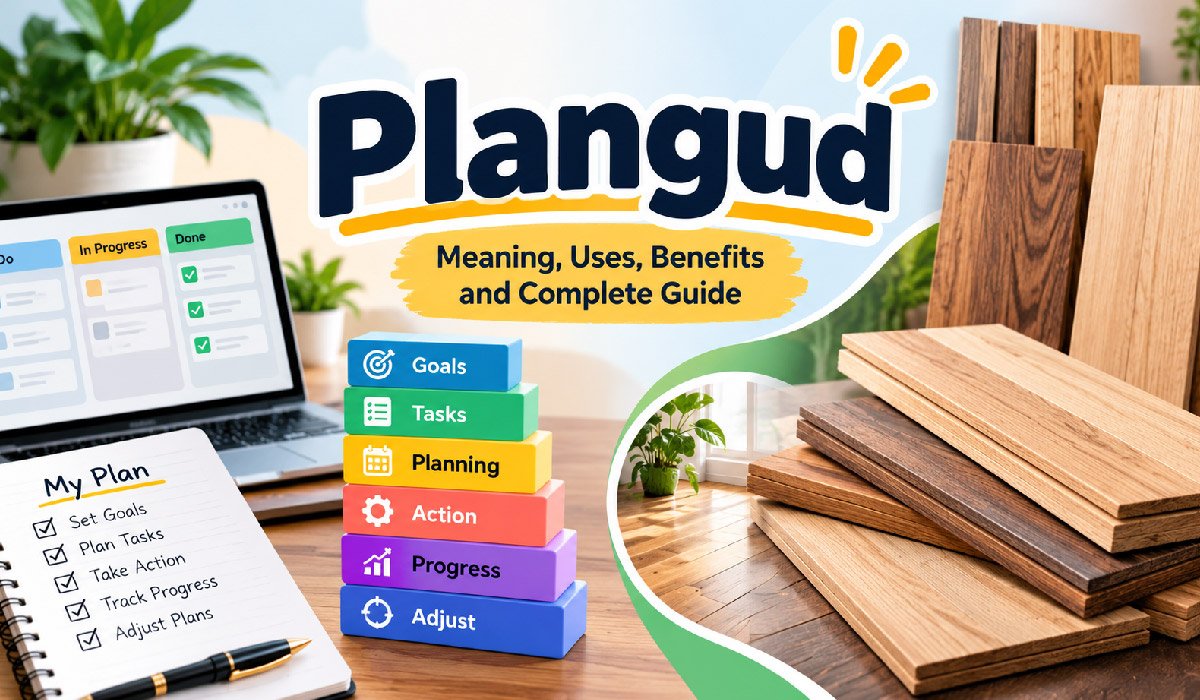
Plangud is an unusual word that has recently appeared across websites discussing everything from wooden materials to productivity and planning. This variety can make the term confusing for someone searching for a simple definition. The strongest documented meaning comes from the Estonian language, where the word is connected with thick wooden boards or planks. At the same time, newer English-language articles have started using Plangud when discussing goal setting, task management, flexible planning, and teamwork.
Because these meanings come from very different contexts, they should not be mixed. Plangud is not clearly established as the name of one recognized productivity method or major software application. Understanding where the word comes from, how it is used, and why planning-related explanations have appeared online provides a much clearer picture.
What Does Plangud Mean?
The best-documented meaning of Plangud comes from Estonian. It is connected with the Estonian noun “plank,” meaning a thick wooden board. Estonian dictionary material describes a plank as a relatively thick, narrower board and provides examples involving planks used for floors, fences, boats, and other structures.
In simple English, plangud can be understood as planks or thick wooden boards when it appears in this linguistic context. It does not identify one particular species of tree, flooring product, brand, or manufacturing process. More information is needed to understand exactly what kind of boards are being discussed.
This established meaning is important because many recent English-language pages use Plangud differently. Some connect it with planning and productivity. That newer use exists online, but readers should separate it from the documented Estonian meaning instead of assuming both definitions have the same origin.
Why Is Plangud Connected With Planning?
The word Plangud looks and sounds similar to the English word “plan.” That resemblance may help explain why it has become associated online with organization, productivity, goals, and project management. Various articles now use the term when explaining ways to turn large objectives into smaller and more manageable activities.
In these discussions, Plangud usually represents familiar planning practices. A person chooses a goal, divides it into tasks, arranges those tasks, starts working, checks progress, and changes the plan when necessary. These practices can certainly be useful, even though they are not unique to a verified Plangud methodology.
Therefore, readers should distinguish between Plangud as a documented Estonian word and Plangud as a newer label used for planning ideas online. The second interpretation can still provide practical advice, but it should not automatically be presented as an officially established productivity system.
How the Plangud Planning Idea Works
The planning interpretation of Plangud starts with a clear objective. Instead of writing something broad such as “improve my business,” a person could choose a measurable target like publishing eight new product pages during the month. A specific result makes it easier to decide what work needs to happen next.
The larger objective is then divided into manageable tasks. For an online store, those activities might include photographing products, researching prices, writing descriptions, uploading images, configuring pages, and checking the finished listings. Some activities need to happen before others, so arranging the work in a sensible sequence becomes important.
Once work begins, progress is reviewed regularly. Finished tasks are marked complete, delayed work is identified, and priorities can be changed when circumstances require it. This creates a repeating cycle of planning, action, review, and adjustment rather than treating the original schedule as something that can never change.
Main Principles Behind Plangud Planning
Clear goals are the foundation of the planning approach associated with Plangud. A useful goal explains the expected result clearly enough that progress can be measured. “Study more,” for example, provides little direction. “Complete five mathematics chapters before Friday” gives the learner a specific target and deadline.
Another principle is breaking complicated work into manageable parts. Large projects can feel difficult because several different activities are hidden inside one objective. Separating research, preparation, production, review, and completion makes the workload easier to understand and allows progress to become more visible.
Flexibility completes the process. Unexpected problems are normal in real projects. A supplier may be late, an employee may be unavailable, or an assignment may require additional research. Instead of abandoning the entire plan, users can adjust individual deadlines, priorities, or responsibilities while keeping the main objective in sight.
Using Plangud for Personal Goals
Personal planning does not require complicated software. Someone can apply the ideas associated with Plangud using a notebook, calendar, spreadsheet, or ordinary task manager. The important part is creating a realistic connection between the final goal and the individual activities required to reach it.
Consider someone learning web development. The person could begin with basic HTML before studying CSS and JavaScript. Each subject could be divided into lessons and practical exercises. Instead of focusing on the intimidating goal of “becoming a web developer,” the learner would concentrate on the next achievable milestone.
The same approach can support fitness schedules, home improvement, event preparation, reading goals, or personal projects. However, planning should remain proportional to the task. Creating a complicated workflow for a simple responsibility can waste more time than it saves. Sometimes an ordinary checklist is the most effective solution.
How Students Can Apply Plangud
Students frequently manage several deadlines at the same time. Assignments, examinations, presentations, reading, and group projects can become difficult to coordinate without a clear overview. A structured plan can separate these responsibilities and show which activities need immediate attention.
For examination preparation, a student could list every subject and divide each one into smaller topics. Difficult subjects might receive additional study sessions, while completed topics can be marked finished. Weekly progress reviews can reveal whether the student is following the schedule or needs to redistribute available study time.
Group assignments require another level of organization because several students share responsibility for one result. Assigning research, writing, design, and presentation tasks to specific people can reduce confusion. The underlying Plangud-style principle remains simple: know the objective, understand the next tasks, monitor progress, and adjust when necessary.
Plangud for Business Planning
Businesses can apply structured planning to product launches, marketing campaigns, content production, client work, hiring, and routine operations. Managers first identify the required result and then map the activities needed to achieve it. Each important task can receive an owner, priority, and realistic completion date.
Imagine a company preparing to launch a product. Before sales begin, the team may need photographs, product descriptions, pricing, advertising material, inventory information, payment setup, and website testing. Some activities can happen together, while others depend on earlier tasks being completed successfully.
Regular reviews help managers identify problems before they become serious. If photography is delayed, for example, the marketing schedule may also need adjustment. Flexible planning allows the company to change individual activities while protecting important business objectives. This can be particularly useful when projects contain uncertainty or multiple dependencies.
Plangud for Team Project Management
Team projects become harder when responsibilities are unclear. Two people may unknowingly perform the same work while another important task remains unfinished. A shared plan creates visibility by showing what needs to happen, who owns each responsibility, and when the work should be completed.
A website project provides a useful example. Writers may prepare page content while designers create layouts. Developers then build required functionality, and testers inspect the finished pages. Certain activities can proceed simultaneously, but others depend on previous work. Mapping these relationships helps prevent avoidable delays.
Teams can manage this process using spreadsheets, shared calendars, Kanban boards, or established project-management applications. There is no verified requirement for dedicated Plangud software. The practical value comes from organizing responsibilities and communication effectively rather than from using a particular application bearing the Plangud name.
Benefits of a Flexible Planning Approach
Breaking large objectives into smaller activities can make demanding projects easier to understand. Instead of constantly thinking about the final result, users can focus on one manageable action at a time. This also makes unfinished work more visible and gives people a clearer sense of what should happen next.
Structured planning can improve priorities as well. When every responsibility is visible, urgent and important work can be separated from activities that can wait. Teams gain an additional advantage because shared plans can identify task owners, deadlines, dependencies, completed activities, and possible delays.
Flexibility is another useful feature. Real projects rarely unfold exactly as expected. Requirements change, new information appears, and delays happen. A plan that can be reviewed and updated allows users to respond without losing sight of the main objective. However, these benefits come from effective planning practices rather than a guaranteed result associated specifically with Plangud.
Plangud Compared With Fixed Planning
A fixed planning approach usually creates tasks and deadlines before work starts and expects participants to follow that schedule closely. This can work well for predictable activities with firm requirements. Repeated administrative processes, scheduled events, and work governed by external deadlines may benefit from greater stability.
The flexible planning interpretation associated with Plangud gives more attention to regular review. A deadline or task sequence can be changed when new information makes the original plan unrealistic. This can suit creative projects, product development, marketing, content production, and other work where requirements may evolve.
Neither method is automatically better. In many situations, combining them produces a stronger workflow. Important milestones can remain fixed while smaller tasks stay flexible. The best planning method depends on the nature of the project, available resources, external deadlines, and the amount of uncertainty involved.
Plangud and Wooden Boards
Outside productivity discussions, Plangud has a genuine connection with timber. Estonian dictionary sources describe “plank” as a thick board, with examples involving stacks of boards, flooring, fences, boats, and construction. The plural usage naturally appears when more than one board is being discussed.
This does not mean Plangud is a particular type of wood. A plank could potentially be produced from pine, spruce, oak, or another suitable species. Its dimensions, moisture level, grade, treatment, strength, surface finish, and intended application must be determined from the actual product specifications.
This distinction matters when shopping for construction materials. Seeing the word Plangud does not tell a buyer whether a board is appropriate for flooring, furniture, decking, or structural work. Buyers should check the supplier’s technical information rather than treating the word itself as a quality or performance standard.
Can Plangud Refer to Flooring?
Wooden planks can certainly be used for flooring, and Estonian dictionary examples include flooring made from planks. However, the word Plangud alone should not be interpreted as the name of a special flooring technology, wood species, or standardized flooring category.
Suitable flooring depends on the actual material. Important considerations can include wood species, dimensions, moisture content, stability, surface treatment, subfloor conditions, installation method, and the environment where the floor will be used. Indoor and outdoor applications can have very different requirements.
Therefore, a product description containing Plangud should be read in its full context. If it comes from an Estonian timber supplier, it may simply be referring to multiple wooden planks. Product specifications provide the information needed to determine whether those boards are suitable for a particular flooring or construction project.
Is Plangud an App or Software Platform?
Current evidence does not establish Plangud as one widely recognized productivity application with a standardized set of features. Search results contain planning-related descriptions, but they do not provide a consistent picture of one established methodology or major software platform behind all uses of the term.
This is an important distinction for readers. General descriptions of dashboards, artificial intelligence, integrations, collaboration features, subscriptions, or mobile applications should not be assumed to belong to Plangud unless they can be traced to an identifiable provider and official product documentation.
When evaluating unfamiliar software, check the developer, company information, privacy policy, terms, pricing, support channels, independent reviews, and official app-store presence where relevant. The planning principles associated online with Plangud do not require special software. A notebook, spreadsheet, calendar, or established task-management tool can perform the basic organizational work.
Common Mistakes When Using a Planning System
One common mistake is choosing a goal that is too broad. “Grow my website” does not identify a measurable result. A target such as publishing twelve useful articles within six weeks gives the user a clearer objective and makes it easier to build a realistic task list.
Overplanning creates another problem. Dividing every activity into dozens of tiny steps can make the planning system harder to maintain than the project itself. Tasks should be small enough to understand and manage but large enough to represent meaningful progress. Simplicity usually makes regular updates easier.
Finally, plans lose value when nobody reviews them. Deadlines change, tasks become unnecessary, and new responsibilities appear. A short daily or weekly review can keep information current. Planning should guide action rather than replace it, so users should begin working once the important tasks and priorities are sufficiently clear.
How to Build a Simple Plangud-Style Plan
Start by writing one specific goal and a realistic completion date. Next, list the major activities required to achieve that result. Divide only complicated activities into smaller tasks. Then arrange the work according to priority and dependency so tasks that unlock other activities receive appropriate attention.
Add deadlines based on realistic estimates rather than ideal circumstances. For team projects, give every important responsibility a clear owner. A basic tracker can use simple statuses such as Not Started, In Progress, Waiting, Review, and Complete. This provides enough information to understand overall progress without creating unnecessary complexity.
Finally, choose a regular review time. Check what has been completed, identify delayed activities, and decide whether priorities or deadlines need to change. The system should remain easy to maintain. If updating the plan becomes a major job itself, simplify it until planning supports the work rather than distracting from it.
Final Thoughts
Plangud is more interesting than many search results initially suggest. Its strongest documented meaning comes from Estonian, where it is associated with planks or thick wooden boards. It does not by itself identify a special wood species, flooring system, or construction product, so material specifications still need to be checked separately.
A newer online interpretation connects Plangud with flexible planning, productivity, and project management. The underlying practices—setting clear goals, dividing work, arranging tasks, taking action, reviewing progress, and adjusting plans—can be useful for individuals, students, businesses, and teams. However, they should not be presented as a formally established Plangud methodology without stronger evidence.
The safest way to understand Plangud is therefore to examine its context. In Estonian and timber discussions, think planks. In newer productivity content, think a label being used for general structured and flexible planning ideas, rather than assuming it represents one verified software platform or universally recognized planning system.
FAQs
What does Plangud mean?
Plangud is associated with the Estonian word “plank,” referring to a thick wooden board. In the relevant plural context, Plangud refers to planks. Some newer English-language websites also use the term when discussing planning and productivity.
Is Plangud a planning method?
Some online articles use Plangud as a name for flexible planning practices involving goals, smaller tasks, progress reviews, and adjustments. However, authoritative evidence does not clearly establish it as a standardized or universally recognized planning methodology.
Is Plangud a productivity app?
There is no strong evidence establishing Plangud as one major, widely recognized productivity application behind the different online descriptions. Claims about software features, pricing, AI tools, or integrations should be checked against official product documentation before being treated as facts.
What is Plangud used for in planning?
In planning-related online usage, the idea can be applied to personal goals, study schedules, business projects, content production, and teamwork. Users define an objective, organize tasks, track progress, and update their plans when circumstances change.
Does Plangud mean flooring or wooden planks?
The documented Estonian meaning is connected with thick wooden boards or planks. Such planks may be used for floors and other purposes, but Plangud is not itself the name of a particular flooring material, wood species, grade, or manufacturing system.
Can I use Plangud without special software?
Yes. If you are referring to the planning ideas described online under the Plangud name, they can be followed using a notebook, spreadsheet, calendar, checklist, or ordinary task-management application. The basic process does not require dedicated Plangud software.
