


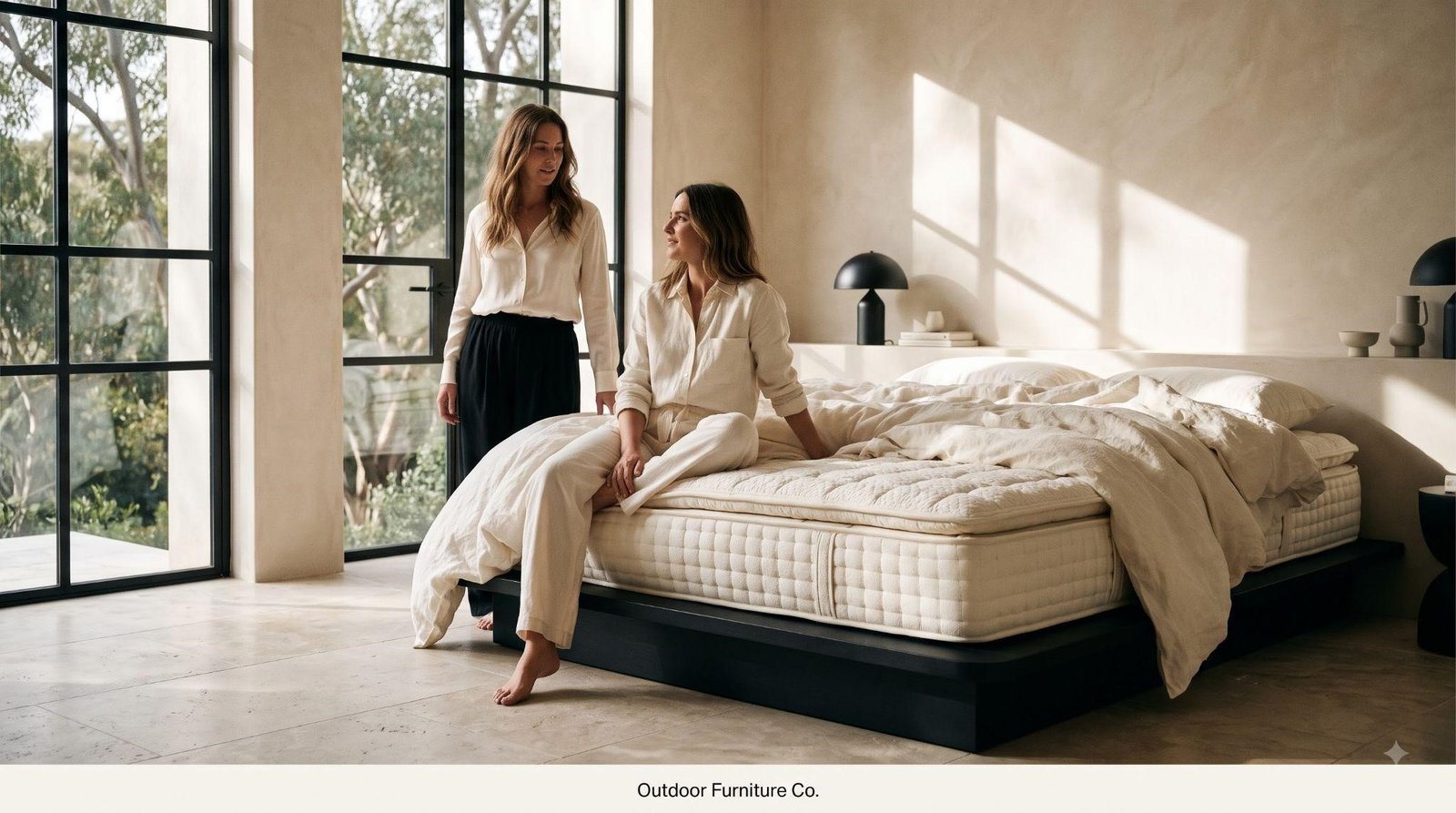
A sore lower back, sheets that slip off at night and a bed too high to sit on often share one cause. Many Australians blame the bed frame or the pillow. The real issue is often on the mattress thickness.
A mattress changes how a person sleeps and how their room looks. This guide shares which thickness suits your body and how to match it to your bed base.
How Thick Should a Mattress Be
Most Australian adults sleep best on a mattress between 25 cm and 30 cm deep. There is no official rule but this is the standard mattress thickness for Australia. However, the depth changes with age and body weight.
- Adults: The best mattress thickness for adults sits at 25 cm to 30 cm. Heavier sleepers over 100 kg do better at 28 cm or more.
- Kids: A 15 cm to 20 cm mattress gives a child enough support. It keeps a bunk bed safe.
- Elders: Older sleepers need a bed they can get on and off with ease. So, a 20 cm to 25 cm mattress on a low base often works best.
Mattress thickness matters, but what fills those centimetres matters even more.
5 Reasons Why Mattress Thickness Matters
Mattress thickness affects how your spine rests, how the bed fits your frame and how safe a bunk is for a child. Here are the reasons why mattress thickness matters.
1. It Decides How Well Your Back Is Supported
A good mattress has two parts. The bottom part is the support core. It keeps your spine straight. The top part is the comfort layer. It cushions your hips and shoulders. The support core should make up at least half of the total depth. So, a 26 cm mattress with a strong core is better than a 32 cm mattress filled with soft, cheap foam.
This matters for your health. The Australian Institute of Health and Welfare reports that around 4 million Australians, or 15.7%, had back problems in 2022. So, your mattress should have a firm core under a thin comfort layer for back support.
2. Thickness and Firmness Are Two Different Things
Thickness is how tall the mattress is. Firmness is how hard or soft it feels when you lie on it. Many shoppers mix these up. A thick mattress can feel hard. A slim mattress can feel soft.
Lie on the bed for ten minutes before you buy. Notice how your hips and shoulders sink in. That tells you the firmness. The height tells you nothing about it.
3. Different Bodies Need Different Depths
Your weight and sleep position decide how deep your mattress should be. A 20 cm mattress suits children, light adults and guest rooms. A 30 cm mattress suits couples and heavier sleepers. Side sleepers need more depth, about 27 cm to 30 cm. So, the shoulder can sink in without touching the springs.
Sleepers over 100 kg should also pick a mattress close to 30 cm with a dense core. The type of mattress matters too. A pocket spring mattress is often 25 cm to 32 cm deep, because the springs alone take up 15 cm to 20 cm. A memory foam mattress can be thinner, around 20 cm to 25 cm, because dense foam does the same job in less space.
4. Your Bed Base Changes the Maths
Your bed base and your mattress work as a pair. Add the height of the base to the depth of the mattress. That gives you the total bed height. For example, a 30 cm mattress on a 40 cm ensemble base makes a 70 cm bed. That is quite tall for a short person or an older sleeper.
Slat frames and low platform beds sit closer to the floor. So, a thicker mattress works well on them. Gas-lift storage beds have a weight limit. Check it before you buy a heavy mattress. A thick vs thin mattress also decides which fitted sheets you need. Standard sheets fit up to about 30 cm. Anything deeper needs a deep-wall sheet, or the corners will slip off at night.
5. Top Bunks Have a Safety Limit
The guardrail on a top bunk stops a child from rolling out. A thick mattress fills up that space. Less rail is left above the mattress. So, a fall is more likely.
In Australia, Product Safety Australia sets a rule for this. If the guardrail is less than 360 mm above the bed base, the bunk must carry a “MAX. MATTRESS HEIGHT” mark. Look for that mark before you buy a mattress for a bunk. Stay under it, even if a thinner mattress looks too slim.
A Simple Way to Pick the Right Thickness
A quick way to choose the right mattress thickness is to measure your base, know your weight, and name your sleep position. The Sleep Health Foundation found 46% of Australians say poor sleep affects their work or study. The wrong bed depth plays a quiet part in that. Use this list as a starting point:
- Under 70 kg or a child: 15 cm to 25 cm
- 70 kg to 100 kg: 25 cm to 30 cm
- Over 100 kg or a side sleeper: 28 cm or more
- Older sleepers: 20 cm to 25 cm on a low base
- Top bunk: follow the label on the frame.
Final Thoughts
Mattress thickness shapes your sleep, your back and the look of your bedroom. Check what sits inside the mattress, match the depth to your base and your body, and test it before you buy.
At Outdoor Furniture Co, they offer mattresses built for Australian homes and Australian weather. Their team gives honest advice on size, height and fit before you spend a cent.
