


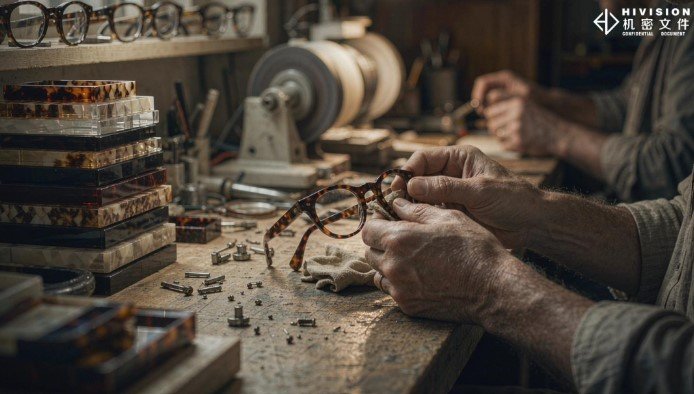
A premium acetate frame can look simple when it is sitting on a display shelf. But its appearance is the result of many decisions made long before it reaches a retailer: the quality of the acetate sheet, the accuracy of the cutting, the skill involved in shaping it, and the time spent polishing and assembling each component.
This is why two frames with similar designs can feel completely different in the hand. One may have smooth edges, rich colour depth and well-aligned temples. The other may show uneven finishing, weak hinge fitting or inconsistent dimensions.
Understanding how acetate eyewear manufacturers turn raw material into finished products helps eyewear brands make better sourcing decisions. It also explains why the manufacturing process matters just as much as the design.
It starts with the acetate sheet, not the frame design
Most quality acetate frames begin with cellulose acetate sheets. Unlike injection-moulded frames, which are formed by injecting heated material into a mould, acetate frames are generally cut and machined from prepared sheets or blocks.
The first decision is material selection. Buyers should examine:
- Colour consistency and pattern distribution
- Sheet thickness and material stability
- Surface defects, bubbles or visible imperfections
- Whether the selected material is suitable for the intended frame design
A transparent frame, a layered tortoiseshell pattern and a solid black frame can require different material choices and visual checks. A good acetate eyewear manufacturer should be able to explain the material options and show how the selected sheet translates into the approved sample.
This is also where brands should ask whether the factory can reproduce the same colour and pattern across repeat orders. A beautiful first sample is not enough if the next production batch looks noticeably different.
What happens during the acetate eyewear frame manufacturing process?
The acetate eyewear frame manufacturing process combines precision machinery with manual finishing. The exact sequence varies by factory and frame construction, but the main stages are relatively consistent.
1. Cutting and CNC machining
After the material is selected and prepared, the frame front and temples are cut from the acetate sheet. CNC equipment follows the product design to create the frame outline, lens openings, grooves and other required details.
Accuracy matters here. Poor machining can affect lens fitting, rim thickness and the symmetry of the frame. Buyers should compare the finished sample with the approved technical drawing rather than judging the product only by its appearance.
2. Shaping, bending and component fitting
The frame front and temples are shaped to achieve their intended curves. Depending on the design, controlled heating and forming may be used.
Hinges and other metal components are then fitted. Some designs also use metal cores inside the temples to provide structural support. This stage deserves close attention: loose hinges, uneven temple angles or poorly fitted components can affect both durability and wearing comfort.
3. Tumbling, sanding and polishing
This is one of the most important stages in creating the familiar smooth finish of acetate eyewear.
Frames may pass through tumbling stages using suitable media and polishing compounds to remove machining marks and refine the surface. Workers then carry out additional sanding, buffing and hand-finishing where required.
Why does this matter? Because polishing is not simply about making a frame shiny. Excessive polishing can soften sharp design details or change the intended dimensions. Insufficient polishing can leave rough edges and visible marks.
When evaluating handmade acetate eyewear manufacturers, ask which operations are performed by hand and which are machine-controlled. The word “handmade” alone does not tell you how much craftsmanship goes into the finished frame.
Why premium acetate frames cost more
A higher price should be supported by measurable differences—not just a premium-looking product photograph.
The cost of an acetate frame can be influenced by material grade, sheet thickness, pattern complexity, CNC machining time, hinge specification, labour, polishing requirements, quality-control standards and order quantity.
A complicated multi-layer design may require more material preparation and careful machining than a basic solid-colour frame. Likewise, detailed hand-finishing takes time that a factory cannot eliminate without affecting the result.
This is why china handmade acetate eyewear manufacturer searches should lead buyers to investigate actual production capabilities, not simply compare quoted prices. Ask for close-up photographs, samples and details of the finishing process.
Choosing between acetate specialists and multi-material factories
Some acetate eyewear manufacturers focus heavily on acetate production. Others operate several production lines and supply acetate, metal, titanium and injection-moulded frames.
Working with acetate and metal eyewear manufacturers can be useful when a brand wants to develop different product categories with fewer supplier relationships. However, having multiple production lines does not automatically prove equal expertise in every material.
When assessing china acetate and metal eyewear manufacturers, ask to see actual production examples for each category. Check whether the factory controls critical processes internally or outsources them, and how it maintains consistent quality between samples and bulk orders.
For buyers considering china acetate eyewear manufacturers, the right supplier is not necessarily the largest factory. It is the manufacturer whose material knowledge, production process, order capacity and communication match the brand’s requirements.
What should buyers inspect before approving bulk production?
Before placing an order with wholesale acetate eyewear manufacturers, request a production sample and inspect more than the colour and overall appearance.
Pay attention to:
- Frame symmetry: Are both sides balanced?
- Hinge performance: Do the temples open and close smoothly without excessive looseness?
- Surface finishing: Are the edges smooth and free from visible machining marks?
- Lens fitting: Are the lens grooves and rims consistent with the approved specification?
- Temple alignment: Do both temples sit evenly when the frame is placed on a flat surface?
- Repeatability: Can the supplier maintain the same specifications in bulk and repeat orders?
A written specification and an approved reference sample are essential. They give the buyer and factory a shared quality standard to follow during production.
Where Hivision fits into acetate eyewear sourcing
For brands exploring a Chinese production partner, Hivision’s website describes an acetate production line alongside metal, titanium and injection production. Its product range includes acetate optical frames and other eyewear categories.
This may be relevant to buyers comparing china acetate eyewear frames manufacturer options or looking for a supplier with more than one material capability. However, buyers should still confirm the specific model, material, construction, sample requirements and production schedule directly with the factory.
Hivision publishes custom-order MOQs of 150–200 pieces per colour for metal and acetate frames, with delivery estimates of 90–120 days for new orders and 70–90 days for reorders. These are published general guidelines, not a guarantee for every design; confirm the terms for the exact project before committing.
Explore Hivision’s acetate eyewear and product range or learn more about its manufacturing capabilities.
Ultimately, premium acetate eyewear is not created by the raw sheet alone. It comes from the control of every stage—from material selection and CNC machining to polishing, hinge fitting and final inspection. Buyers who understand this process can ask better questions, evaluate suppliers more accurately and build collections with greater consistency.
