


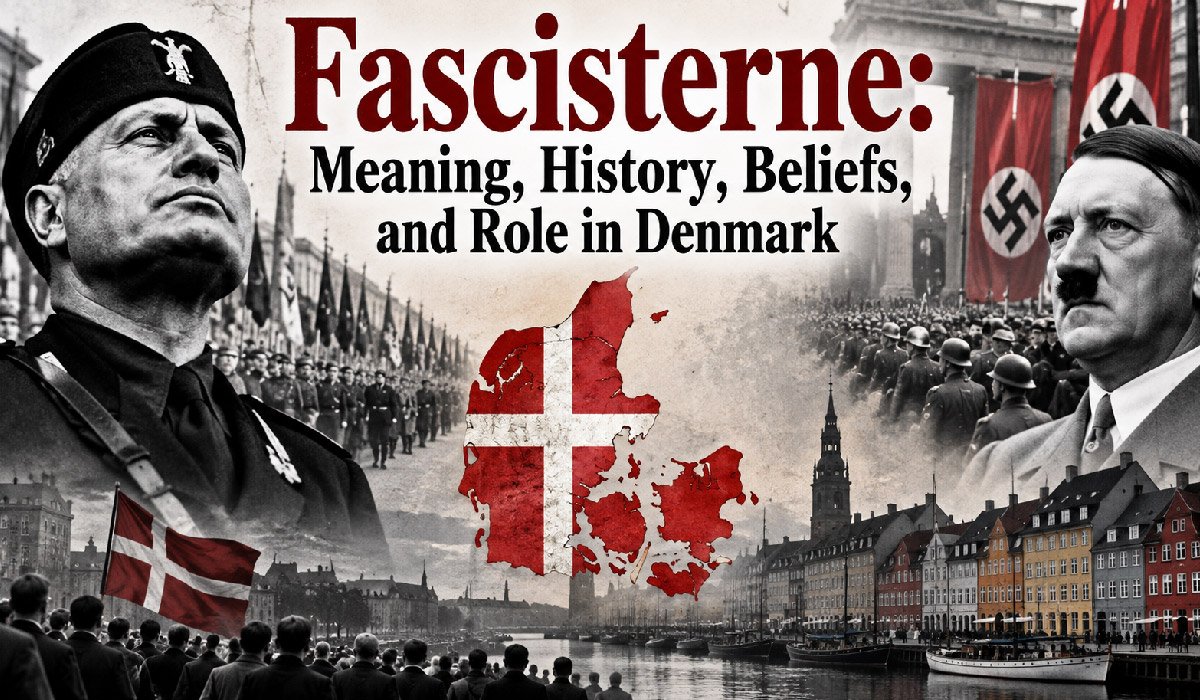
Fascisterne is a Danish word that means “the fascists” in English. It refers to people connected with fascism, a political ideology that became especially important in Europe during the first half of the twentieth century. The word may appear unfamiliar to people who do not speak Danish, but the history behind it is connected with major political changes, dictatorships, war, and the decline of democracy in several European countries.
Fascism became particularly associated with Benito Mussolini’s movement in Italy, while other authoritarian and ultranationalist movements developed elsewhere in Europe. Understanding Fascisterne therefore requires more than translating a single Danish word. It requires looking at the people, political beliefs, historical conditions, and events associated with fascist movements.
This article explains Fascisterne in clear and simple language, beginning with the meaning and origin of the word before examining the development of fascism in Europe. It also explores common characteristics associated with historical fascist movements, including extreme nationalism, authoritarian leadership, propaganda, political repression, and opposition to liberal democracy.
Special attention is given to Denmark, where the Danish National Socialist Workers’ Party, known as DNSAP, operated before and during the Second World War. Denmark’s experience under German occupation also provides important historical context for understanding the term. Finally, the article examines the consequences of fascist rule and explains why words such as Fascisterne and fascism continue to appear in historical writing and modern political discussions.
What Does Fascisterne Mean?
Fascisterne is the definite plural form of the Danish word “fascist.” The simplest English translation is “the fascists.” This grammatical detail is useful because Fascisterne describes people rather than the political ideology itself. In Danish, “fascisme” refers to fascism as an ideology, while a “fascist” is a person associated with or supportive of fascism. Fascisterne can therefore refer to a particular group of fascists being discussed.
The term is commonly encountered in Danish historical material, political writing, books, articles, and discussions about twentieth-century Europe. Someone searching for Fascisterne may simply be trying to translate the word, but understanding its full meaning depends on the context in which it appears. Historical use of the term normally carries a much more specific meaning than its casual use in an online political argument.
The deeper origin of fascist terminology is connected with the Latin word fasces, referring to a bundle of rods associated with authority in ancient Rome. Related terminology later became important in Italian political movements, and Benito Mussolini’s movement helped give modern fascism its name. As fascist movements gained influence in Europe, languages across the continent developed or adopted their own forms of words such as fascism and fascist.
Danish was no exception. Fascisterne should therefore not be understood as a separate Danish political ideology. It is a Danish language form used to describe fascists. Depending on the historical setting, those people might be members or supporters of an organized fascist movement, while in modern conversation the label is sometimes applied much more broadly. That difference makes context essential.
Where Did Fascism and the Fascisterne Come From?
Modern fascism emerged most clearly in Europe following the First World War. The war had caused enormous human and economic damage, and several countries experienced political instability, unemployment, social conflict, and fear about the future. Established political institutions faced strong criticism, while revolutionary socialism and communism also worried many conservatives, business owners, landowners, and members of the middle class
. Italy became the birthplace of the first major fascist movement. Benito Mussolini established the Fasci Italiani di Combattimento in 1919. His movement presented itself as a force for national renewal, political strength, discipline, and order. Mussolini and his supporters opposed liberal democratic politics and socialism, while using intense nationalism to attract people who believed Italy needed stronger and more decisive leadership.
Mussolini became prime minister of Italy in 1922 and gradually transformed the country’s political system into a dictatorship. Fascist ideas and political methods also influenced movements elsewhere in Europe during the 1920s and 1930s. Germany became the most destructive example after Adolf Hitler and the Nazi Party gained power in 1933. Nazism shared important features with fascism, such as ultranationalism, dictatorship, anti-communism, militarism, propaganda, and suppression of political opponents.
However, Nazism placed racial hierarchy and antisemitism at the center of its ideology to an especially extreme degree. Fascist or fascist-inspired organizations also existed in other European countries, although their beliefs, popularity, and political success differed considerably. It is therefore more accurate to understand historical fascism as a family of related movements rather than assume that every fascist organization was identical.
What Were the Main Characteristics of Fascism?
Although historical fascist movements differed, several characteristics appeared repeatedly. Extreme nationalism was among the most important. Fascists placed the nation above individual interests and promoted the idea that national unity required discipline and obedience. They generally rejected liberal democracy and political pluralism because competing parties and open political disagreement were viewed as sources of weakness or division.
Fascist systems favored centralized authority, often built around a powerful leader who claimed to embody the nation’s interests. Political opposition could be restricted or eliminated, while independent organizations and critical media could lose their freedom. Militarism, public displays of strength, mass rallies, uniforms, political symbols, and organized youth movements were also important to several historical fascist movements because they encouraged loyalty, discipline, and a shared political identity.
Propaganda and political mobilization were equally significant. Fascist governments and movements used speeches, newspapers, radio, posters, ceremonies, slogans, and public events to influence how people understood political and social problems. Political opponents and minority groups could be presented as threats to national unity, making it easier to justify discrimination or repression.
Violence was also important in several fascist movements. Mussolini’s Blackshirts attacked political opponents in Italy, while Nazi Germany developed a far more extensive system of persecution, imprisonment, terror, and mass murder. The Nazi regime’s racial ideology led to the Holocaust, in which approximately six million Jews were murdered, alongside the persecution and killing of millions of other victims. These historical realities show why fascism means much more than simply having a strong government or patriotic beliefs.
Fascisterne in Denmark and World War II
Denmark never developed a fascist government comparable to Mussolini’s Italy or Hitler’s Germany, but fascist and Nazi-inspired organizations did exist in the country. The best-known was Danmarks Nationalsocialistiske Arbejderparti, commonly abbreviated as DNSAP. The party was inspired by German National Socialism and was eventually led by Frits Clausen.
It attempted to build political support during the 1930s and adopted ideas and organizational features associated with Nazi Germany. However, DNSAP never gained enough electoral support to take control of the Danish government. This distinction is important when discussing Fascisterne in Danish history. The existence of Danish fascists and National Socialists does not mean that the Danish population as a whole embraced fascism. Democratic parties and institutions retained much broader support, even as political extremism developed elsewhere in Europe.
Denmark’s situation changed dramatically when Nazi Germany invaded the country on 9 April 1940. German occupation continued until May 1945 and created difficult political and moral choices for Danish society. Some Danes collaborated with the occupying power, while others eventually became involved in resistance activities. Danish resistance groups conducted sabotage, distributed illegal publications, collected intelligence, and opposed German control in different ways.
One of the best-known episodes occurred in 1943, when most Danish Jews escaped to neutral Sweden with help from fellow citizens and resistance networks after plans for their arrest became known. The occupation period gave fascism and Nazism an immediate human meaning for people living in Denmark. Fascisterne could no longer be understood only as supporters of a distant political movement; the wider conflict had reached Danish society directly.
The German occupation ended in May 1945 as Nazi Germany collapsed. Denmark then faced the difficult task of dealing with the legacy of occupation and collaboration. People accused of serious collaboration were investigated and, in many cases, prosecuted under the postwar legal process. Fascist and Nazi political organizations lost the limited influence they had held, while the occupation and resistance became lasting subjects of Danish historical memory.
Museums, archives, academic studies, personal accounts, and educational material continue to examine the choices people made during those years. This history is one reason Fascisterne has particular significance when encountered in Danish sources. The word can connect a reader not only to the broader history of European fascism but also to Denmark’s experience of occupation, collaboration, resistance, persecution, liberation, and postwar reckoning.
What Did Fascisterne Believe, and What Were the Consequences?
Historical fascists generally believed that a strong and unified nation should take priority over individual political freedoms. Liberal democracy, competitive political parties, and independent institutions were often portrayed as barriers to national strength. Fascist movements instead favored centralized leadership and expected citizens to show loyalty to the nation, state, movement, or leader.
Many also promoted militarism and presented struggle, sacrifice, and discipline as positive national values. Fascism was strongly anti-communist, although its economic ideas differed between countries and periods. It is also important not to treat every fascist movement as identical. Italian Fascism and German Nazism shared major authoritarian and ultranationalist features, but Nazi ideology made racial hierarchy, antisemitism, and supposed biological differences between peoples especially central to its worldview and policies.
The consequences became catastrophic when fascist and Nazi governments obtained enough power to destroy democratic restraints and pursue aggressive policies. Political opponents could be censored, imprisoned, attacked, or killed, while independent media and organizations were brought under state control. Nazi Germany took persecution to an unprecedented level through systematic racial policies, concentration camps, mass shootings, deportations, and genocide.
Fascist and Nazi expansionism also contributed directly to the enormous destruction of the Second World War. Millions of soldiers and civilians died, communities were destroyed, populations were displaced, and much of Europe was left physically and economically devastated. The Holocaust remains one of the most horrific consequences of Nazi rule, demonstrating what can happen when racial hatred, authoritarian power, dehumanization, bureaucracy, and state violence operate together without meaningful legal or democratic restraint.
The defeat of Nazi Germany and its allies in 1945 ended the major European fascist regimes of that period, but their impact did not disappear. The aftermath included war-crimes trials and renewed international attention to human rights, genocide, political freedom, and the protection of civilians. European societies also had to confront collaboration, resistance, responsibility, and the experiences of victims. Fascism consequently became an important field of historical and political research.
Scholars continue to study why people supported these movements, how democratic systems were weakened, how propaganda shaped public opinion, and how governments turned prejudice into organized persecution. Studying Fascisterne is therefore not simply about memorizing political labels or famous leaders. It provides a way to examine how political institutions, social pressures, ideology, fear, violence, and individual choices can interact during periods of severe instability.
What Does Fascisterne Mean Today?
Today, Fascisterne remains primarily a Danish term for “the fascists,” and it continues to appear in historical research, education, journalism, books, documentaries, and discussions about twentieth-century politics. When historians use terms such as fascist or fascism, they generally examine a combination of characteristics rather than applying the label because a political leader is merely unpopular or authoritarian.
Relevant characteristics can include ultranationalism, hostility toward liberal democracy and pluralism, leader-centered politics, mass mobilization, political violence, suppression of opposition, militarism, and ideas about national rebirth. The precise definition of fascism remains a subject of scholarly discussion, so context and evidence are important. A movement can possess one authoritarian characteristic without necessarily fitting every historical or academic definition of fascism.
The situation becomes more complicated in everyday political debate, where “fascist” is sometimes used as a general insult. Calling every strict government, disliked politician, nationalist movement, or political opponent fascist can make the term less precise and obscure important historical differences. Fascism has a specific twentieth-century history involving movements that challenged democratic pluralism and, once in power, often used repression and violence to reshape society.
For this reason, understanding Fascisterne involves both knowing its literal Danish translation and recognizing the historical weight carried by the word. Careful use does not prevent comparisons between historical and modern political movements. Instead, it encourages those comparisons to be based on evidence, ideology, institutions, political behavior, and treatment of opposition rather than on anger or disagreement alone.
Conclusion
Fascisterne means “the fascists” in Danish, but the history connected with the word reaches far beyond its simple translation. Modern fascism emerged most prominently in Italy after the First World War and developed around ultranationalism, authoritarian leadership, rejection of liberal democratic pluralism, political mobilization, and the pursuit of national unity.
Related movements spread to other parts of Europe, with Nazi Germany becoming the most destructive example. The Nazi regime combined authoritarian and ultranationalist politics with extreme racial ideology and antisemitism, leading to systematic persecution and the Holocaust. Understanding these differences and similarities is essential because terms such as fascism and Nazism describe related historical phenomena but should not automatically be treated as completely interchangeable.
For Denmark, Fascisterne also connects with a distinct national history. DNSAP represented Danish National Socialism but never achieved enough popular support to establish a fascist government. Nazi Germany’s occupation of Denmark from 1940 to 1945 nevertheless brought the consequences of dictatorship, war, collaboration, resistance, and persecution directly into Danish life.
Today, Fascisterne continues to appear in both historical and political discussions. Knowing what the word means, where fascism came from, what historical fascists believed, and what followed when fascist and Nazi regimes obtained power makes the term easier to use accurately. Its history also demonstrates why careful definitions and reliable historical evidence matter whenever powerful political labels are applied to either the past or the present.
(FAQs)
What does Fascisterne mean?
Fascisterne is a Danish word meaning “the fascists” in English. It refers to a specific group of people associated with fascist beliefs, organizations, or political movements.
Where did fascism originate?
Modern fascism emerged most prominently in Italy after World War I. Benito Mussolini founded the Fasci Italiani di Combattimento in 1919 and later established a fascist dictatorship.
Were there Fascisterne in Denmark?
Yes. Denmark had fascist and Nazi-inspired groups, including Danmarks Nationalsocialistiske Arbejderparti (DNSAP). However, the party never gained enough electoral support to take control of the Danish government.
Are fascism and Nazism the same?
No. They are closely related but not identical. Nazism shared many characteristics with fascism, including authoritarianism and extreme nationalism, but placed an especially strong emphasis on racial hierarchy and antisemitism.
What does Fascisterne mean today?
Today, Fascisterne is still used in Danish to mean “the fascists.” It appears in historical writing and modern political discussions, although the term should be used carefully and with appropriate historical context.
Read Next: Thinklymagazine
