


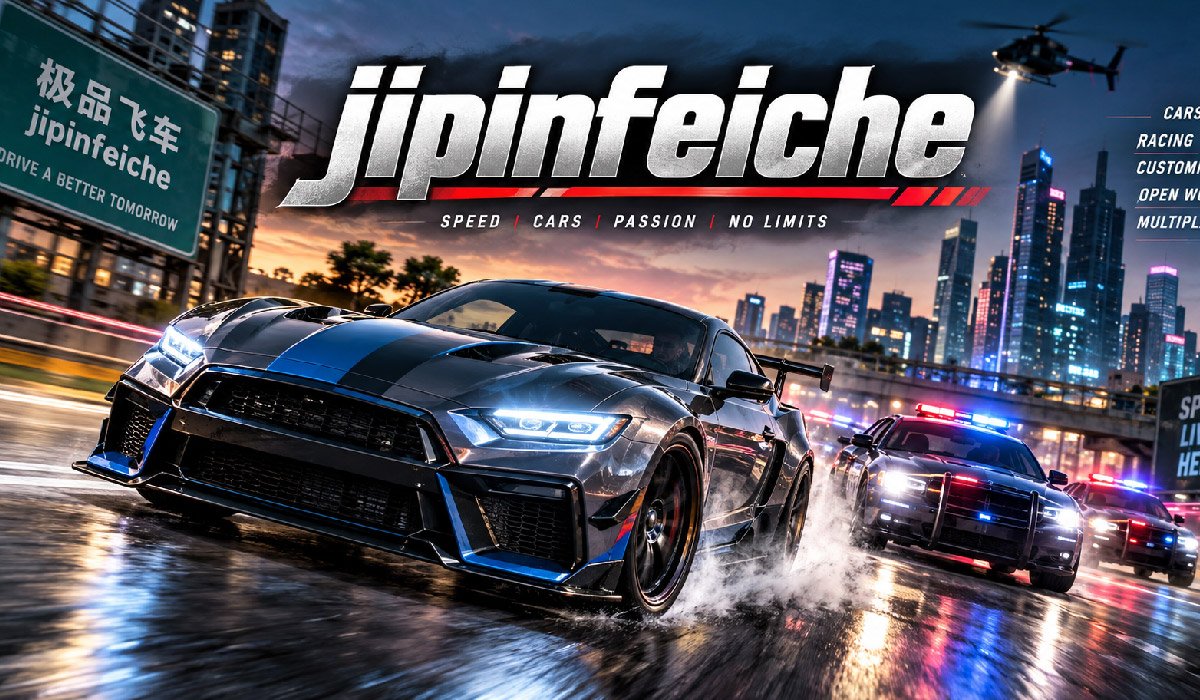
jipinfeiche is a term that people often discover when searching online for racing games, fast cars, mobile racing titles, or the Need for Speed series. At first, the unusual spelling can make it look like the name of an independent game, company, or new gaming platform. Its established gaming use, however, has a much clearer explanation.
The term comes from the Simplified Chinese name 极品飞车, associated with Electronic Arts’ Need for Speed franchise. Its pinyin is Jípǐn Fēichē, and when the spaces and tone marks are removed, it becomes jipinfeiche. This connection explains why searches for the term often lead to Need for Speed games, cars, racing videos, guides, and Chinese gaming pages.
Understanding this distinction is useful because Need for Speed is not one game. It is a long-running racing franchise containing many releases with different cars, maps, racing modes, customization systems, police pursuits, and multiplayer features. This guide explains the meaning, history, gameplay, major titles, mobile games, customization, platforms, downloads, and common misunderstandings surrounding jipinfeiche.
What Is jipinfeiche?
jipinfeiche is the Latin-letter form commonly associated with the Simplified Chinese title 极品飞车. In gaming contexts, this title is used for the Need for Speed franchise. Therefore, someone searching for jipinfeiche is normally looking for Need for Speed information rather than a completely different racing series.
The proper pinyin form is Jípǐn Fēichē. Pinyin is a system used to represent the pronunciation of Mandarin Chinese with Latin letters. Online searches often remove spaces and tone marks, producing the simpler spelling “Jipinfeiche.” This explains why the word can appear unfamiliar to English-speaking gamers even though the games themselves may be very familiar.
It is also important to understand that jipinfeiche does not identify one universal Need for Speed release. Depending on the context, it can refer to the overall franchise or appear alongside the Chinese title of an individual game. Players should therefore check the complete title, release year, and platform whenever they are searching for a particular version.
What Does jipinfeiche Mean in English?
The Chinese expression behind jipinfeiche can be understood by examining its two main parts. 极品 (jípǐn) can describe something excellent, exceptional, premium, or top-grade. 飞车 (fēichē) relates to a fast-moving or speeding vehicle. Together, these words create a name that fits a racing franchise built around speed and powerful cars.
Literal explanations such as “ultimate speed car,” “top-quality racing car,” or similar phrases sometimes appear online. These translations can help English readers understand the general idea behind the Chinese words, but they should not be confused with the official English name. Translating individual Chinese characters does not automatically produce an official product title.
The recognized English franchise name is Need for Speed. For this reason, a person who encounters jipinfeiche on a Chinese gaming page should understand it in relation to Need for Speed rather than search for an English game officially called “Ultimate Speed Car.” Knowing this difference between romanization, rough translation, and localization prevents considerable confusion.
jipinfeiche and Need for Speed
The connection between jipinfeiche and Need for Speed becomes easier to understand when localization is considered. Large video game franchises are often marketed using translated or localized names in different regions. The words displayed to players can therefore look completely different even when they refer to games belonging to the same international franchise.
In Simplified Chinese, Need for Speed is associated with 极品飞车. Traditional Chinese markets can use 極速快感, while English-speaking markets know the franchise as Need for Speed. These titles should not automatically be interpreted as three separate racing franchises simply because their written forms differ. They reflect regional naming and localization practices.
This distinction is especially important when reading game guides, watching videos, or searching Chinese websites. A page containing 极品飞车 may discuss a game already known internationally under a Need for Speed title. Likewise, searching jipinfeiche can return information about different entries in the series. The complete game name is therefore more useful than the romanized keyword alone when looking for specific cars, platforms, features, or gameplay instructions.
History of jipinfeiche and Need for Speed
The Need for Speed franchise began in 1994 with The Need for Speed. Electronic Arts published the series, while different development teams have worked on individual releases throughout its long history. The early games helped establish an identity centered on desirable performance cars, high-speed driving, and accessible racing rather than extremely demanding motorsport simulation.
As the franchise developed, its direction changed considerably. Later games introduced street-racing culture, vehicle tuning, visual customization, open-world environments, police pursuits, story elements, online multiplayer, drifting, and increasingly detailed vehicle collections. Different releases emphasized different features, which is why the experience can vary greatly from one Need for Speed title to another.
The jipinfeiche name became part of the franchise’s identity for Simplified Chinese audiences. Over time, generations of players encountered different Need for Speed games under this localized naming system. The continued popularity of older releases alongside modern titles also means that searches for the term can lead to games from very different periods of the franchise’s history.
Popular jipinfeiche Games
Many well-known Need for Speed releases can fall under searches related to jipinfeiche. Need for Speed: Underground became closely associated with street racing and vehicle modification, while Underground 2 expanded the experience with open-world exploration and deeper customization. Most Wanted became particularly memorable for combining street racing with intense police pursuits and progression through increasingly difficult opponents.
Other notable releases include Carbon, Hot Pursuit, Rivals, Payback, Heat, and Unbound. Each offers a different interpretation of the Need for Speed formula. Hot Pursuit places major emphasis on competition between racers and police, while Heat combines street racing, customization, open-world driving, and a day-and-night structure with different activities and levels of risk.
Need for Speed Unbound, released in 2022, introduced a distinctive presentation combining realistic vehicles with animated visual effects. These examples demonstrate why jipinfeiche cannot describe one fixed gameplay experience. Someone comparing cars, maps, multiplayer features, or tuning systems must first identify the exact Need for Speed release because features differ significantly between games.
jipinfeiche Online and Chinese Racing Releases
Some searches for jipinfeiche lead specifically to 极品飞车 ONLINE, which can create another layer of confusion. This was a particular online racing title rather than another meaning for the entire term. It was associated with Need for Speed and offered a multiplayer-oriented experience for the Chinese market, with Tencent involved in its operation in China.
The game included elements familiar to racing fans, such as licensed vehicles, car collection, upgrades, matchmaking, and competition against other players. Its online structure made multiplayer an important part of the experience. Players could develop their vehicle collections and participate in races rather than treating the product like a traditional standalone Need for Speed campaign.
The important point is that 极品飞车 ONLINE and jipinfeiche are not interchangeable definitions. The first identifies a particular online game, while the broader Chinese name can be associated with the Need for Speed franchise. Readers researching an older Chinese PC release should therefore check whether the information specifically refers to ONLINE rather than assuming that every result describes the same game.
jipinfeiche Mobile Games
Mobile gaming is another area where jipinfeiche searches can produce different results. Need for Speed has appeared on mobile devices in multiple forms, and some releases have been designed specifically around mobile hardware and audiences. These games should be identified by their complete titles because they do not represent the entire franchise.
One notable Chinese-market title is 极品飞车:集结. It has been associated with Need for Speed mobile gaming and was developed by TiMi Studio Group with EA authorization. Its experience includes licensed vehicles, open-world driving, multiplayer competition, car collection, mobile-focused controls, and activities designed for a large explorable environment.
Mobile availability can depend on country, operating system, device compatibility, and regional publishing arrangements. A game available through an official Chinese platform may not necessarily have the same name, release schedule, or availability elsewhere. Players searching for a jipinfeiche mobile download should therefore verify the exact game, publisher, supported device, and official store before installing anything, particularly when third-party APK websites appear in search results.
How jipinfeiche Gameplay Works
There is no single gameplay system shared identically by every jipinfeiche or Need for Speed release. The franchise has changed repeatedly, but most entries are generally associated with arcade-style racing. This approach prioritizes exciting speed, responsive controls, and accessible driving instead of attempting to reproduce every detail of real-world vehicle physics.
Basic racing skills still matter. Players need to understand acceleration, braking, steering, corner entry, corner exits, overtaking, and route selection. Simply holding the accelerator is rarely the fastest strategy on a difficult road. Braking before a sharp corner and accelerating smoothly while exiting can preserve momentum and reduce crashes, often producing better results than relying only on raw vehicle power.
Individual titles can add drifting, nitrous boosts, off-road sections, pursuit mechanics, special equipment, or open-world activities. Handling can also differ substantially between releases. For that reason, a tuning setup or driving technique recommended for one jipinfeiche title should not automatically be applied to another. Good guides should always identify the exact Need for Speed game being discussed.
Cars in jipinfeiche Games
Cars are central to the jipinfeiche experience, but vehicle lists vary between releases. Need for Speed games have featured Japanese tuner cars, American muscle cars, European performance models, luxury vehicles, exotic sports cars, and high-end supercars. Licensing agreements and game design decisions determine which manufacturers and individual models appear in each title.
Choosing a vehicle involves more than comparing maximum speed. Acceleration determines how quickly a car gains speed, while handling affects its behavior through corners. Braking, grip, weight, drivetrain characteristics, and upgrade potential can also influence performance. A powerful vehicle that struggles through technical corners may lose to a slower but more controllable car on the right route.
Consequently, there is no universal “best jipinfeiche car.” The strongest choice depends on the exact game, race type, road layout, available upgrades, and player technique. Beginners often benefit from a predictable vehicle that is easy to control, while experienced racers may prefer cars requiring more precise inputs but offering greater performance when driven correctly.
Car Customization and Performance Upgrades
Customization has become one of the most recognizable features of many jipinfeiche games. Depending on the release, players can modify paint, wraps, decals, wheels, spoilers, bumpers, body kits, and other exterior components. These options allow the same basic vehicle model to look very different when customized by individual players.
Performance modification serves a different purpose. Engine-related upgrades may improve power or acceleration, while tires, brakes, suspension, and handling components can affect how effectively that performance is used. Maximum horsepower is therefore not the only consideration. A very powerful car can become difficult to drive efficiently when its braking, grip, or handling cannot match its increased speed.
Balanced upgrades are particularly useful for new players. Instead of spending every resource on engine power, it can be better to improve the areas that match the event and driving style. Customization systems vary considerably across Need for Speed releases, so players should consult information created for their exact jipinfeiche game before following a detailed build or tuning recommendation.
Racing Modes and Challenges in jipinfeiche
The Need for Speed franchise has used many event types, giving jipinfeiche players different challenges beyond standard races. Common formats include circuits, sprints, drift events, drag races, time-based challenges, elimination events, and speed activities. However, not every mode appears in every title, and individual games can introduce their own event rules.
Circuit events usually involve completing multiple laps around a defined route, while sprint races typically run from one location to another. Drift challenges reward controlled sliding and scoring rather than simply reaching the finish line first. Drag events emphasize acceleration and timing, while time challenges require players to complete a route within a specified period.
Different events can make different vehicle characteristics more valuable. Tight roads with frequent corners often reward grip, braking, and controllable handling. Long straights can make acceleration and top speed more important. Understanding the event is therefore an important part of jipinfeiche progression. Choosing the appropriate vehicle and setup can be just as important as improving driving skill.
Police Chases and Open-World Driving
Police pursuits are among the most recognizable features associated with jipinfeiche and Need for Speed. Games such as Most Wanted, Hot Pursuit, Rivals, Heat, and Unbound use police action in different ways. Some make escaping law enforcement an important part of progression, while others build entire game modes around racers competing against police units.
Successful pursuits require more than maximum speed. Players may need to control their vehicle through traffic, recognize roadblocks, select useful escape routes, avoid unnecessary crashes, and decide when taking additional risks is no longer worthwhile. Pursuit mechanics vary between games, so strategies that are highly effective in one title may be less useful in another.
Open-world environments further expand the racing experience in many releases. Instead of selecting every activity from a simple menu, players can explore cities, highways, industrial districts, mountain roads, countryside, and other areas. Free driving lets jipinfeiche players learn routes, discover shortcuts, test upgrades, practice handling, locate activities, and become familiar with the environment before entering competitive events.
Online Multiplayer, Cross-Play, and Community
Online multiplayer has become an important part of modern jipinfeiche games. Depending on the title, players can race against friends or other people, participate in events, explore shared environments, and display customized vehicles. Human opponents also create less predictable races because their decisions and driving styles differ from computer-controlled competitors.
Some Need for Speed releases support cross-play, allowing people on different supported platforms to compete together. Cross-play should not be confused with cross-progression. Cross-progression means carrying saved progress, vehicles, or other content from one platform to another, and its availability depends on the particular game. Players should check both features separately before purchasing multiple versions.
The wider community also contributes to the franchise’s longevity. Players share car builds, tuning suggestions, race strategies, gameplay videos, speedruns, customization designs, and comparisons between releases. Older jipinfeiche games continue generating discussion because many fans revisit their favorite maps, vehicles, soundtracks, pursuits, and racing systems years after the original release.
jipinfeiche Platforms, Price, and Requirements
There is no single platform requirement or price for jipinfeiche because Need for Speed includes many different games. Across its history, the franchise has appeared on Windows PCs, PlayStation consoles, Xbox systems, Nintendo hardware, Android devices, iPhones, and other platforms. Individual releases support only specific systems, so compatibility must always be checked by game title.
PC requirements vary especially widely. An older Need for Speed release can run on hardware very different from that required by a modern game such as Unbound. Before buying, PC users should check the supported operating system, processor, graphics card, RAM, available storage, and other requirements listed for that exact release.
Pricing also differs. Many PC and console titles are sold as paid games, while certain releases may become available through gaming subscriptions or promotional offers. Some mobile and online games use free-to-play models supported by optional purchases. Therefore, searches such as “jipinfeiche free” need a specific game name before a reliable answer can be given.
How to Download jipinfeiche Safely
Anyone trying to download jipinfeiche should first determine which Need for Speed game they actually want. There is no single installation package containing everything represented by the term. Search results may point to modern PC games, older console releases, Chinese online titles, mobile games, downloadable content, or unofficial files using similar names.
Once the correct game has been identified, the safest approach is to use the official publisher or a legitimate platform store. Check the complete game title, edition, supported platform, regional availability, language options, system requirements, storage requirements, and account conditions. Also confirm whether a listing contains the base game, an expansion, downloadable content, or an upgrade.
Extra caution is needed with unknown websites offering cracked installers, unofficial APKs, modified executables, cheats, or unusually small download files. Such files can carry security risks or may not contain the advertised game. Official availability for older jipinfeiche titles can change, so a game disappearing from a digital store does not make an unofficial download trustworthy.
Common Misunderstandings About jipinfeiche
The unusual spelling of jipinfeiche has created several misunderstandings online. The most important is the belief that it represents an entirely separate racing franchise. In its established gaming context, the term comes from the romanization of 极品飞车, which is associated with Need for Speed in Simplified Chinese. It should therefore not normally be presented as an unrelated competitor to Need for Speed.
Another mistake is treating jipinfeiche as one specific game. Need for Speed contains numerous individual releases, and Chinese gaming searches can also surface specific online and mobile titles. Information about one game’s cars, map, price, or system requirements should not be generalized to every other release in the franchise.
Some online content also describes jipinfeiche as an ancient philosophy, productivity technique, lifestyle method, or cultural principle. There is no comparable established basis for treating these descriptions as its recognized meaning. Likewise, it is not the name of a major car manufacturer. Its strong association with vehicles comes from the Need for Speed racing franchise.
Is jipinfeiche Worth Playing Today?
jipinfeiche remains relevant for players who enjoy accessible arcade racing, licensed vehicles, customization, street-racing environments, police pursuits, and competitive driving. However, choosing the right Need for Speed release is more important than simply choosing the newest one because different games emphasize different aspects of racing.
Older titles can remain attractive because of their distinctive maps, soundtracks, car selections, customization, pursuit systems, and driving styles. Games such as Underground, Most Wanted, and Carbon developed strong identities that continue to attract longtime fans. Modern releases can provide newer graphics, contemporary vehicles, updated customization, larger environments, and online functionality designed for newer hardware.
Players interested primarily in multiplayer should check the current service status for the exact game before purchasing it. A title can remain playable offline even after parts of its online ecosystem change. Overall, the long history of jipinfeiche gives racing fans many choices rather than forcing everyone into a single style of Need for Speed experience.
Final Thoughts
jipinfeiche is best understood as the Latin-letter form associated with 极品飞车, the Simplified Chinese name used in connection with Electronic Arts’ Need for Speed franchise. The proper pinyin Jípǐn Fēichē explains where the spelling comes from, while Need for Speed remains the familiar English franchise name. It is not necessary to invent a separate philosophy, car brand, or unrelated racing series to explain the term.
The most important point for players is that jipinfeiche does not represent one universal game. Need for Speed has developed across decades, producing releases with different vehicles, maps, customization systems, race formats, police mechanics, multiplayer features, platforms, and hardware requirements. Chinese-market online and mobile releases add further variety.
Whenever you encounter the term, identify the complete game title before searching for downloads, prices, car lists, tuning advice, multiplayer support, or system requirements. That simple step makes it much easier to find accurate information and understand why jipinfeiche remains closely connected with one of gaming’s longest-running racing franchises.
(FAQs)
What does jipinfeiche mean?
jipinfeiche is the romanized form associated with the Simplified Chinese name 极品飞车. The words suggest ideas related to excellence and fast vehicles, but literal English translations should not be treated as the official title. In gaming, the established English franchise name is Need for Speed.
Is jipinfeiche the same as Need for Speed?
Yes, in its established gaming use, jipinfeiche is connected with the Simplified Chinese title used for the Need for Speed franchise. It is not normally a separate racing franchise. Individual Need for Speed games can still have their own Chinese titles and additional wording.
Is jipinfeiche one game?
No. The term can refer broadly to Need for Speed rather than one particular release. The franchise includes games such as Underground, Most Wanted, Hot Pursuit, Heat, and Unbound, as well as particular online and mobile releases for different markets.
Can I play jipinfeiche on PC?
Yes. Many Need for Speed titles have PC versions, but compatibility depends on the individual game. Before purchasing or downloading one, check its operating-system support, processor, graphics card, RAM, storage requirements, online requirements, and official availability.
Is jipinfeiche available on mobile?
Need for Speed has had multiple mobile games, including releases intended for particular regional markets. Availability depends on the game, country, operating system, and supported device. Players should use official app stores or publisher sources rather than unknown APK download websites.
Is jipinfeiche free?
There is no universal price. Many Need for Speed PC and console games are paid products, while certain mobile or online releases can follow a free-to-play model with optional purchases. Always check the exact title and store listing before downloading or paying.
Is jipinfeiche a Chinese philosophy?
There is no reliable basis for treating jipinfeiche as an established ancient Chinese philosophy or recognized productivity method. Its clearly documented context is gaming, where the spelling is connected with 极品飞车 and the Need for Speed racing franchise.
