


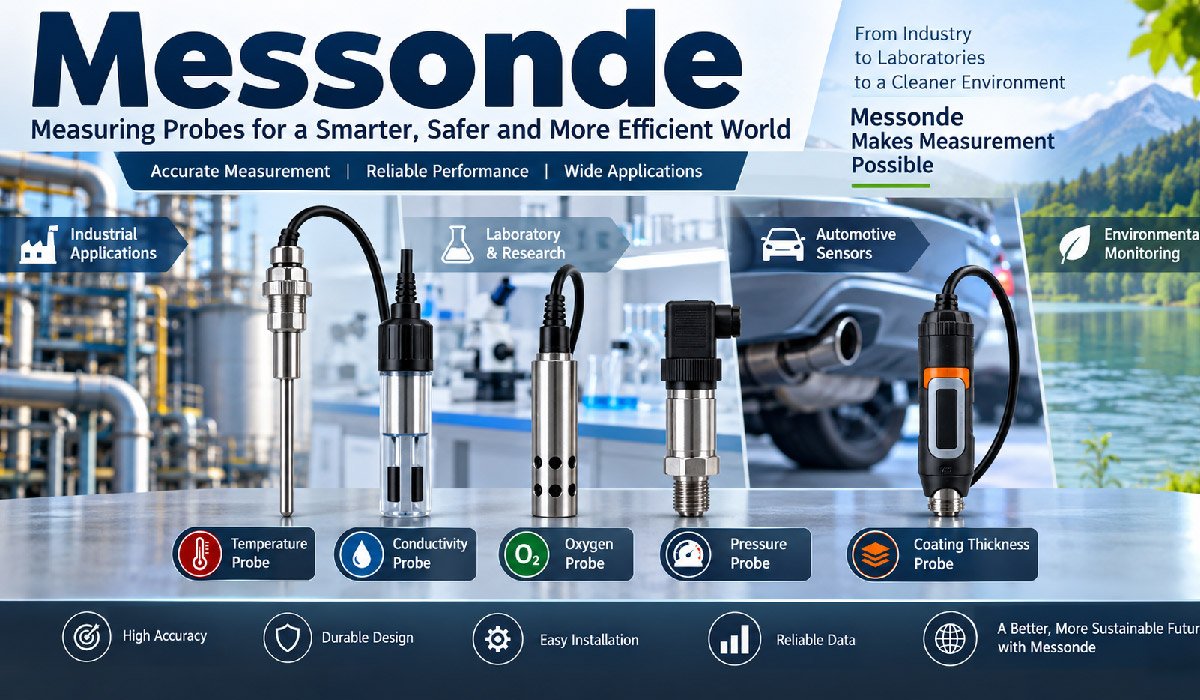
Messonde is an unusual term that can appear in technical searches, translated documents, product descriptions, engineering materials, and online articles. Its meaning can be confusing because Messonde is not a common English technical word with one fixed definition. In many technical contexts, it is closely connected with the German word Messsonde, which generally refers to a measuring probe or sensing device.
A measuring probe detects a physical or chemical condition and provides information that another device can process. Depending on its design, it may measure temperature, oxygen, conductivity, pressure, liquid level, humidity, gas concentration, or another measurable value.
Understanding Messonde therefore requires context. Instead of assuming that every use of the term describes the same product, readers should examine the equipment, measurement type, language, and specifications around it. This guide explains the meaning, working process, applications, accuracy, calibration, installation, maintenance, and selection of measuring probes in detail.
What Is Messonde?
Messonde is best understood as a term associated with a measuring probe when it appears in engineering, laboratory, scientific, or industrial material. A measuring probe is a device or component designed to detect a particular property in the environment, material, liquid, gas, or object being examined. It normally works as part of a larger measurement system.
The probe contains or connects with a sensing element. This element reacts when the condition being measured changes. A temperature probe, for example, responds to changes in heat, while a conductivity probe responds to electrical properties in a liquid.
The information collected by the probe is then transferred to another device. A meter, controller, computer, monitoring unit, or other electronic system can process the signal and convert it into a useful reading. For this reason, Messonde should not automatically be understood as one particular instrument. Its exact purpose depends on the measurement application.
Messonde Meaning and Connection With Messsonde
The meaning of Messonde becomes clearer when its possible German connection is considered. The established German technical word Messsonde combines measurement-related wording with Sonde, meaning a probe. In English technical material, translations can include measuring probe, measurement probe, test probe, sensor probe, or sometimes measuring sensor.
These translations are related, but they are not always completely interchangeable. The most suitable English term depends on the construction of the equipment and how it is being used. A probe placed inside a liquid may be described differently from a sensing component built permanently into industrial machinery.
The spelling also matters when searching for technical information. Messonde may occur in online searches, translated text, copied descriptions, or material where the original spelling has changed. If information under Messonde is unclear, searching for Messsonde together with the property being measured can make it easier to identify the correct equipment and technical documentation.
Why the Meaning of Messonde Can Be Confusing
Messonde can create confusion because the word by itself does not explain what is being measured. Measuring probes exist for many different applications, and their construction can vary greatly. A small food temperature probe and an industrial oxygen probe may both belong to the wider category of measurement devices, but they cannot perform the same task.
Another source of confusion is language. Technical terminology often changes slightly when product descriptions, manuals, catalogs, and engineering documents are translated. Search queries may also contain altered spellings, causing several forms of the same technical term to circulate online.
The surrounding information is therefore more useful than the word alone. Measurement units, operating range, probe material, connector type, equipment name, and application can all provide clues. If the surrounding material discusses degrees of temperature, for example, Messonde probably relates to temperature measurement. Conductivity, oxygen, pressure, and other specifications point toward different probe technologies.
How Does a Messonde Measuring Probe Work?
A Messonde measuring probe begins with a sensing element designed to respond to a particular condition. When that condition changes, the sensing element produces a corresponding response. The exact process depends on the technology. Different probes can respond to heat, pressure, electrical conductivity, oxygen concentration, humidity, or other physical and chemical properties.
The response then needs to become useful information. Depending on the system, the probe may produce an electrical, optical, analog, or digital signal. Connected electronics process this signal and convert it into a value that an operator or automated system can understand.
The final result can appear in several forms. A handheld meter may display a number, while industrial equipment may send measurements directly to a control system. Modern monitoring software can also record values over time and display trends. Automated systems may use probe readings to activate alarms or adjust machinery when measured conditions move outside an acceptable range.
Main Components of a Measuring Probe
Although measuring probes differ according to their purpose, many contain several basic components. The most important is the sensing element, because this is the part responsible for responding to the property being measured. The sensing technology must match the target measurement, which is why one universal probe cannot accurately measure every possible condition.
The sensing element may be protected by a probe body, housing, membrane, coating, or other material. Protection is especially important in industrial settings where sensors can face heat, pressure, chemicals, moisture, vibration, dust, or physical contact. Some designs must balance protection with fast exposure to the material being tested.
Cables and connectors transfer information from the Messonde to the connected equipment. Some probes also contain electronics for signal conditioning or digital communication. The receiving instrument may provide power, process the signal, display measurements, store records, or communicate the information to a larger automation or monitoring system.
Common Types of Messonde Measuring Probes
Messonde technology can cover many forms of measurement because probes are built for different physical and chemical properties. Temperature probes measure heat and are common in food preparation, laboratories, heating equipment, manufacturing, tanks, pipes, and machinery. Conductivity probes examine how effectively a liquid conducts electrical current and are often associated with water and solution testing.
Oxygen probes are designed for oxygen measurements in suitable gases or liquids. Level probes can help determine the amount or position of material inside a tank or container. Other sensing equipment can be designed around pressure, humidity, gas concentration, distance, flow, or related process conditions.
Specialized probes also support material inspection. Certain systems can examine coating or layer thickness without relying on visual judgment alone. Each measurement requires suitable sensing technology. As a result, users should never select a Messonde simply because it is described as a probe. Its measurement range, technology, environment, and compatibility must match the intended application.
Temperature Measurement With Messonde
Temperature is one of the most common properties measured with probe technology. A temperature Messonde can be designed for everyday, laboratory, commercial, or industrial applications. In food preparation, a probe may be inserted into food to measure internal temperature rather than simply measuring the temperature of the surrounding air or cooking surface.
Industrial temperature probes can operate in ovens, pipes, tanks, heating systems, production machinery, and processing equipment. Their designs vary because operating conditions can be very different. Equipment intended for moderate temperatures may not survive inside a high-temperature industrial process.
Correct placement also affects measurement quality. The sensing area needs sufficient contact with the environment or material whose temperature is being measured. Response time is another consideration because some applications require changes to be detected quickly. Measurement range, accuracy, construction material, dimensions, and environmental protection should therefore be considered before choosing a temperature measuring probe.
Water, Conductivity, and Liquid Measurement
Liquid testing is another important area for Messonde measuring technology. Conductivity probes can determine how effectively a liquid carries an electrical current. Conductivity is influenced by dissolved ions, making this type of measurement useful in applications involving water quality, industrial liquids, laboratory solutions, water treatment, environmental testing, and similar systems.
Some liquid-testing systems measure more than one property. Temperature is particularly important because it can influence conductivity measurements. Appropriate equipment may therefore use temperature information when interpreting or compensating conductivity readings. Other probes can measure properties such as dissolved oxygen depending on the sensing technology.
Liquid probes require appropriate maintenance because their sensing surfaces can come into direct contact with the sample. Minerals, chemical residue, biological material, or other deposits may gradually collect on exposed surfaces. Contamination can alter sensor response and reduce measurement reliability. Cleaning methods must match the specific probe because sensitive membranes, electrodes, coatings, and other sensing surfaces can be damaged by unsuitable cleaning techniques.
Oxygen and Gas Measurement
Oxygen measurement demonstrates why identifying the exact type of Messonde is important. Oxygen can be measured in gases as well as liquids, but the same probe design is not automatically suitable for both situations. Different environments can require different sensing methods, protective materials, operating ranges, and calibration procedures.
In automotive applications, oxygen sensing can help monitor exhaust conditions. Measurements can provide information used by engine-management systems when controlling combustion and emissions. Industrial gas measurement can serve different purposes, including process monitoring and environmental or safety-related measurement, depending on the equipment.
Dissolved oxygen measurement involves oxygen present in a liquid rather than oxygen concentration in an exhaust or surrounding gas. Suitable probes may use electrochemical, optical, or other sensing approaches. Temperature, contamination, pressure, flow conditions, and probe condition can affect some measurement systems. Users should therefore choose equipment according to the actual gas or liquid, measurement range, environmental conditions, and manufacturer specifications.
Industrial Uses of Messonde
Industrial facilities depend heavily on measurement because production processes need controlled conditions. A Messonde can be positioned in a tank, pipe, vessel, machine, oven, duct, or production system to collect information about an important process variable. Depending on the application, this could include temperature, level, gas concentration, conductivity, pressure, or another measurable condition.
Continuous measurement allows control equipment to respond to changes while production is operating. If a reading moves outside a defined range, the system may alert an operator or use the information as part of an automated control process. Reliable measurements can support consistent production, equipment monitoring, process efficiency, and quality control.
Industrial conditions can also be demanding. High heat, moisture, dust, chemicals, pressure, vibration, and material deposits may affect probe performance or shorten service life. For this reason, industrial probe selection includes both measurement requirements and environmental compatibility. Housing material, protection, connections, operating limits, and maintenance requirements all need careful consideration.
Automotive and Exhaust Applications
Modern vehicles use numerous sensing systems to monitor changing operating conditions. Measuring probes can form part of this wider network by supplying information related to exhaust gases, temperature, airflow, fluids, and other variables. These measurements allow vehicle control systems to respond to changing engine and operating conditions.
An oxygen sensor in an exhaust system is a familiar example. It measures information related to oxygen in exhaust gases and provides data that the engine-management system can use when controlling combustion. Temperature sensing is also important because many automotive components operate across changing thermal conditions.
The general idea behind Messonde remains measurement, but automotive sensors should not all be treated as identical probes. Their designs depend on their specific jobs. An exhaust oxygen sensor, fluid-temperature sensor, and airflow-related sensing system use different technologies and operate in different environments. Automotive replacements therefore need to match the vehicle, location, measurement purpose, electrical connection, and technical specifications required by the original system.
Scientific, Laboratory, and Environmental Uses
Laboratories use measuring probes because many scientific tasks require precise numerical information. A Messonde may help researchers measure temperature, conductivity, oxygen, salinity-related properties, or other physical and chemical conditions. These tools are useful because measurements can be recorded, compared, repeated, and analyzed instead of relying only on visual observations.
Environmental testing also uses probe technology. Water samples, natural bodies of water, controlled laboratory solutions, and industrial samples may need measurements at different times or locations. The exact probe must be selected according to the property being studied and the conditions in which measurements will occur.
Accuracy becomes particularly important when small differences can change how results are interpreted. Proper preparation, calibration, cleaning, positioning, and storage can all influence data quality. Researchers must also understand the limitations and measurement range of their equipment. A precise instrument cannot produce dependable results when the probe is contaminated, damaged, incorrectly calibrated, or unsuitable for the sample.
Messonde and Atmospheric Measurement
Atmospheric science uses specialized sensing instruments to collect information about weather conditions. One important example is the radiosonde, an instrument commonly carried into the atmosphere by a weather balloon. Radiosondes can collect measurements such as temperature, humidity, and atmospheric pressure as they move through different altitudes.
This terminology should not be confused with the general Messonde meaning. A radiosonde is a specific atmospheric instrument rather than another name for every measuring probe. Its measurements can be transmitted to receiving equipment, allowing meteorologists to study conditions above the ground.
Upper-air observations are valuable because surface weather stations cannot directly measure every condition higher in the atmosphere. Atmospheric data contributes to weather forecasting, research, and analysis of changing conditions. When readers encounter words ending in “sonde,” identifying the full technical term is important. The surrounding application usually reveals whether the material concerns general measurement probes, atmospheric equipment, industrial sensors, or another specialized instrument.
Material and Coating Thickness Measurement
Some measuring probes are designed for material inspection rather than temperature, gases, or liquids. Specialized equipment can measure coating or layer thickness on appropriate surfaces. These measurements are useful in manufacturing, automotive inspection, industrial maintenance, construction, and quality-control processes where coating thickness can affect protection, appearance, or product specifications.
The measurement technology needs to suit both the coating and the underlying material. A probe designed for one surface combination may not provide reliable results on another. Surface curvature, roughness, contamination, coating characteristics, and measurement position can also influence results.
Calibration and correct probe placement are therefore important. Operators may need appropriate reference standards or procedures depending on the equipment. A Messonde used for material inspection should be selected from its complete technical specifications rather than its general description as a measuring probe. Understanding the substrate, coating, expected thickness range, required accuracy, and operating procedure helps ensure that the chosen equipment is suitable.
Messonde vs Sensor, Probe, and Measuring Instrument
Messonde, sensor, probe, and measuring instrument are related terms, but they do not always describe the same component. A sensor is broadly a device or element that detects a physical or chemical change. It may be installed inside a larger piece of equipment and does not necessarily have the shape normally associated with a probe.
A probe is often a component positioned in, against, or near the material or environment being measured. It can contain the sensing element and may connect through a cable or connector to separate electronics. In some products, the sensor and probe form one integrated assembly.
A measuring instrument can include much more than the probe. It may supply power, process signals, perform calculations, display values, store measurements, and communicate with other equipment. Messonde is therefore best interpreted from context. Calling it a measuring probe can explain its general role, while the equipment documentation reveals its exact sensing technology and system configuration.
Why Accuracy and Calibration Matter
Accuracy determines how closely a measurement represents the actual condition being tested. An inaccurate Messonde can provide misleading information even when its display appears to operate normally. In manufacturing, incorrect measurements can affect process control or product quality. In laboratory work, they can weaken experimental results. In equipment monitoring, incorrect data may lead operators to make unsuitable decisions.
Calibration is one method used to maintain confidence in measurements. It involves comparing a measurement system against an appropriate known reference and determining whether its readings remain within the required limits. The exact procedure varies between technologies.
Calibration requirements are not identical for temperature, conductivity, oxygen, thickness, and other measurement systems. Some instruments allow adjustments, while others require specific service procedures. Calibration also cannot correct every hardware problem. A damaged, contaminated, worn, or electrically faulty probe may require cleaning, servicing, or replacement. Following the equipment manufacturer’s calibration procedure is therefore important for dependable measurements.
Factors That Can Affect Messonde Accuracy
Several conditions can influence the accuracy and stability of a Messonde. Contamination is a common problem when the sensing surface comes into contact with water, chemicals, exhaust gases, food, industrial fluids, dust, or other materials. Deposits may prevent the sensing element from interacting properly with the condition it needs to measure.
Positioning can create problems as well. A working temperature probe installed in an unsuitable location may measure a local hot or cold area rather than the condition operators actually need to know. Incorrect immersion depth, poor surface contact, unsuitable flow conditions, and nearby heat sources can influence certain applications.
Age and physical condition also matter. Cables can wear, connectors can loosen, protective surfaces can become damaged, and sensing elements may gradually change. Extreme temperature, vibration, moisture, chemicals, or pressure can accelerate deterioration when equipment is not designed for those conditions. Regular inspection, calibration where required, and appropriate maintenance help identify these problems.
How to Choose the Right Messonde
Choosing the correct Messonde starts by defining exactly what needs to be measured. Temperature, oxygen, conductivity, level, pressure, and coating thickness require different sensing technologies. Once the measurement is identified, the expected operating range and required accuracy should be established.
Environmental conditions come next. Users should consider temperature, pressure, moisture, chemicals, vibration, contamination, and whether the probe will be immersed in a liquid or exposed to moving gases. Probe materials must be compatible with the environment. Physical dimensions can also matter when installation space or insertion depth is limited.
Finally, the probe needs to communicate correctly with the rest of the measurement system. Output signal, connector, cable length, electrical requirements, instrument compatibility, response time, calibration needs, and maintenance requirements should all be checked. Selecting a probe only by appearance or general name can cause compatibility problems. Technical specifications provide a much more reliable basis for choosing appropriate measurement equipment.
Installation and Placement of a Measuring Probe
Proper installation allows a measuring probe to detect conditions that accurately represent the intended measurement. The sensing portion of the Messonde should be positioned according to the equipment and application requirements. Incorrect placement can produce readings that are technically real at the probe’s location but do not represent the overall process accurately.
Installation requirements vary considerably. A liquid probe may require a suitable immersion depth, while a surface probe needs appropriate contact. Industrial sensors may require threaded fittings, seals, protective housings, or specific orientation. Cables should also be protected from excessive heat, mechanical damage, chemicals, and unnecessary strain.
After installation, connections should be checked before relying on measurements. Loose connectors or damaged wiring can produce unstable readings or signal loss. Where calibration or initial verification is required, it should be completed using the correct procedure. Manufacturer instructions remain important because probe construction and installation requirements differ between sensing technologies and equipment designs.
Cleaning, Maintenance, and Troubleshooting
Regular maintenance helps a Messonde continue producing dependable readings. Inspection should include the sensing area, probe body, cable, connector, mounting points, and any protective parts. Dirt, mineral deposits, chemical residue, biological buildup, or other contamination should be addressed using cleaning procedures appropriate for the particular probe.
Aggressive cleaning can create additional problems. Sensitive electrodes, membranes, coatings, optical surfaces, and other sensing components can be damaged by unsuitable chemicals, brushes, or handling. Storage requirements also vary, particularly for laboratory and liquid-testing probes. Manufacturer instructions should therefore guide cleaning and storage.
Unstable or unexpected readings can have several causes. Possible issues include contamination, poor calibration, incorrect placement, loose connections, damaged wiring, unsuitable environmental conditions, or an aging sensing element. Troubleshooting should begin with basic inspection and verification before replacing equipment. If readings remain unreliable after appropriate cleaning, connection checks, and calibration, the probe or connected instrument may require servicing or replacement.
Smart Messonde Technology and Modern Measurement Systems
Modern measuring probes increasingly work as parts of connected digital systems. Instead of providing information only to a nearby display, a Messonde can supply data to controllers, computers, monitoring software, automation systems, or centralized dashboards. This makes measurements easier to record and compare over longer periods.
Continuous data can reveal trends that individual readings may not show. For example, gradual changes in temperature, pressure, vibration, or another monitored condition can help maintenance teams recognize developing equipment problems. Automated systems can also generate warnings when measurements move beyond configured operating limits.
Digital connectivity does not change the fundamental role of the probe. The sensing element must still interact with a real physical or chemical condition and produce dependable information. Software can make that information easier to analyze, store, and use, but poor sensor placement, contamination, damage, or incorrect calibration can still create unreliable data. Good measurement practice therefore remains essential even in advanced connected systems.
How to Identify Messonde in Technical Documents
When Messonde appears in a manual, product listing, or technical document, readers should first examine the original spelling. If the material is German or translated from German, check whether the intended term is Messsonde. Searching the established spelling can provide clearer technical results when the shorter form produces confusing information.
Next, identify the measurement property. Units are particularly helpful. Temperature units, pressure values, conductivity measurements, oxygen concentrations, or thickness ranges can quickly reveal the function of a device. Product specifications may also describe sensing technology, operating limits, materials, connector types, cable requirements, or compatible instruments.
The manufacturer or equipment documentation should be preferred when identifying a particular product. Similar-looking probes can have very different operating ranges and electrical characteristics. Searching for the exact model together with terms such as Messsonde, measuring probe, measurement probe, or the property being measured can narrow the results. Context is ultimately more dependable than interpreting the word Messonde in isolation.
Final Thoughts
Messonde is most useful to understand as a technical term associated with measurement, especially when it appears in material connected with the German word Messsonde. In this context, it generally points toward a measuring probe or sensing component rather than one universal device with a single function.
Measuring probes are used across industrial engineering, automotive systems, laboratories, environmental testing, liquid analysis, temperature monitoring, material inspection, and many other technical fields. Their designs differ because each measurement requires suitable sensing technology, operating range, materials, installation, calibration, and maintenance.
When you encounter Messonde, the surrounding information provides the strongest clues about its exact meaning. Check the spelling, source language, measurement units, specifications, equipment type, and manufacturer information. Understanding what the probe measures and how it connects to the wider system provides a clearer explanation than relying on the term alone.
(FAQs)
What is Messonde?
Messonde is a term often connected with the German word Messsonde, meaning a measuring probe. Such probes can measure temperature, oxygen, conductivity, pressure, liquid levels, and other physical or chemical conditions.
Is Messonde the same as Messsonde?
Messsonde is the established German technical term for a measuring probe. Messonde may appear as an alternative or altered spelling in searches and translated material. Checking the original technical context helps determine the intended meaning.
How does a Messonde work?
A Messonde uses a sensing element to detect changes in a specific condition. It converts the detected change into a signal that a meter, controller, computer, or monitoring system can process and display.
Where are Messonde measuring probes used?
Measuring probes are used in factories, laboratories, vehicles, water-testing systems, environmental monitoring, and scientific equipment. Their exact application depends on what they are designed to measure and their operating conditions.
Does a Messonde need calibration?
Many measuring probes require calibration or regular verification to maintain dependable readings. Calibration compares measurements with an appropriate reference. The correct method and maintenance schedule depend on the probe type and manufacturer requirements.
