


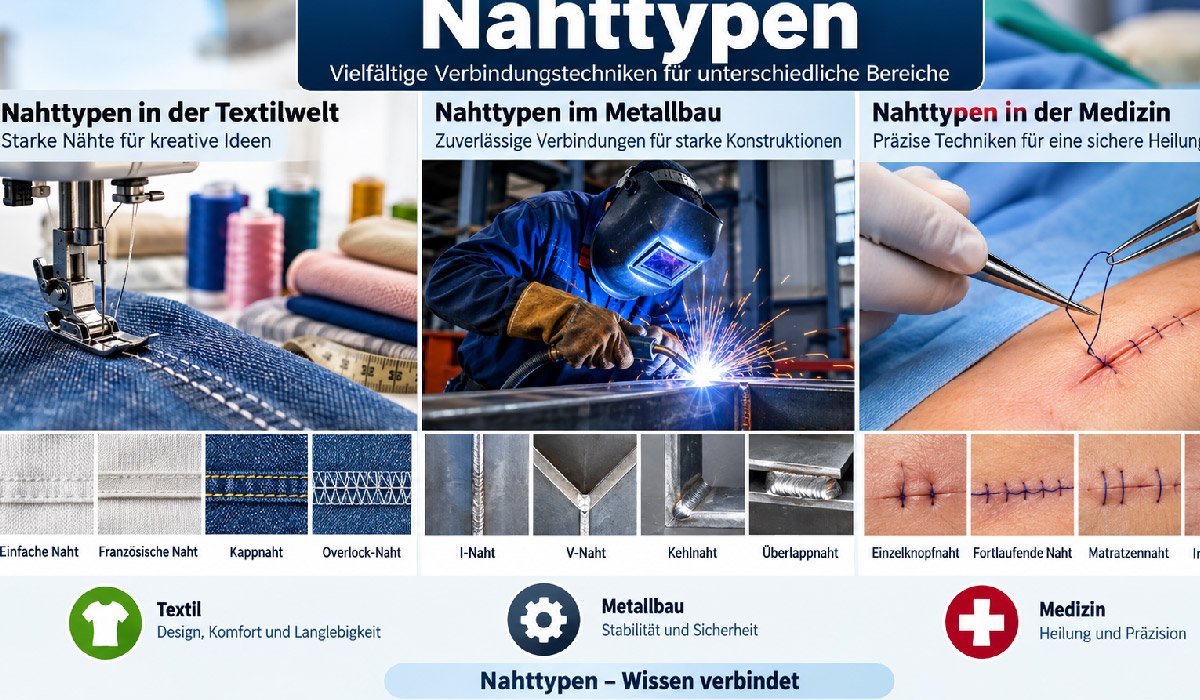
Nahttypen is a German term used to describe different types of seams, joining methods, welds, or sutures. The exact English meaning depends on the subject. The German word “Naht” generally refers to a line where separate parts are joined, while “Typen” means types or categories.
In textiles, Nahttypen usually means seam types used to connect pieces of fabric. In metalworking and welding, the same term can describe weld seams or joint forms. In medicine, it can refer to different surgical suture techniques used to close wounds or tissue.
This broad meaning makes context very important. A person reading a German sewing guide will understand the word differently from an engineer studying a welding drawing or a medical student reading about wound closure. Understanding the field first makes it much easier to select the correct English meaning.
What Does Nahttypen Mean?
The simplest translation of Nahttypen is “seam types,” but this translation does not work in every situation. “Naht” has several technical meanings in German because joining is an important process in many industries. Fabric can be joined by stitching, metals can be joined through welding, and body tissue can be closed with sutures.
For this reason, the surrounding words should always be considered. Terms such as fabric, thread, garment, and sewing machine usually indicate textile seams. Words such as metal, plate, groove, electrode, and welding suggest that the subject is metalworking.
Medical words provide another clear context. When Nahttypen appears near terms such as wound, skin, tissue, operation, or surgery, it normally refers to suture types or techniques. Therefore, understanding Nahttypen requires more than a direct dictionary translation. The professional setting determines the most accurate English term.
Main Fields Where Nahttypen Are Used
Nahttypen are particularly important in textiles, clothing production, welding, metal fabrication, medicine, and surgery. Although these fields are very different, each uses some form of joining. The design of that connection can affect strength, appearance, performance, comfort, or safety.
In textile production, seam construction determines how fabric pieces are connected and how the finished product behaves. Clothing manufacturers consider fabric thickness, stretch, seam strength, appearance, and edge protection. Different Nahttypen are therefore selected for jeans, shirts, sportswear, underwear, jackets, and delicate dresses.
Engineering uses seam terminology differently. Weld geometry and joint preparation influence how metal components are connected. In medicine, surgical sutures bring tissue edges together during wound closure. These examples explain why Nahttypen is a broad technical term rather than the name of one particular joining method.
Nahttypen in Sewing and Textile Production
In sewing, Nahttypen are different seam constructions used to join fabric pieces. A seam is more than a visible row of stitches. Its complete construction includes the way fabric layers are positioned, the location of the stitching, the seam allowance, and sometimes the method used to protect the raw edges.
The correct seam affects both appearance and performance. Lightweight material may need a fine construction that creates little bulk, while denim or workwear usually requires a stronger connection. Stretch fabrics create another challenge because the seam may need to move without thread breaking or fabric becoming distorted.
Nahttypen also influence comfort. Thick or raised seams can cause rubbing in garments worn close to the body. Flat constructions are therefore useful in some sportswear and underwear. Designers consider fabric properties and the purpose of the garment before deciding which seam construction provides the best balance of durability, appearance, flexibility, and comfort.
Plain Seam: A Basic Textile Nahttyp
The plain seam, often associated with the German term einfache Naht, is one of the most widely used seam constructions. Two pieces of fabric are normally placed with their appropriate sides together and stitched at a selected distance from the raw edge. The seam allowances can then be pressed open or toward one side.
This construction is common because it is straightforward and suitable for many woven fabrics. It appears in shirts, dresses, skirts, home textiles, pillow covers, and numerous everyday sewing projects. It is also useful for beginners because it introduces essential skills such as controlling seam allowance, stitching straight lines, and pressing completed seams.
A plain seam does not automatically protect raw fabric edges. Materials that fray can require an additional finish, such as overlocking or zigzag stitching. This means the plain seam is versatile, but its suitability depends on the material, expected wear, and finishing method.
French Seam for Delicate and Lightweight Fabrics
A French seam, known in German as Französische Naht, encloses the raw fabric edges within the finished seam. Instead of leaving exposed seam allowances inside the garment, the construction surrounds them with fabric. This creates a clean interior appearance without requiring a separate overlocked edge.
French seams are particularly useful with lightweight or delicate woven materials. Fine cotton, chiffon, organza, and some sheer fabrics can benefit from an enclosed finish because exposed edges may fray or remain visible. The technique is therefore frequently associated with blouses, dresses, lingerie, and carefully finished lightweight garments.
This Nahttyp is not suitable for every material. Enclosing several layers creates additional thickness, making the construction less practical with bulky or very heavy fabric. Curved areas can also require greater care. Its main strengths are a tidy appearance, protected raw edges, and a refined finish on suitable lightweight materials.
Flat-Felled Seam for Strength and Durability
A flat-felled seam, commonly connected with the German term Kappnaht, is designed to create a durable and tidy connection. The raw edges are enclosed within the seam construction and secured flat. Additional visible stitching often becomes part of the finished appearance while strengthening the joined area.
Jeans provide one of the easiest examples. Denim garments experience repeated movement, pulling, washing, and everyday wear, so their construction needs dependable seams. Flat-felled seams are also found in shirts, uniforms, workwear, jackets, and other products where both durability and a neat interior finish are useful.
Compared with a simple plain seam, this Nahttyp generally requires more construction steps. However, it provides enclosed raw edges and a relatively flat, strong result. Fabric weight, seam position, machinery, and garment design still need consideration because several folded layers can create excessive thickness when very heavy materials are used.
Overlock, Flatlock, and Zigzag Methods
Overlocking is widely used in modern clothing production. An overlock machine forms stitches around a fabric edge and, depending on the machine and operation, can trim the edge while sewing. This helps control fraying and produces the familiar finished edges visible inside many commercially manufactured garments.
Flatlock construction serves a different purpose. It can create a relatively flat joining area with reduced bulk, making it valuable in applications where comfort matters. Sportswear, activewear, underwear, and some stretch garments can use flat seams because raised seam allowances may rub against the skin during repeated movement.
Zigzag stitching is another useful technique, particularly for home sewing. Its side-to-side formation can provide more movement than an ordinary straight stitch and can also help finish raw edges. However, stitches and Nahttypen are not technically identical concepts. A stitch describes thread formation, while a seam describes the complete joining construction involving fabric layers and stitching.
Other Useful Nahttypen in Textile Work
Textile construction includes many additional Nahttypen beyond plain, French, and flat-felled seams. A lapped seam places one section of material over another before they are secured. Depending on its construction, it can provide strength while also creating a visible design line. Variations are found in clothing and other sewn products.
Bound seams use another material or strip to cover and protect an edge. Binding can improve appearance while controlling raw edges, making it useful in garments, bags, accessories, and other textile products. Decorative seam treatments can intentionally make stitching or seam lines visible as part of a design.
Different projects therefore require different solutions. Upholstery experiences different stresses from a lightweight blouse, while a reusable bag has different requirements from activewear. Learning multiple Nahttypen gives a sewer or designer more control over strength, bulk, flexibility, appearance, edge protection, and the overall quality of the finished product.
How to Choose Nahttypen for Different Fabrics
Choosing suitable Nahttypen begins with understanding the fabric. Weight is an important factor because a construction suitable for thin cotton may become weak or inappropriate on heavy denim. Very bulky seams can also create uncomfortable or unattractive areas when several thick fabric layers meet.
Stretch is equally important. Knit fabrics and elastic materials change shape during movement, so the stitches and seam construction must accommodate that movement. Fraying also matters. Loosely woven fabrics may need enclosed or finished edges, while materials that do not fray can allow different construction options.
The final use should guide the decision as well. Workwear requires durability, while lingerie may prioritize softness and reduced bulk. A formal garment may place greater emphasis on appearance, whereas outdoor clothing can require weather resistance. The most suitable Nahttypen therefore depend on three connected factors: material properties, product construction, and the conditions the finished item will experience.
Textile Seam Classification and ISO 4916
Professional textile manufacturing requires more precise terminology than everyday sewing. A garment can be designed in one country, technically specified in another, and manufactured somewhere else. Standardized seam descriptions help different teams understand how fabric components should be assembled without relying entirely on informal local names.
ISO 4916 provides a recognized system associated with the classification and terminology of seam types in textiles. Such classification systems organize seams according to their construction and the arrangement of material components. They allow manufacturers, technical designers, quality teams, and other professionals to communicate seam requirements more consistently.
This technical approach also shows why Nahttypen should not be confused with stitch types. Two seams may use related stitching while arranging the fabric components differently. Likewise, different stitch formations may be used to produce or finish particular seam constructions. Understanding this distinction becomes increasingly important when moving from basic home sewing into industrial garment production and technical documentation.
Nahttypen in Welding and Metalworking
In metalworking, Nahttypen can refer to weld seam forms, weld types, or joint configurations, depending on the document. Welding joins metal components by applying a suitable process to create a connection. The shape and preparation of the joint influence how the welding operation can be performed.
Several factors determine the appropriate configuration. Material thickness, accessibility, loading, welding process, required penetration, edge preparation, and engineering specifications can all influence the design. A thin metal component may require different preparation from a thick structural plate that must carry substantial loads.
German technical documentation can use terms such as I-Naht, V-Naht, Y-Naht, and Kehlnaht. Their exact interpretation should be based on the technical standard, drawing, and joint geometry involved. This is particularly important because a casual translation may not describe the same geometry expected by an engineer, fabricator, or welder working from formal specifications.
Common Welding Nahttypen and Their Forms
An I-Naht is associated with a joint where the adjoining edges do not receive the pronounced V-shaped preparation seen in a V groove. Its suitability depends on factors such as component thickness, welding process, accessibility, and the penetration required for the specific application.
A V-Naht uses edge preparation that creates a V-shaped groove. This provides space for weld metal and is particularly relevant when thicker materials require suitable access to the joint. A Y-shaped or single-bevel-style configuration uses asymmetric preparation, although terminology should always be interpreted according to the applicable technical system.
A Kehlnaht corresponds to a fillet weld and is common where components meet at an angle, including many T-joint, corner, and lap configurations. Overlapping components can form lap joints that are welded in suitable locations. These Nahttypen demonstrate how joint geometry, rather than simply the presence of welding, affects technical terminology.
Why Welding Nahttypen Need Accurate Identification
Correct identification of welding Nahttypen is important because joint geometry directly affects fabrication. Different preparations require different amounts of machining, weld metal, access, working time, and heat input. A design that is appropriate for one material thickness or loading condition may not automatically be suitable for another.
Technical drawings normally communicate this information through standardized welding symbols, dimensions, reference lines, and accompanying specifications. Welders and fabricators should therefore interpret the complete drawing rather than depending on the ordinary-language meaning of a single German term. The applicable welding procedure and engineering requirements also remain important.
Translation requires the same level of care. “Seam” may be understandable in general English, but professional welding documentation often requires terminology such as weld, groove, joint, or fillet weld. Translating Nahttypen according to the actual geometry and relevant technical context helps preserve the engineering meaning of the original information.
Nahttypen in Medicine and Surgery
In medicine, Nahttypen generally refers to different suture types or suture techniques. Suturing is used to bring tissue edges together during wound or surgical closure. The purpose is different from sewing fabric, but the shared idea of joining explains why German uses the word “Naht” in both fields.
Medical professionals consider several factors when selecting an appropriate closure technique. These include tissue type, wound location, tension, depth, healing requirements, cosmetic considerations, and the characteristics of the wound. The material used for suturing can also vary according to the clinical situation.
Suture material and suture technique should not be treated as the same concept. Suture material describes the thread-like medical material used for closure, including absorbable and non-absorbable options. A technique describes how that material is placed through tissue. This distinction is essential when explaining medical Nahttypen accurately and avoiding overly broad translations.
Common Surgical Nahttypen Explained
The Einzelknopfnaht is generally understood as an interrupted suture. Each stitch is placed and secured separately. Because individual stitches are independent, failure or removal of one does not automatically release the entire closure. Interrupted suturing also allows individual adjustment along different parts of a wound.
A fortlaufende Naht, or continuous suture, uses a continuing sequence of stitches rather than individually tying every stitch. A Matratzennaht, or mattress suture, can appear in vertical and horizontal forms. The Donati technique is associated with a form of vertical mattress suturing used in surgical wound closure.
An Intrakutannaht refers to an intradermal or subcuticular type of closure running within the skin. These medical Nahttypen have different characteristics and clinical applications. The appropriate technique is selected by trained medical professionals according to the wound, tissue, tension, treatment objectives, and individual clinical circumstances.
How to Translate Nahttypen Correctly
The most reliable way to translate Nahttypen is to identify the subject before choosing an English term. If the surrounding information discusses fabric, garments, sewing machines, thread, denim, overlocking, or clothing construction, “seam types” is usually the natural translation.
Engineering vocabulary changes the answer. References to steel, plates, joints, grooves, weld symbols, electrodes, or fabrication suggest that Nahttypen concerns weld or joint forms. In that setting, “weld types,” “weld seam types,” or “joint types” may be appropriate depending on what is actually being classified.
Medical context requires another translation. Words such as tissue, skin, wound, surgical closure, and operation indicate that “suture types” or “suture techniques” is more suitable. Diagrams and surrounding technical terms can provide additional clues. Context-based translation is therefore more dependable than automatically replacing Nahttypen with the same English phrase every time.
Modern Nahttypen and New Joining Technologies
Traditional stitching remains essential, but modern textile manufacturing includes additional joining technologies. Seam sealing is widely associated with products where water resistance matters. Waterproof garments can use tape or other sealing systems over stitched seam areas to reduce the possibility of water entering through needle holes.
Some technical textiles can also be joined through adhesive bonding, ultrasonic processes, welding, or other specialized methods. These technologies may reduce bulk, change the appearance of a seam, or provide properties that conventional stitching alone cannot achieve. Their suitability depends heavily on the fibers, coatings, equipment, product design, and performance requirements.
Seamless and reduced-seam garment construction has also become important in areas such as activewear. Fewer raised joining areas can improve comfort in certain designs. However, modern joining technology does not make traditional Nahttypen obsolete. Conventional seams remain practical, repairable, versatile, and highly effective across clothing, home textiles, industrial products, and many other applications.
Nahttypen and Quality, Comfort, and Durability
Correct Nahttypen contribute directly to product performance. In clothing, a seam needs enough strength for the forces placed on the garment without creating unnecessary stiffness or bulk. Well-selected construction can also protect raw edges, maintain shape, improve appearance, and reduce uncomfortable rubbing against the body.
Durability becomes especially important in frequently used products. Jeans, uniforms, bags, outdoor equipment, and work clothing face repeated pulling, bending, washing, and abrasion. Selecting a seam appropriate for the material and stress can help the finished item remain functional for longer. Strong construction can also repair and continued use more practical.
The same general principle extends beyond textiles. Weld design affects how fabricated metal components are joined, while medical suture techniques address tissue closure. Although these fields use very different materials and professional standards, their Nahttypen exist for the same broad reason: different joining situations require different technical solutions.
Nahttypen and Sustainable Textile Production
Seam construction can also contribute to the useful life of textile products. Clothing that fails at a seam may become unusable even when most of its fabric remains in acceptable condition. Durable construction can reduce premature failure and support longer use when the rest of the product is also designed for longevity.
Repairability is another consideration. Some garments can be repaired by restitching an opened seam, reinforcing a stressed area, or replacing damaged thread. Product designers can consider seam accessibility and construction alongside fabric quality when creating items intended to withstand repeated use.
Sustainability depends on much more than Nahttypen alone. Fiber production, dyeing, manufacturing energy, transportation, consumer behavior, washing, repair, reuse, and end-of-life treatment all contribute to a textile product’s environmental impact. Nevertheless, selecting suitable seams is one practical part of producing durable garments and reducing avoidable failures caused by inappropriate construction.
Why Learning Nahttypen Is Useful
Understanding Nahttypen is useful for beginners, professional sewists, fashion students, textile designers, translators, engineers, technicians, and medical readers. Each group encounters the term differently, but accurate understanding makes technical information easier to interpret and communicate.
For sewing beginners, learning seam construction improves the ability to match a technique with fabric and purpose. Textile professionals benefit from standardized terminology when preparing technical specifications or communicating with manufacturers. Translators need contextual knowledge because a single fixed English translation cannot accurately cover every professional use of the German word.
Engineering and medical contexts demand even greater precision because terminology can describe specific technical configurations or procedures. Recognizing the subject before interpreting the term prevents confusion. Once the context is known, Nahttypen becomes much easier to understand because its different meanings all return to one central concept: selecting an appropriate method for joining separate parts.
Final Thoughts
Nahttypen is a useful German term with a broader meaning than it first appears to have. In sewing and textiles, it describes different seam constructions such as plain seams, French seams, flat-felled seams, overlocked seams, and other joining methods. Each construction offers different characteristics involving strength, appearance, flexibility, edge protection, and comfort.
In welding and metalworking, Nahttypen can describe weld seam forms and joint configurations such as I, V, Y, fillet, and overlapping arrangements. In medicine, the term can refer to surgical suture techniques, including interrupted, continuous, mattress, and intradermal closures.
The key to understanding Nahttypen is therefore context. Fabric terminology points toward textile seams, engineering terminology toward welding, and clinical terminology toward sutures. Instead of memorizing one English definition, readers should identify the field, material, joining purpose, and surrounding vocabulary to determine the most accurate meaning.
(FAQs)
What does Nahttypen mean?
Nahttypen is a German term meaning different types of seams or joining methods. Depending on the context, it can describe textile seams, welding joints, or surgical suture techniques.
What are the most common Nahttypen in sewing?
Common Nahttypen in sewing include plain seams, French seams, flat-felled seams, overlock seams, flatlock seams, and lapped seams. Each type provides different levels of strength, flexibility, comfort, and edge protection.
Which Nahttypen are best for beginners?
A plain seam is usually one of the easiest Nahttypen for beginners to learn. It has a simple construction and can be used for shirts, skirts, pillow covers, bags, and many other basic sewing projects.
What does Nahttypen mean in welding?
In welding, Nahttypen can refer to weld seam forms or joint configurations. Common examples include I-Naht, V-Naht, Y-Naht, Kehlnaht, and different overlapping joint arrangements.
What does Nahttypen mean in medicine?
In medicine, Nahttypen generally refers to surgical suture types or techniques used for wound closure. Examples include interrupted, continuous, mattress, and intradermal or subcuticular sutures.
