


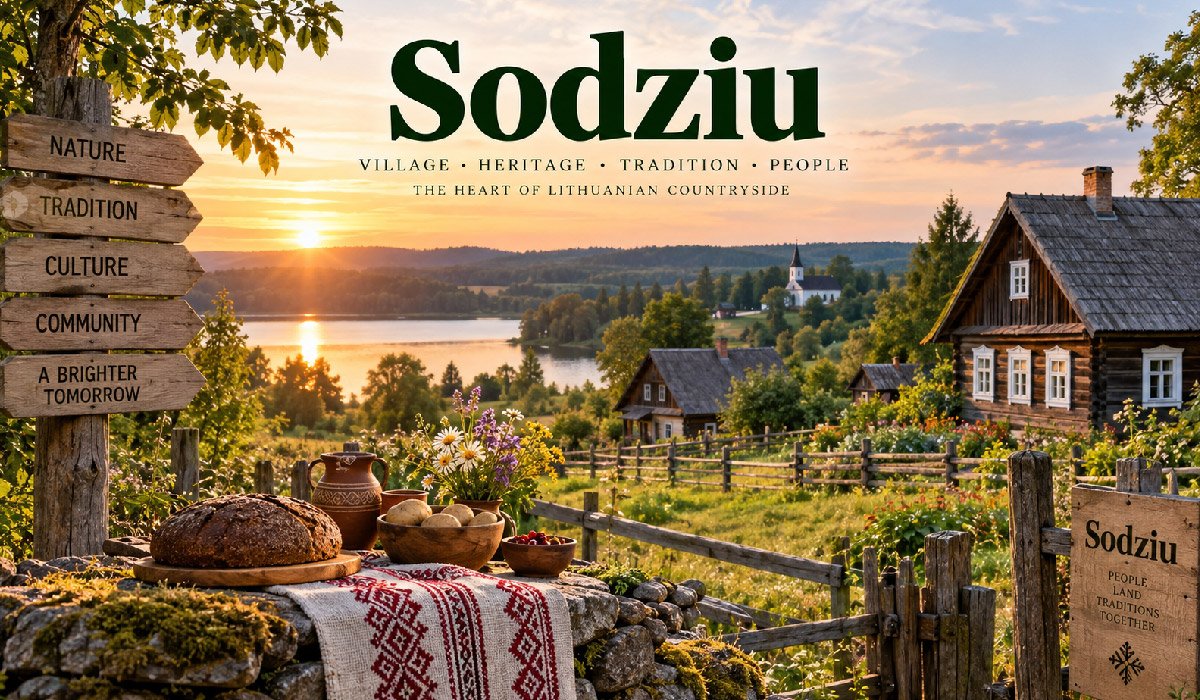
Sodziu is a term connected with the Lithuanian language, rural history, and traditional village life. The spelling often appears online without Lithuanian diacritical marks, which can make its meaning difficult to understand. The Lithuanian word sodžius generally refers to a village or rural settlement, especially in historical and traditional contexts.
Understanding Sodziu requires more than translating it as “village.” Historical rural settlements were closely connected with farmland, homes, animals, forests, roads, and community relationships. Their physical form also changed as Lithuania’s agricultural and land systems developed over time.
This guide explains Sodziu in detail, including its spelling, linguistic forms, historical background, traditional village organization, architecture, farming, food, crafts, folklore, celebrations, tourism, and modern relevance. It also clears up common confusion involving sodžius, sodžiu, sodyba, kaimas, and žodžiu.
What Does Sodziu Mean?
Sodziu is commonly used online as a simplified spelling connected with the Lithuanian word sodžius. In general terms, sodžius refers to a village, countryside settlement, or historically a settlement associated with rural households. The English word “village” provides a useful basic translation, although it does not explain every historical detail attached to the Lithuanian term.
In historical contexts, Sodziu can lead readers toward a particular part of Lithuania’s rural development. A settlement was not simply a group of houses placed together. Homes were connected with fields, paths, livestock areas, water, forests, and other resources needed by agricultural households.
For this reason, Sodziu should not automatically be described as a modern platform, company, product, lifestyle movement, or artistic method. Its clearest linguistic and historical meaning belongs to the subject of Lithuanian villages and rural settlements.
Why Sodziu Appears Without Lithuanian Diacritics
Lithuanian uses letters that are not found in the basic English alphabet. One important example is ž. When Lithuanian words are typed on keyboards without these characters, used in URLs, or copied into systems that simplify spelling, their diacritical marks may disappear. As a result, sodžius can appear online as sodzius.
This change may look small, but diacritical marks are important for understanding Lithuanian words correctly. Removing them can make separate words appear much more similar than they actually are. Search engines can also display several spelling forms when people search for an unfamiliar Lithuanian expression.
Therefore, Sodziu is best approached as an unaccented search spelling that needs context. Readers should look for the original Lithuanian characters whenever possible. Restoring the correct spelling can make dictionary research easier and prevent unrelated Lithuanian words from being given the same meaning.
Sodziu, Sodžius, and Sodžiu Explained
The basic Lithuanian noun relevant to this topic is sodžius. Lithuanian is an inflected language, so the endings of nouns can change according to their grammatical function in a sentence. This means readers may encounter sodžiu as a grammatical form related to sodžius rather than as an entirely separate concept.
English also changes some words according to grammar, but Lithuanian uses a much more developed case system. For someone unfamiliar with the language, different endings may therefore look like different vocabulary words even when they belong to the same noun.
Online spelling creates another layer of difficulty. Sodžius can become sodzius after the letter ž is simplified. Sodžiu can similarly appear as sodziu. Therefore, anyone researching Sod ziu should identify the original spelling, read the complete sentence, and consider its grammatical context before choosing an English translation.
Sodziu and Žodžiu Are Different Words
One of the most important distinctions concerns žodžiu. This Lithuanian form is connected with žodis, which means “word.” In conversation, expressions involving žodžiu may sometimes be translated in ways similar to “in a word,” “basically,” or “in short,” depending on the sentence and intended meaning.
That should not be confused with sodžius, the word associated with a village or rural settlement. When Lithuanian diacritical marks are removed, žodžiu may appear as zodziu, while sodžiu may appear as sodziu. The resulting spellings are visually similar enough to cause mistakes in online explanations.
The distinction matters because the meanings are completely different. A historical text discussing sodžius may concern settlement patterns and countryside life, while žodžiu in ordinary speech has a linguistic meaning related to “word.” Checking the original first letter and its diacritical mark can prevent this confusion.
Sodziu, Sodyba, and Kaimas: Key Differences
Several Lithuanian terms relate to countryside life, but they should not be treated as interchangeable. Sodžius generally refers to a village or rural settlement and can carry an older or historical sense. Kaimas is another Lithuanian word for village and is commonly encountered in modern rural contexts.
Sodyba has a different focus. It normally refers to an individual homestead, farmstead, or rural property. A sodyba may contain a family house together with gardens, barns, storage spaces, land, and other structures. A sodyba can therefore exist within or near a wider rural settlement.
The plural sodybos belongs to sodyba. It is not the plural form of Sod ziu. Remembering the scale makes the distinction easier: sodžius or kaimas can refer to a wider village, while sodyba normally identifies an individual homestead or rural property. Historical usage can vary, but this basic distinction is useful.
Historical Origins of Sodziu in Lithuania
The historical importance of Sodziu is closely connected with Lithuania’s agricultural development. Rural settlements were essential because most households needed direct access to resources required for farming and everyday survival. Cultivated fields, grazing land, woodland, water, paths, and nearby households all influenced where people lived.
Historical descriptions connect sodžius with forms of rural settlement found in medieval Lithuania. These settlements developed within agricultural landscapes rather than according to the expectations of a modern planned town. Household locations were influenced by practical relationships between homes, land, animals, and natural resources.
The term therefore provides more historical information than a simple translation might suggest. Studying Sodziu can help explain how Lithuanian communities organized their living environment before later reforms reshaped agricultural land. It also shows how language can preserve traces of settlement patterns even after those physical arrangements have changed or disappeared.
What Did a Historical Sodžius Look Like?
A historical sodžius did not necessarily resemble the modern image of a village with houses neatly arranged beside one main road. Older Lithuanian rural settlements could have a relatively irregular or scattered arrangement. Individual homesteads developed according to the surrounding land and practical needs of farming households.
Access to fields was important, but it was only one consideration. Water, grazing areas, forests, paths, storage requirements, livestock, and connections with neighboring households could also influence settlement organization. Natural features therefore played an important part in shaping the physical appearance of rural communities.
There was no single design followed by every Sodziu settlement. Geography, historical period, agricultural conditions, regional customs, and household circumstances could produce differences. This variety is important because historical rural communities should not be reconstructed as identical collections of wooden houses. They were working landscapes shaped by local conditions and changing human needs.
How Agricultural Reform Changed Sodziu Settlements
Lithuanian rural settlements changed as systems of agriculture and land management developed. A particularly important transformation occurred during the 16th century with the Valakų reform, which reorganized agricultural land. Older irregular settlement patterns in some areas were replaced or transformed as land and villages became more systematically organized.
This process affected more than the appearance of settlements. Reorganizing fields could influence where households were located, how roads connected communities, how farmland was divided, and how agricultural work was managed. More regular street-village forms became associated with this changing rural landscape.
The history of Sodziu therefore demonstrates that traditional villages were never completely frozen in time. Political decisions, economic conditions, land ownership, agricultural methods, and administrative reforms could reshape everyday rural life. Later centuries brought further transformations, making Lithuanian countryside history a continuing story of adaptation rather than one unchanged traditional lifestyle.
Traditional Daily Life in Lithuanian Villages
Daily village life depended heavily on the agricultural calendar. Spring brought land preparation, planting, garden work, and increased outdoor activity. Summer required crop care, haymaking, animal management, and other demanding farm tasks. Autumn centered on harvesting and preparing enough food and supplies for the colder months.
Winter changed the type of work rather than ending it. Families still cared for animals, prepared food, maintained equipment, repaired household items, and completed practical indoor tasks. Crafts and other forms of household production could become particularly useful when field work was limited by winter conditions.
Family members often shared responsibilities according to age, ability, household needs, and local custom. Practical knowledge about crops, animals, plants, food, weather, and crafts could pass between generations. Neighbors could also cooperate when demanding jobs required additional labor. However, village routines varied significantly between regions, households, and historical periods.
Traditional Homes and Rural Architecture
Wood was an important building material in traditional Lithuanian countryside architecture because forests provided a readily available local resource. A rural homestead could contain a main dwelling together with barns, sheds, animal buildings, storage structures, gardens, fences, and other spaces required by a working household.
Heating was essential during Lithuania’s cold winters. Stoves and fireplaces played practical roles in keeping homes warm, while some heating structures could also be used for cooking. Food storage was equally important. Cellars and other cool spaces helped households preserve vegetables and supplies for periods when fresh produce was less readily available.
Rural architecture was not identical throughout Lithuania. Building layouts, decorative elements, materials, and construction traditions could differ by region, time, and household wealth. This architectural context also clarifies the meaning of sodyba: an individual farmstead and its buildings could form one part of the broader landscape associated with a Sodziu settlement.
Farming, Gardening, Livestock, and Beekeeping
Agriculture formed the economic foundation of much traditional Lithuanian rural life. Families cultivated grains, potatoes, vegetables, and garden produce according to local soil, weather, available land, and household needs. Rye became particularly significant because it was suitable for regional conditions and important in traditional Lithuanian bread-making.
Livestock provided several valuable resources. Depending on the household, people might keep cattle, pigs, poultry, horses, or other animals. Animals could provide meat, dairy products, transport, labor, and useful materials. Farming therefore involved several interconnected activities rather than simply growing one crop.
Beekeeping also has a long association with Lithuanian rural culture. Bees provided honey and beeswax, while successful beekeeping required knowledge of plants, flowering seasons, weather, and the local environment. Forests added mushrooms, berries, herbs, wood, and other resources. Together, farming, gardening, animals, beekeeping, and foraging supported diversified rural households.
Food and Bread-Making in Sodziu Life
Traditional Lithuanian countryside food depended largely on ingredients that households could cultivate, raise, gather, store, or obtain locally. Grains, potatoes, vegetables, dairy foods, meat, mushrooms, berries, and honey all became important parts of rural diets. Seasonal availability strongly influenced what families prepared throughout the year.
Rye bread became especially significant. Juoda duona, or dark rye bread, remains one of the best-known elements of Lithuanian food culture. Traditional home bread-making could involve fermentation and oven baking. Potatoes also became central to Lithuanian cuisine and appear in famous dishes such as cepelinai, while šaltibarščiai, a cold beet soup, is another widely recognized national dish.
Food preservation was necessary for winter. Families could ferment vegetables, dry mushrooms, smoke or salt meat, preserve berries, and store root vegetables. These are broader Lithuanian traditions and should not be presented as foods belonging exclusively to Sodziu settlements.
Crafts and Traditional Rural Skills
Rural households needed many practical objects, and manufactured products were not always readily available. People therefore developed skills that allowed them to make, repair, and maintain clothing, textiles, furniture, tools, buildings, storage items, and other necessities. Such work combined practical knowledge with materials available in the surrounding area.
Weaving was important in Lithuanian textile traditions. Linen and wool could be transformed into useful household fabrics and clothing. Woven belts, towels, embroidery, and decorative patterns also allowed practical objects to carry regional or family styles. Woodworking provided furniture, spoons, tools, fences, building components, and many everyday objects.
These authentic craft traditions should be separated from claims that Sodziu itself means a fabric-dyeing method. Lithuania certainly has textile and folk-art traditions, but the established linguistic meaning of sodžius concerns rural settlement. A craft practiced in villages does not automatically become the definition of the word describing those villages.
Folklore, Songs, and Rural Beliefs
Oral tradition helped preserve cultural knowledge before modern communication became widely available. Stories, folk songs, sayings, legends, and practical knowledge could move from one generation to another through families and communities. Songs addressed subjects including work, relationships, nature, war, family, and seasonal events.
Lithuanian and wider Baltic folklore contains supernatural figures connected with older beliefs and storytelling traditions. Laumės, for example, appear as supernatural female beings in Baltic folklore, while Velnias appears in numerous traditional stories. Their roles and meanings could vary considerably between periods, regions, and individual narratives.
Lithuanian rural customs were also shaped by interaction between older Baltic traditions and Christianity. As religious life changed, earlier seasonal ideas could exist alongside later Christian practices. Folklore should therefore be understood as part of the wider cultural environment surrounding Lithuanian villages rather than as a literal component of the dictionary definition of Sodziu.
Seasonal Festivals and Village Traditions
Seasonal celebrations brought families and communities together and reflected the close relationship between agricultural life, religion, and the yearly calendar. Joninės, Lithuania’s midsummer celebration, takes place around the summer solstice and is associated with traditions involving bonfires, wreaths, plants, singing, and outdoor gatherings.
Kūčios, the traditional Christmas Eve meal, is an important family occasion with established food and remembrance customs. Užgavėnės, held before Lent, is known for masks, costumes, performances, noise, and festive foods. Agricultural communities also celebrated harvest periods after completing major seasonal work.
These traditions were never necessarily identical in every Sodziu or Lithuanian village. Regional culture, religion, family practice, and historical change influenced how celebrations developed. Their importance lies in showing how rural communities organized social life around seasons, family relationships, agricultural work, and shared cultural traditions rather than demonstrating one universal set of village rituals.
Sodziu and Modern Lithuanian Rural Life
Modern Lithuanian villages differ greatly from historical settlements. Electricity, paved roads, cars, agricultural machinery, smartphones, internet connections, modern education, and improved transport have transformed everyday countryside life. Farming remains important, but many rural residents now earn their living through other industries and services.
Some people commute to towns, operate small businesses, work remotely, or combine agriculture with another occupation. Older wooden houses may stand alongside renovated properties and modern homes. Historical farmsteads can also be adapted into guesthouses, museums, private residences, or tourism businesses.
Sodziu should therefore not be presented as a lifestyle that survived unchanged from medieval Lithuania. Rural culture continuously responds to technological, economic, and social developments. What survives is a mixture of historical landscapes, buildings, foods, customs, knowledge, and community memories alongside modern living. This combination makes Lithuania’s countryside heritage particularly valuable for cultural study.
Sodziu and Sustainable Use of Local Resources
Some historical countryside practices resemble ideas now associated with sustainable living. Families commonly repaired tools, reused useful materials, grew vegetables, preserved seasonal foods, gathered forest products, and depended heavily on resources available close to home. Careful resource use was often an economic necessity rather than a deliberate environmental movement.
Seasonal eating was also practical. Fresh foods were consumed when available, while fermentation, drying, smoking, salting, and cool storage helped extend supplies through winter. Household items could be maintained for long periods because replacing them was not always simple or affordable.
However, historical Sodziu communities should not automatically be described using modern labels such as “zero waste,” “organic,” or “eco-friendly.” These concepts have contemporary definitions that do not necessarily match older agricultural practices. Modern rural properties may now add efficient heating, renewable energy, or other technologies, combining older resource-conscious habits with present-day environmental solutions.
Rural Tourism and Lithuanian Village Heritage
Rural tourism allows visitors to explore parts of Lithuania’s countryside heritage without pretending that modern villages still operate exactly as they did centuries ago. Travelers can stay in a sodyba, which may range from a traditional rural property to a comfortable modern guesthouse surrounded by forests, fields, rivers, or lakes.
Activities vary by location. Visitors may encounter bread-making demonstrations, craft workshops, beekeeping, traditional food preparation, mushroom gathering, sauna experiences, cycling, fishing, hiking, or canoeing. Museums, restored farmsteads, wooden churches, and heritage villages can provide additional historical context about earlier rural life.
Responsible tourism also benefits local communities when it supports locally owned accommodation, food producers, guides, craftspeople, and heritage projects. Visitors should remember that villages and farmsteads are real communities and private homes, not simply attractions. Respecting local customs and asking permission before entering or photographing private property helps create a more responsible countryside experience.
Is Sodziu a Traditional Fabric-Dyeing Technique?
Some online descriptions present Sodziu as an old Eastern European textile or fabric-dyeing art. These explanations may discuss natural dyes, wax-resist techniques, batik, tie-dye patterns, indigo, or handmade fabrics. Such descriptions can sound convincing because traditional textile crafts genuinely existed across Europe.
The linguistic information surrounding sodžius, however, points to a village or rural settlement rather than an established Lithuanian dyeing technique. Weaving, embroidery, natural dyes, and other textile skills can certainly form part of rural cultural history, but that does not establish Sodziu as the formal name of one of those methods.
Readers should therefore separate genuine textile traditions from the definition of the term itself. If a modern artist, business, or collection uses Sodziu as a creative label, that particular usage can have its own meaning. It should not automatically be presented as the historical Lithuanian definition.
Common Misunderstandings About Sodziu
Several misunderstandings come from simplified spelling. One is that Sodziu means “basically” or “in short.” This confusion can arise from žodžiu, a different Lithuanian form related to “word.” Another mistake is treating sodybos as the plural of Sodziu, even though sodybos belongs to the separate noun sodyba.
A further misconception describes Sodziu as an ancient fabric-dyeing art. Traditional Lithuanian textile crafts exist, but they should not be used to replace the documented settlement meaning of sodžius. It is also incorrect to assume that Sodziu automatically identifies one specific geographical place. Individual Lithuanian villages have their own names.
Finally, Sodziu should not be turned into a universal philosophy of simple living, community, or sustainability. These themes can be associated with rural heritage, but they are cultural interpretations rather than direct definitions. Keeping language, history, and symbolism separate produces a clearer explanation.
How to Research Sodziu Correctly
The first step when encountering Sodziu is to check the original spelling. Look carefully for forms such as sodžius, sodžiu, žodžiu, or another similar Lithuanian word. Missing diacritical marks should be restored whenever the original text or a reliable language source makes that possible.
Next, read the entire sentence rather than relying on a search snippet. Historical material may use the term for settlement history, while conversational Lithuanian may contain a completely different similar-looking word. A brand or tourism business could also use Sodziu creatively without following its dictionary meaning.
Reliable research should prioritize Lithuanian dictionaries, encyclopedias, academic material, museums, universities, historical archives, and recognized cultural institutions. Repetition across several general websites is not evidence by itself. Researchers should also distinguish a dictionary definition from symbolism. A writer may associate a village with belonging or nostalgia, but those associations do not change the linguistic definition.
Why Sodziu Still Matters Today
Sodziu remains valuable because historical words can preserve information about societies that have changed. For historians, rural terminology can provide clues about settlement organization, agriculture, land use, and community development. For language learners, it demonstrates why Lithuanian grammar and diacritical marks must be considered when translating unfamiliar vocabulary.
The concept is also relevant to genealogy and cultural heritage. People researching Lithuanian family histories may encounter older rural terminology in documents, maps, parish records, or descriptions of ancestral communities. Travelers can use similar knowledge to better understand heritage villages, farmsteads, museums, architecture, and countryside landscapes.
Modern interest in traditional food, crafts, folk songs, rural tourism, and historic buildings gives this heritage continuing cultural value. Preserving it does not require keeping villages unchanged. Instead, preservation can document older knowledge while allowing communities to develop modern housing, employment, transport, education, technology, and other services.
Historical Meaning and Cultural Symbolism of Sodziu
The historical meaning of Sodziu should be separated from the symbolism people may attach to village life. Linguistically, sodžius concerns a village or rural settlement. Historically, it can lead to discussions about particular forms of Lithuanian settlement organization and how agricultural reforms changed those communities.
Culturally, a writer may use the countryside to represent family roots, tradition, cooperation, nature, memory, belonging, or nostalgia. These associations can be meaningful because generations of Lithuanian families lived and worked in rural communities. However, cultural associations are interpretations rather than additional dictionary definitions.
Making this distinction strengthens any explanation of Sodziu. It allows readers to appreciate both dimensions without confusing them. The word has a definable linguistic background, while the world surrounding Lithuanian villages provides a much broader cultural story involving agriculture, architecture, food, folklore, family relationships, natural landscapes, religion, work, and historical change.
Final Thoughts
Sodziu is best understood through its connection with the Lithuanian word sodžius, a term associated with a village or rural settlement. Its meaning becomes much clearer when Lithuanian spelling and grammar are considered, especially because removing diacritical marks can make different words appear deceptively similar.
The historical context adds another important layer. Lithuanian rural settlements were working environments shaped by agriculture, land organization, homes, livestock, forests, food production, crafts, seasonal routines, and community relationships. Their structure changed as agricultural reforms, political systems, technology, and modern economic life transformed the countryside.
Understanding Sodziu therefore provides more than a simple vocabulary definition. It offers an introduction to Lithuanian rural history and demonstrates why cultural terms need careful research. By separating sodžius from žodžiu, sodyba, unsupported textile claims, and modern interpretations, readers can understand the term with far greater accuracy.
(FAQs)
What does Sodziu mean?
Sodziu is commonly encountered as an unaccented spelling connected with the Lithuanian word sodžius, which refers to a village or rural settlement. Its historical context is closely associated with Lithuanian countryside communities and settlement patterns.
Is Sodziu a Lithuanian word?
The standard Lithuanian form is sodžius. Sodziu or sodzius may appear online when Lithuanian diacritical marks are omitted. The exact meaning should always be checked against the original spelling and context.
What is the difference between Sodziu and sodyba?
Sodžius generally refers to a village or wider rural settlement. Sodyba usually refers to an individual homestead, farmstead, or countryside property containing a house, land, gardens, and sometimes agricultural buildings.
Is Sodziu the same as žodžiu?
No. Sodžius is associated with a village or rural settlement, while žodžiu is related to the Lithuanian word žodis, meaning “word.” Removing diacritical marks can make these different words look confusingly similar.
Is Sodziu a traditional fabric-dyeing technique?
The linguistic information discussed in this article supports sodžius as a Lithuanian term associated with a village or rural settlement. Claims describing Sodziu as an established traditional fabric-dyeing technique should therefore be treated cautiously.
