


Many manufacturers work in environments where being able to show your work is part of the job. Food plants, medical device makers, aerospace suppliers, automotive producers, and pharmaceutical companies all operate under standards and customer requirements that ask a simple but important question: how do you know, and can you show me? Quality teams in these plants are experts at answering it. They keep thorough records, follow documented procedures, and welcome audits as a chance to demonstrate good practice. As automation becomes part of daily operations, these teams have a natural and healthy interest in making sure it can answer that question too. The good news is that automation built to be explainable fits beautifully into this culture.
Why Explanations Matter in a Regulated Setting
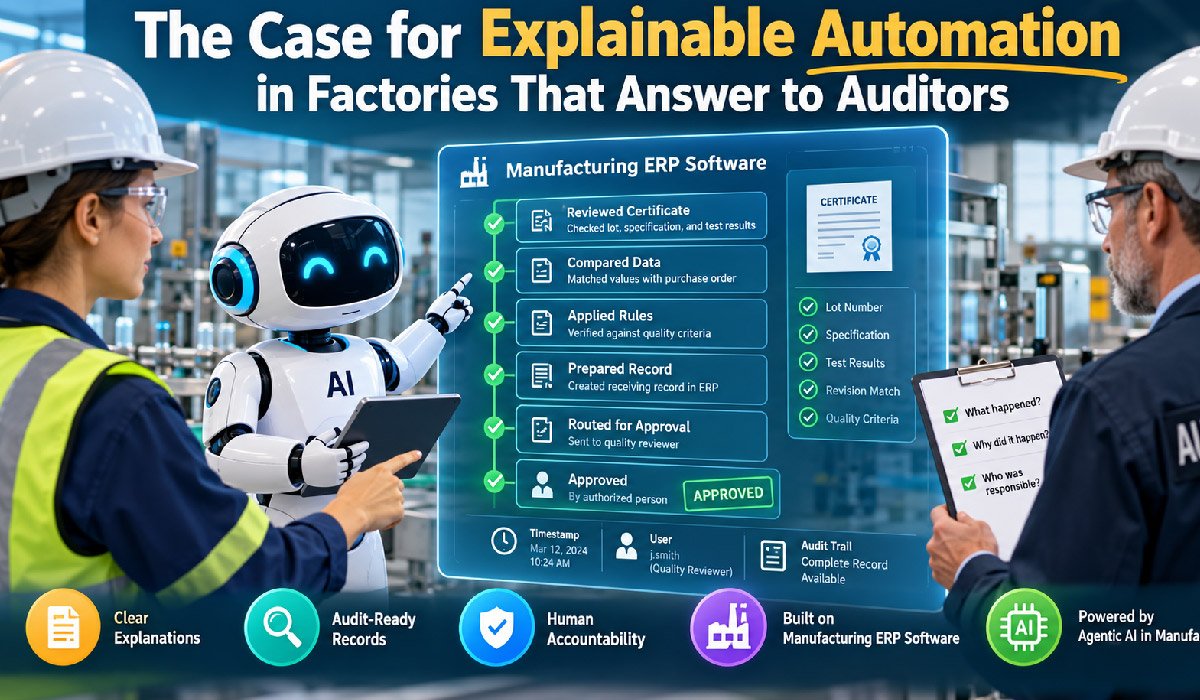
An auditor typically wants to understand three things. What happened? Why did it happen that way? And who was responsible for the decision? When people perform a task, the answers come from procedures, signatures, and records. The same expectations apply when software takes part in the work.
If an automated step updates an inventory record, releases an order, or drafts a quality document, the plant should be able to show what information the software used, what rule or logic led to the action, and which person approved it. This isn’t an obstacle to automation. It’s simply good practice, and it’s one of the reasons teams in regulated industries can adopt new tools with confidence once the right design is in place.
A Trustworthy Record Starts With a Strong Core System
Explainability begins with a dependable source of facts. A thoughtfully configured Manufacturing ERP Software platform keeps items, lots, bills of materials, routings, orders, inventory movements, and approvals in one connected place, with timestamps and user identities attached to each transaction. When something happens, there is a clear record of who did what and when.
Plants in audited industries often put particular care into this foundation. They define roles and permissions carefully, so each person can perform only the actions their position allows. They maintain revision control for documents and specifications. They record lot and serial information at every step, which supports traceability from receipt to shipment. These practices make audits smoother today, and they also lay the groundwork for explainable automation, because any helper working inside the system inherits the same structure and the same record-keeping.
Automation That Shows Its Work
When it comes to adding smart helpers, the question is how to keep that same transparency. This is a natural strength of agentic AI in manufacturing when it is designed with explanation in mind. An agentic assistant can carry out a short series of steps toward a goal, and it can record each step as it goes.
Imagine a helper that reviews an incoming supplier certificate against the purchase order and the material specification. It can log what it checked: the lot number, the revision of the specification, the test results received, and the values compared. It can note whether everything matched or highlight what didn’t. If the certificate is complete and consistent, it can prepare the receiving record and route it to the quality reviewer for approval. If something is missing, it can flag the gap and request the right document.
Each action carries a clear explanation: the inputs used, the checks performed, the outcome, and the person who approved it. An auditor looking at that record sees a thorough, consistent process, often more consistent than manual notes written at the end of a busy shift.
Clear Roles Keep People Accountable
Accountability is central in audited environments, and thoughtful automation supports it. The plant decides what the assistant may prepare, what it may complete under defined limits, and what always requires a named person’s approval. Decisions about material disposition, customer commitments, and changes to controlled documents remain with qualified people.
This structure keeps responsibility where it belongs. The assistant does the preparation and the documentation, and the accountable person reviews and signs off. Because every step is logged, anyone can follow the path from the original information to the final decision.
What Teams Tend to Notice
Quality and compliance teams that adopt explainable automation often share encouraging observations. Records are more complete and uniform, because the helper documents each step the same way. Audit preparation becomes easier, since the information auditors ask for is organized and easy to retrieve. Routine checks happen reliably, which frees quality professionals to spend more time on investigations, improvement projects, and supplier development.
Many teams also find that explanations build confidence across the plant. Operators and supervisors can see why a suggestion was made, which helps them learn and gives them an easy way to ask questions or suggest improvements. When everyone can follow the reasoning, trust grows naturally.
A Practical Way to Begin
For plants interested in this approach, a good first step is to choose a routine task that already has a clear procedure, such as verifying incoming documentation or preparing a standard record. Write down what a careful person checks, what the acceptance criteria are, and who approves the result. Those details become the rules and the explanation format for the assistant.
Involve your quality team from the beginning. Their experience shapes what a good record looks like, and their involvement helps ensure the result fits the plant’s quality system. Run the new approach alongside the current one for a few weeks, review the records together, and refine. Starting with a well-bounded task keeps the experience friendly and builds a strong template for future projects.
Showing the Work, With Pride
Factories that answer to auditors have always taken pride in doing things the right way and being able to demonstrate it. Explainable automation extends that pride to the newest members of the team. With a solid core system, clear roles, and helpers that record their reasoning, plants can welcome smarter tools while keeping the transparency their customers and regulators value. It’s a natural fit, and for many quality teams, it’s a welcome one.
About the Contributor
Nishkam Batta, Editor-in-Chief, HonestAI Magazine | AI Consultant, GrayCyan AI Solutions
Nish leads an applied AI company helping manufacturing and related companies automate operations with human-in-the-loop AI that integrates into ERPs, WMS, CRMs, and other enterprise tools, with an emphasis on explainable AI, clear audit trails, and measurable outcomes. His team builds agentic ERP systems that execute multi-step tasks inside approved guardrails so humans keep accountability, approvals, and override control.
