


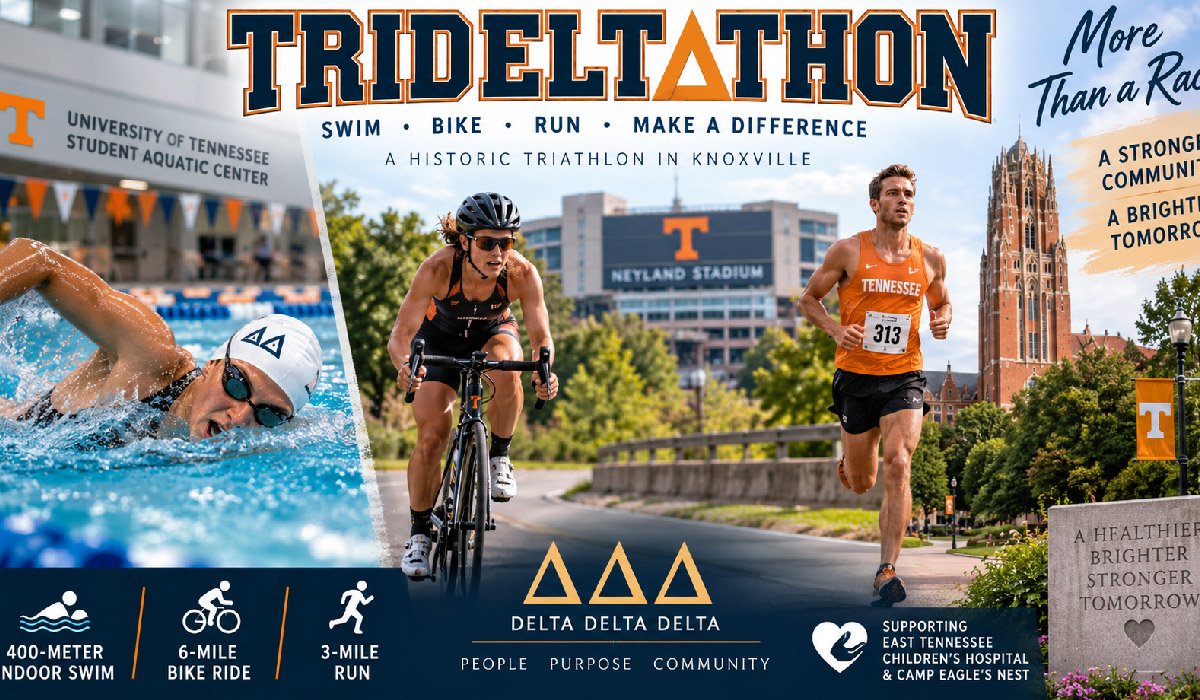
Trideltathon holds an interesting place in the endurance sports history of Knoxville, Tennessee. The event became known as a short pool-based triathlon connected with the University of Tennessee, Delta Delta Delta sorority, and community fundraising. Its format brought swimming, cycling, and running together without requiring athletes to begin their race in open water.
The historic Trideltathon included a 400-meter indoor pool swim, a 6-mile bike ride, and a 3-mile run. These shorter distances made the event approachable for students, local athletes, relay teams, and people taking their first steps into multisport racing. Experienced competitors could also race the compact course at a fast pace.
Beyond competition, Trideltathon developed a strong community identity. Volunteers helped with race activities, while fundraising supported causes connected with children and families in East Tennessee. Its combination of sport, campus involvement, and charity explains why the name remains part of Knoxville’s race history.
What Is Trideltathon?
Trideltathon was a charity pool triathlon held around the University of Tennessee campus in Knoxville. Like other triathlons, participants completed three disciplines in order: swimming, cycling, and running. The main difference was that the swimming section took place inside a pool instead of a lake, river, or other open-water location.
This indoor format gave Trideltathon a distinctive character. Athletes could concentrate on swimming technique and pacing without dealing with waves, currents, poor underwater visibility, or navigation around outdoor buoys. It also created a more controlled starting environment for people who were unfamiliar with open-water racing.
The event was closely associated with Delta Delta Delta, commonly known as Tri Delta. Students, volunteers, local athletes, and community supporters became part of the race environment. This combination meant Trideltathon functioned as both an athletic challenge and a community-focused fundraising event.
History of Trideltathon in Knoxville
Trideltathon developed a long connection with Knoxville’s endurance sports community. Historic event information described it as one of the country’s oldest continuously running pool triathlons. Its long presence helped distinguish it from many shorter-lived local races and allowed generations of participants to experience multisport competition.
The University of Tennessee setting played an important role in that history. Instead of taking place on a remote endurance course, much of the event was closely connected with a busy university environment. Students could participate, volunteer, watch competitors, or become involved through Delta Delta Delta and its fundraising activities.
Its relatively short distances also helped create a broad audience. Trideltathon could provide experienced competitors with a fast race while giving newer athletes a manageable introduction to triathlon. This balance between competition and accessibility became an important part of the event’s identity within Knoxville’s local sporting history.
University of Tennessee and Tri Delta Connection
The University of Tennessee was central to the identity of Trideltathon. The swimming section was associated with the university’s Student Aquatic Center, while the cycling and running portions used the campus and nearby Knoxville roads. This created a course that was closely connected with familiar university surroundings.
Delta Delta Delta also played a major role in the event. Commonly called Tri Delta, the sorority provided volunteer support and helped connect the athletic event with charitable work. Student involvement added energy to race day while creating opportunities for people who were not competing to participate through volunteering and fundraising.
This relationship helped Trideltathon become more than a simple race. It brought together university life, organized endurance sport, student volunteers, local athletes, and community causes. These different elements gave the event a recognizable identity that remained connected with Knoxville and the University of Tennessee.
Trideltathon Race Format and Distances
The historic Trideltathon followed a compact swim-bike-run format. Participants began with a 400-meter indoor swim before moving to a 6-mile bicycle course. After completing the bike stage, athletes entered the final discipline, a 3-mile run through the University of Tennessee campus area.
Although these distances were shorter than those found in many triathlons, the event could still be physically demanding. Short races encourage competitors to maintain a stronger pace because each stage ends relatively quickly. There is also less time available to recover from a slow transition, pacing mistake, or equipment problem.
The format offered a useful balance for different experience levels. New competitors could face manageable distances, while trained athletes could focus on speed and efficiency. Successful participation still required swimming ability, safe bicycle handling, running fitness, transition preparation, and an understanding of how to distribute effort across three different sports.
The 400-Meter Indoor Pool Swim
The opening stage of Trideltathon was a 400-meter swim inside the University of Tennessee Student Aquatic Center. Historic race instructions describe swimmers starting individually at short intervals rather than entering the water together in a large mass start. Athletes were generally organized according to expected swimming speed.
Participants moved through the pool lanes in sequence as they completed the required distance. This arrangement was very different from open-water triathlon starts, where many swimmers can enter a lake or river together. Pool swimming removed the need to navigate around buoys while dealing with changing currents, waves, and limited visibility.
A controlled pool did not make the swimming section effortless. Competitors still needed efficient technique and sensible pacing. Starting too quickly could waste energy needed for cycling and running. The 400-meter distance therefore tested an athlete’s ability to swim efficiently while preparing physically and mentally for the next stage.
The Six-Mile Bike Course
After leaving the swimming area, Trideltathon competitors entered the first transition before beginning the approximately six-mile cycling stage. Historic descriptions connected the bike route with the University of Tennessee campus and Neyland Drive, giving the cycling portion a recognizable Knoxville setting.
Six miles is relatively short for a triathlon bike leg, but that can increase the importance of efficiency. Athletes have limited distance in which to establish their pace and recover time. Smooth bicycle handling, awareness of the course, correct gear selection, and a controlled effort can therefore make a noticeable difference.
Participants also have to consider the upcoming run. Cycling too aggressively can leave the legs tired before the final three miles. A sensible strategy involves riding strongly while preserving enough energy to run effectively. For beginners, safe handling and predictable pacing are especially important because cycling comes immediately after the physical effort of swimming.
The Three-Mile Campus Run
The final Trideltathon discipline was a three-mile run through the University of Tennessee campus area. Historic course descriptions connected the route with prominent campus locations, including Neyland Stadium and the arena long known as Thompson-Boling Arena. These surroundings gave competitors a clear sense of the university setting.
Running after cycling feels different from beginning an ordinary road run. The muscles have already spent several miles performing a repetitive cycling motion. When an athlete starts running, the legs can temporarily feel heavy or awkward as the body adjusts to a new movement pattern.
Pacing therefore becomes important during this final part of Trideltathon. Starting the run too quickly can make the later portion difficult, while an overly cautious beginning can cost valuable time. Experienced racers may gradually increase their effort, while beginners can concentrate on finding a comfortable rhythm and completing the final discipline consistently.
Why Transitions Were Important
Trideltathon included two transitions in addition to its three sporting disciplines. The first, commonly called T1, connected swimming with cycling. The second, known as T2, connected cycling with running. Transition time forms part of a triathlon result, so athletes need to complete these changes efficiently.
Preparation can make the process easier. Competitors can organize their helmet, cycling equipment, shoes, race number, and running gear before the race starts. Knowing exactly where each item is located reduces confusion after leaving the pool or returning from the bicycle course.
Transitions become especially important in a short event such as Trideltathon because the overall race time is relatively compact. Several unnecessary minutes in transition can represent a significant part of the total performance. Beginners do not need to rush dangerously, however. A calm and organized transition usually provides a better approach than moving quickly without following equipment and safety procedures.
Why Trideltathon Appealed to Beginners
One important feature of Trideltathon was its indoor swimming environment. Open-water swimming can be challenging for people entering their first triathlon. Lakes and rivers may involve cold temperatures, changing water conditions, limited visibility, waves, crowded starts, and the need to navigate toward course markers.
A swimming pool removes many of those variables. Athletes know the distance, can follow marked lanes, and compete in a controlled facility. For swimmers who are comfortable in a pool but inexperienced in open water, this structure can make the idea of completing a triathlon more approachable.
The shorter cycling and running distances also reduce the training volume generally required compared with longer endurance events. However, participants still need preparation. They must be able to swim 400 meters, control a bicycle safely, run three miles, and move between disciplines. Accessibility does not remove the need for fitness, equipment knowledge, and race preparation.
Individual Competitors and Relay Teams
Trideltathon provided opportunities for different types of competitors. Individual athletes could complete the entire swim-bike-run sequence themselves. This required preparation across three sports and gave participants the complete triathlon experience from the opening pool length to the finish of the campus run.
Relay participation offered another approach. Instead of requiring one athlete to complete every discipline, team members could divide the swimming, cycling, and running responsibilities. This structure allowed people with different athletic strengths to participate together and experience the event as a team.
Relay racing can also introduce new participants to multisport events. A strong swimmer who does not regularly cycle, for example, can complete the pool section while teammates handle the other disciplines. This format matched the community nature of Trideltathon by allowing participation to extend beyond athletes who were prepared to complete all three parts independently.
How Athletes Could Train for Trideltathon
Preparing for Trideltathon required balanced training rather than extremely high mileage. Athletes needed regular exposure to swimming, cycling, and running because fitness in one discipline does not automatically provide the technique or movement skills required in another. Consistency across the three sports was therefore important.
Swim training could include comfortable technique work and repeated 400-meter efforts. Cycling sessions could develop bike handling, steady pacing, and confidence riding at different intensities. Running workouts could focus on building enough endurance to cover three miles comfortably while also preparing the body for faster efforts.
Training should increase gradually. New athletes benefit from establishing basic fitness before adding harder sessions. Recovery also matters because combining three sports can create fatigue even when individual workouts are short. The objective is to reach race day comfortable with every discipline rather than relying heavily on one athletic strength to compensate for limited preparation elsewhere.
Brick Workouts and Race Preparation
Brick workouts are useful when preparing for an event like Trideltathon. A brick combines two disciplines in one training session, with cycling followed by running being the most common example. The athlete completes a bike ride and begins running shortly afterward instead of taking a long recovery period.
This training helps the body become familiar with the unusual feeling of running immediately after cycling. The first few minutes can feel uncomfortable because the muscles must change from cycling movements to running movements. Regular practice can make this transition feel more predictable by race day.
Equipment preparation is equally important. Athletes should check their bicycle, helmet, footwear, and other required items before arriving at the event. Learning the transition layout and understanding the course can also prevent avoidable confusion. Good preparation allows competitors to concentrate on swimming, cycling, and running rather than solving equipment problems during the race.
Trideltathon and Its Charity Purpose
Charitable fundraising was an important part of the identity surrounding Trideltathon. The event’s connection with Delta Delta Delta helped combine student participation and endurance sport with support for children and families. Race involvement therefore carried a community purpose beyond finishing times and competitive positions.
Historic information connects Trideltathon fundraising with East Tennessee Children’s Hospital. Camp Eagle’s Nest, a summer camp serving children with cancer and rare blood disorders, also became associated with the wider charitable tradition. This connection provided participants and volunteers with another reason to support the event.
Community races can generate assistance through registration, fundraising, sponsorship, volunteering, and public awareness. Trideltathon demonstrated how a relatively compact athletic event could bring together several groups around a shared cause. Athletes gained a multisport experience, students participated in volunteer activities, and charitable programs benefited from attention and financial support generated through the event.
Community and Volunteer Involvement
A triathlon requires considerably more organization than simply marking a start and finish line. Swimming, cycling, running, and transition areas all need coordination. Volunteers can help athletes understand where to go, support registration procedures, provide course assistance, and contribute to the overall organization of race day.
Tri Delta volunteers became closely associated with Trideltathon and strengthened its university character. Their involvement connected the event with campus life while supporting its fundraising purpose. Local athletes, students, organizers, spectators, and other community members also contributed to the atmosphere surrounding the competition.
This participation helped make Trideltathon a community event rather than an activity involving only registered athletes. Volunteer-based races often depend on cooperation between organizers and local supporters to operate smoothly. In the case of Trideltathon, this community involvement complemented the short race format and helped connect endurance sports with student service and charitable activity in Knoxville.
What Happened to the Original Trideltathon?
The original Trideltathon remains visible through historical race information, archived event pages, and older results, but those records should be separated from current race schedules. The planned 2020 edition was canceled after the University of Tennessee changed its operations during that period, preventing the event from proceeding as originally planned.
Older online pages can continue appearing in search results long after a particular race format has stopped operating. This can create confusion for people who discover the traditional 400-meter swim, 6-mile bicycle ride, and 3-mile run and assume those distances describe a currently scheduled event.
Today, Trideltathon is mainly important as a historic Knoxville multisport event. Anyone looking for registration or a future race date should rely on current organizer information rather than archived listings. Understanding the difference between historical race records and active schedules prevents the original triathlon from being confused with newer Tri Delta fundraising events.
Trideltathon and TriDeltaRUN Are Different Events
Trideltathon and TriDeltaRUN share connections with Tri Delta and charitable activity in Knoxville, but their race formats are different. Historic Trideltathon was a triathlon. Athletes completed swimming, cycling, and running sections, beginning with its recognizable 400-meter indoor pool swim.
TriDeltaRUN uses a running-only format. The related event has operated as a 5K, meaning competitors do not complete swimming or cycling stages. The change makes it important for people researching the name to check whether an older source describes Trideltathon or a newer listing refers specifically to TriDeltaRUN.
The charitable connection provides continuity between the traditions, but it does not make the events identical. Trideltathon belongs to Knoxville’s pool-triathlon history, while TriDeltaRUN represents a later running-focused event. Keeping these names and formats separate provides a clearer understanding of how the Tri Delta-associated sporting and fundraising tradition has changed over time.
Conculsion
Trideltathon became a distinctive part of Knoxville’s endurance sports story through its simple but challenging race format. The historic event combined a 400-meter indoor pool swim, a 6-mile bike ride, and a 3-mile campus run. These distances made the race approachable while still requiring preparation across three different athletic disciplines.
Its University of Tennessee location gave Trideltathon a strong campus identity. Delta Delta Delta involvement added student participation and volunteer support, while connections with East Tennessee Children’s Hospital and Camp Eagle’s Nest gave the event a charitable purpose extending beyond athletic competition.
The original swim-bike-run format should now be understood separately from TriDeltaRUN, the related running-focused event. Even though event formats have changed, Trideltathon remains relevant when exploring Knoxville triathlon history. Its legacy reflects a combination of accessible multisport racing, university involvement, community participation, volunteering, and charitable support.
(FAQs)
What is Trideltathon?
Trideltathon was a historic pool-based charity triathlon in Knoxville, Tennessee. It combined swimming, cycling, and running and had strong connections with the University of Tennessee, Delta Delta Delta, and local charitable programs.
What were the Trideltathon race distances?
The historic Trideltathon included a 400-meter indoor pool swim, a 6-mile bike ride, and a 3-mile run. Its short format made the event suitable for both experienced competitors and newer triathletes.
Where was Trideltathon held?
Trideltathon was held around the University of Tennessee campus in Knoxville, Tennessee. The swim took place indoors, while the cycling and running routes used the campus area and nearby Knoxville roads.
What charity did Trideltathon support?
Trideltathon fundraising was connected with East Tennessee Children’s Hospital and Camp Eagle’s Nest. The event combined endurance sports with community support for programs serving children and families in the East Tennessee region.
Is Trideltathon still held today?
The original Trideltathon swim-bike-run format is mainly a historic event today. A related event called TriDeltaRUN continues the broader Tri Delta charity tradition as a running-focused event rather than the original pool triathlon.
