


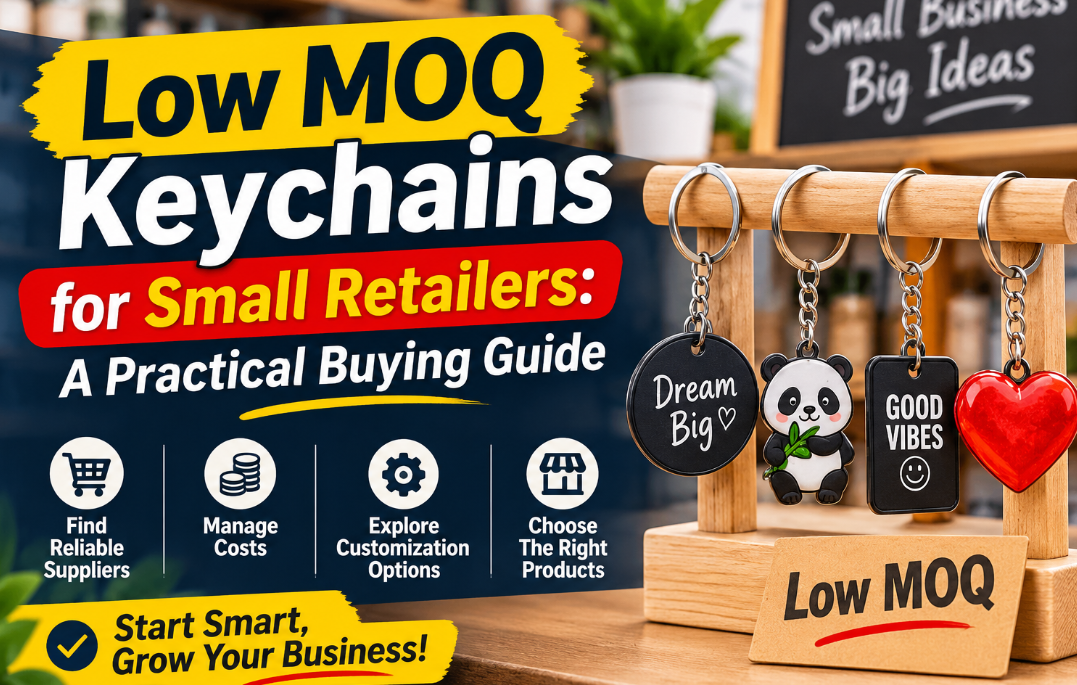
Starting or managing a small retail business requires careful decisions about inventory. Unlike larger companies, independent retailers may not have enough storage space or purchasing budgets to order large quantities of every product. They need products that are affordable, easy to manage, and suitable for different customer preferences.
Keychains can be a useful addition to a small retail collection because they are compact, versatile, and available in many designs. However, purchasing large quantities before understanding customer demand can create unnecessary inventory risks. Exploring wholesale keychains with flexible purchasing options can help retailers find products that better match their inventory needs.
What Does Low MOQ Mean?
MOQ stands for Minimum Order Quantity. It refers to the smallest number of units a supplier requires a customer to purchase in a single order.
For example, if a supplier has an MOQ of 100 pieces, a retailer may need to purchase at least 100 keychains to place an order. A supplier offering a lower MOQ may allow a business to purchase a smaller quantity.
Low MOQ purchasing can be particularly helpful for:
- New businesses testing their first product collection.
- Independent gift shops with limited storage.
- Online sellers exploring different product categories.
- Small retailers working with restricted inventory budgets.
- Businesses testing seasonal or customized designs.
The actual minimum quantity varies by supplier and product type, so retailers should always confirm order requirements before purchasing.
Why Small Retailers Should Consider Low MOQ Keychains
For smaller businesses, inventory management is just as important as choosing products. Ordering too much stock can tie up money that could be used for marketing, packaging, or other business expenses.
Low MOQ purchasing provides several practical advantages.
1. Lower Initial Inventory Investment
Retailers can begin with smaller orders instead of spending a large amount on one product category. This makes it easier to distribute purchasing budgets across different merchandise.
2. Opportunity to Test Multiple Designs
Customer preferences are not always predictable. Some shoppers prefer colorful acrylic designs, while others may choose metal, wooden, or personalized accessories.
Ordering smaller quantities can help retailers test several styles and identify which ones attract the most interest.
3. Reduced Storage Requirements
Small businesses may operate from home, compact shops, or limited warehouse spaces. Smaller orders can make inventory organization easier and reduce the need for additional storage.
4. More Flexible Inventory Planning
Retailers can adjust future orders according to actual sales performance. Instead of purchasing the same quantity repeatedly, they can focus on designs that customers prefer.
Where Can Small Retailers Find Low MOQ Keychains?
Finding a suitable supplier requires comparing product selection, purchasing conditions, and communication. Retailers can explore specialized wholesale websites, manufacturers, and online marketplaces.
When comparing suppliers, consider the following questions:
- What is the minimum order quantity for each design?
- Can different designs be combined in one order?
- Are product samples available?
- Is customization offered?
- What are the estimated processing and shipping times?
- Are there different prices for different order quantities?
Not every supplier offers the same conditions. Getting these details in advance helps small retailers avoid unexpected purchasing requirements.
Which Keychain Styles Should Small Retailers Test?
A small business does not need to stock every available design. It is often more practical to begin with a selection that reflects the interests of its target customers.
Here are some categories worth considering:
Acrylic Keychains
Acrylic designs are suitable for colorful illustrations, decorative artwork, names, and creative themes. They can work well in gift shops, stationery stores, and online accessory businesses.
Metal Keychains
Metal options may appeal to customers who prefer classic accessories. Simple shapes and decorative finishes can make them suitable for everyday use and gifting.
Personalized Keychains
Personalized designs can attract customers looking for birthday gifts, event souvenirs, or accessories featuring names and meaningful messages.
Wooden Keychains
Wooden designs offer a different visual style and may suit retailers interested in minimalist or natural-looking products.
Novelty Keychains
Creative shapes, themed designs, and character-inspired styles can help retailers introduce variety into their collections. Retailers should ensure that any branded or character-related products are properly licensed.
Small retailers interested in exploring more designs can browse Fabulk’s keychains collection for wholesale buyers when comparing potential products for their stores.
How to Manage a Small Keychain Inventory
Purchasing smaller quantities is only one part of inventory management. Retailers should also track product performance and plan future orders carefully.
Consider following these practices:
- Start with a limited selection: Choose a few different styles instead of purchasing too many variations immediately.
- Track individual sales: Record which designs sell quickly and which remain in stock.
- Monitor customer feedback: Pay attention to questions, requests, and comments about colors, materials, and personalization.
- Set reorder points: Decide when stock levels are low enough to place another order.
- Review total costs: Include product prices, shipping, packaging, and other expenses when calculating profitability.
- Avoid unnecessary overstocking: Purchase quantities according to sales trends rather than assumptions.
These simple practices can help small retailers maintain better control over their purchasing decisions.
Important Factors to Check Before Ordering
Even when a supplier offers low minimum quantities, retailers should not overlook product quality and purchasing terms.
Before confirming an order, consider:
- Material and finishing: Check whether the product matches your quality expectations.
- Attachment strength: Inspect key rings, clasps, and connecting parts.
- Product consistency: Make sure different units have consistent colors and finishing.
- Shipping costs: Small orders can sometimes have higher shipping costs per item.
- Return policies: Understand how damaged or incorrect products are handled.
- Customization requirements: Confirm whether personalized orders have separate minimum quantities.
Requesting samples, when available, can be a useful way to evaluate products before placing a larger order.
How Low MOQ Purchasing Supports Business Growth
Small retailers can use low MOQ purchasing as a gradual growth strategy. Instead of investing heavily in one product, they can introduce a variety of designs and observe how customers respond.
For example, a gift shop might initially test acrylic, metal, and wooden keychains in smaller quantities. After reviewing sales, the retailer can identify the strongest-performing categories and increase future orders accordingly.
Online sellers can follow a similar approach by testing different product photographs, descriptions, and pricing strategies. Sales data can then guide purchasing decisions.
This approach does not guarantee higher sales, but it can help businesses make more informed decisions while managing inventory risks.
Conclusion
Low MOQ keychains offer small retailers a flexible way to explore a popular accessory category without immediately committing to large inventory purchases. Smaller order quantities can make it easier to test different styles, manage storage, and understand customer preferences.
The most effective approach is to compare suppliers, confirm minimum order requirements, evaluate product quality, and track sales before expanding inventory. With careful planning, keychains can become a useful addition to a small retailer’s product collection while supporting a more manageable purchasing strategy.
