


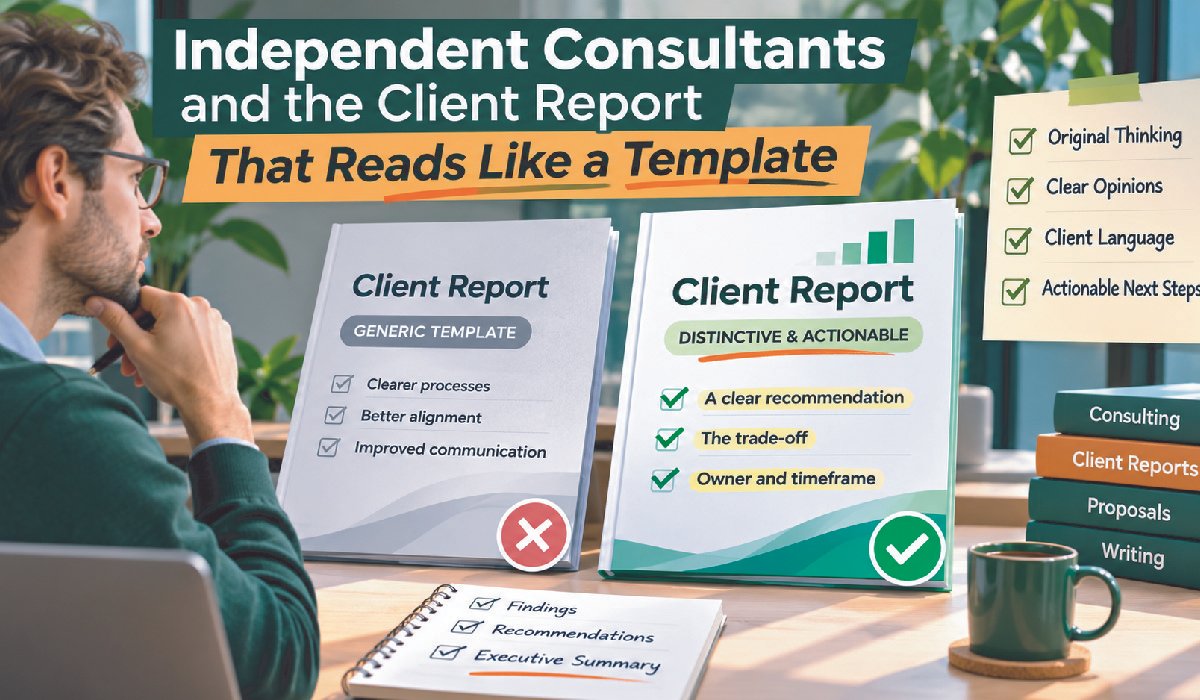
A consultant spends three weeks analyzing a client’s operations, then writes a report that recommends clearer processes, better alignment, and improved communication. The client reads it, nods politely, and does nothing.
The analysis may be excellent. The problem is the prose, which sounds like every consulting report ever written. In a field where clients pay for original thinking, generic writing quietly undermines the value of the work behind it.
The Deliverable Is the Product
For many independent consultants, the report or proposal is the tangible thing the client receives. It is what gets forwarded to colleagues, quoted in meetings, and judged when the next engagement is being considered. A report that reads as distinctive reflects well on the whole project. One that reads as generic makes the project feel smaller than it was.
The Freelancer Kompass 2026 report found that 84 percent of freelancers now use AI tools regularly, up from 41 percent in 2023. Clients increasingly expect polished writing as a baseline, which means distinctive thinking has to show in the voice.
How Drafting Tools Flatten Expertise
Assistants are trained on vast amounts of business writing, so they produce its most common patterns: balanced paragraphs, cautious qualifiers, and recommendations that begin with leverage or streamline. A consultant who has seen a specific problem a dozen times has opinions that are sharper than that, and sharp opinions are what clients hire experts for.
- Hedged recommendations that avoid committing to a view.
- Framework language that could describe any company.
- Summaries that restate the findings without ranking them.
- Uniform paragraph length and a predictable three-point structure.
The Value of a Strong Opinion
Clients rarely want a survey of options. They want to know what the consultant would do and why. A report that says plainly which of three approaches to choose, and what trade-off the client is accepting, is more useful than a balanced analysis that never lands. That kind of clarity is also exactly the quality a smoothing tool tends to remove.
A Practical Writing Process for Consultants
The most effective approach is to separate thinking from drafting. Decide the conclusions first, in plain notes. Use an assistant to structure sections or draft routine material such as methodology and background. Write the findings and recommendations in your own words, since those are where your judgment lives.
After that, if a section still reads as stiff, it can help to humanize AI text with a rewriting tool and compare the result with the original. The goal is a report whose rhythm sounds like the consultant explaining things across a table, with all figures and conclusions untouched.
The same tool is useful for proposals, which tend to be even more templated than reports and are read by decision makers who see many of them.
Checking What You Send
Before delivering, read the executive summary aloud. If it could apply to any client in the sector, rewrite it with one fact only this client has. Check that every number traces to a source and that no section contains a claim the analysis does not support.
- Replace one generic sentence with a specific finding in each section.
- Make sure every recommendation names an owner and a timeframe.
- Verify every figure against the underlying data.
Protecting Confidentiality
Consultants handle sensitive information, and pasting client material into any external tool deserves care. Check contract terms and client policies before sending anything confidential through a drafting or rewriting service, and remove identifying details where possible.
Building a Recognizable Voice Over Time
Over several engagements, a consultant’s writing becomes part of their reputation. Clients recommend people whose reports are clear, direct, and a pleasure to read. Protecting that voice, even while using tools to save time, is an investment in referrals and repeat work.
The Executive Summary Deserves the Most Attention
Many clients read only the executive summary and the recommendations. Those pages carry disproportionate weight, and they are also where generic prose does the most damage. A summary that opens with the single most important finding, in plain words, signals confidence and earns attention for the rest of the document.
Writing the summary last, after the analysis is finished, usually produces a sharper result than drafting it first. It also gives the consultant a final chance to check that every claim in it is supported further on.
Proposals Are Read Even More Quickly
Proposals compete with others for a decision maker’s time, and they are often skimmed. A proposal that names the client’s specific problem in the first paragraph, offers a clear approach, and states a price and timeline plainly stands out from the stack. Generic descriptions of methodology are rarely what wins the work.
- Open with the client’s problem in their own words.
- Describe the approach in terms of what the client will see and when.
- State fees, timeline, and assumptions plainly.
- End with one clear next step.
Learning From Feedback
After each engagement, ask the client which parts of the report were most useful and which they skimmed. Over time, patterns emerge: clients value concrete recommendations, short summaries, and clear next steps. Feeding that back into the next report improves both the writing and the results.
Using Client Language Throughout the Report
Clients trust reports that echo their own vocabulary. If the client calls their departments pods and their customers members, the report should too. Replacing consultancy jargon with the client’s own terms makes the findings feel grounded and makes it easier for the client to circulate the document internally without translation.
A short glossary of client terms, built during interviews, makes this simple. It also guards against the drift toward generic framework language that assistants tend to introduce.
Keeping Reports Shorter Than the Analysis
The temptation after weeks of work is to include everything. Clients rarely want that. A report that leads with the conclusions, keeps the body focused, and puts supporting detail in an appendix is more likely to be read and acted on. Editing down is also the best protection against filler, which tends to be where drafting tools add the most words.
Following Up After Delivery
The relationship does not end when the report is sent. A short follow-up a few weeks later, asking what has been implemented and where the client is stuck, shows that the consultant cares about results. It also generates the testimonials, referrals, and repeat work that sustain an independent practice.
Consultants who send a one-page summary of progress at that point, written in plain language, tend to be remembered long after generic reports have been filed away.
The consultants who build lasting practices tend to be those whose writing is recognizably theirs. Clear opinions, plain language, and a consistent voice make every report a small advertisement for the next engagement, and protecting them is worth the extra hour per document.
A final tip: keep a short file of the sentences clients have quoted back to you. They show which of your phrasing truly resonates and tend to point toward the plain, confident style worth repeating.
Clients pay consultants for judgment, and judgment shows in the writing. AI can accelerate the routine parts, but the opinions, the priorities, and the voice that make a report worth acting on still have to come from the person who did the work.
Read More: How Managed IT Services Help Simplify Software Updates and Patch Management
