


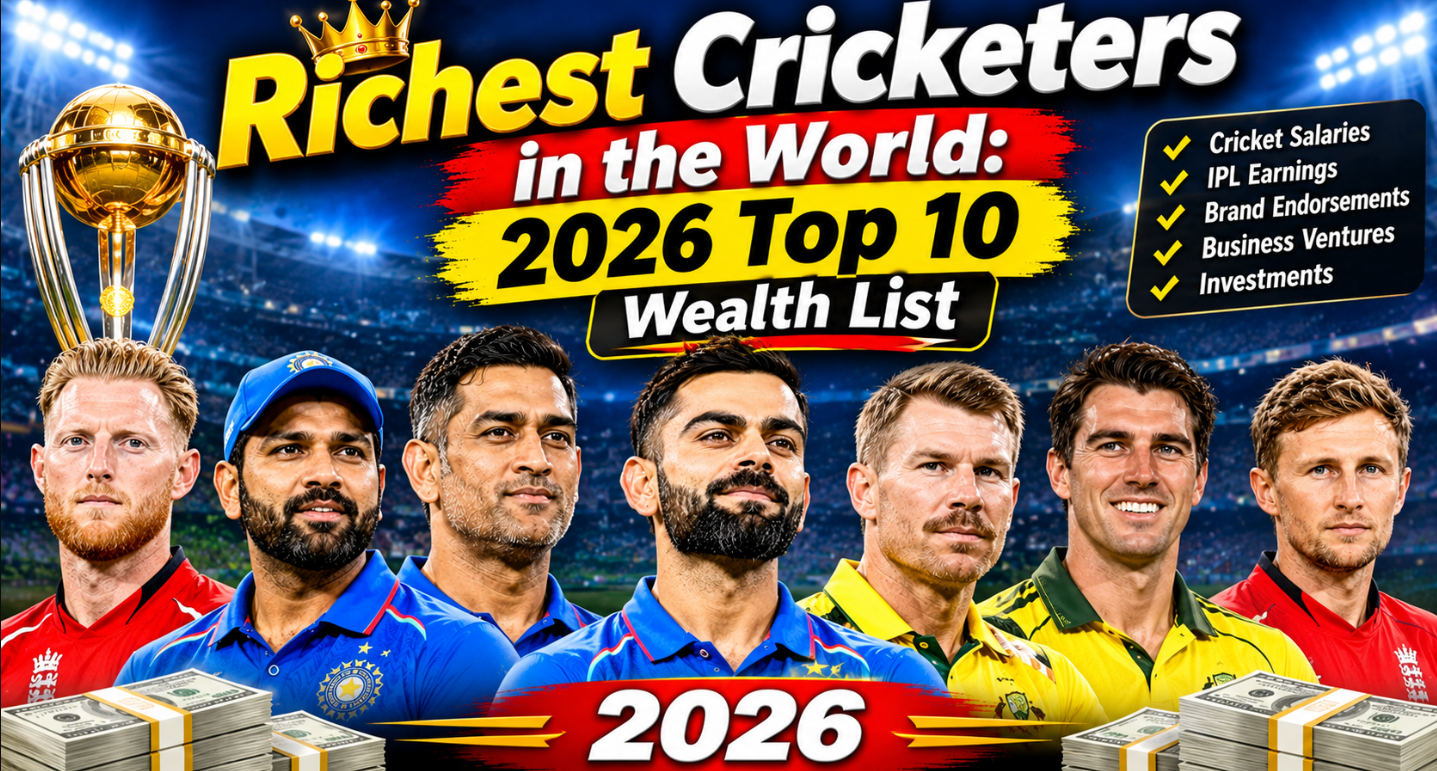
Sachin Tendulkar leads the 2026 list of the richest cricketers in the world, with estimated wealth of ₹1,450 crore. MS Dhoni and Virat Kohli follow him, underlining India’s major presence at the top of cricket’s financial landscape. These figures are estimates rather than audited personal accounts, but the rankings show how elite cricketers have built income streams far beyond match fees through endorsements, franchise cricket, media work, investments and businesses.
The 2026 top 10 by estimated net worth
A November 2026 ranking based on CricRadar estimates placed five Indians in the global top 10. It also included former players from Australia, the West Indies and South Africa. Tendulkar’s position at the top reflects the enduring commercial value of a long playing career combined with business and endorsement activity after retirement. The list contains both retired icons and active international players, making it a snapshot of accumulated wealth rather than annual sporting income.
| Rank | Cricketer | Country | Estimated net worth |
| 1 | Sachin Tendulkar | India | ₹1,450 crore |
| 2 | MS Dhoni | India | ₹1,070 crore |
| 3 | Virat Kohli | India | ₹1,025 crore |
| 4 | Ricky Ponting | Australia | ₹640 crore |
| 5 | Brian Lara | West Indies | ₹510 crore |
| 6 | Jacques Kallis | South Africa | ₹410 crore |
| 7 | Shane Warne | Australia | ₹385 crore |
| 8 | Virender Sehwag | India | ₹360 crore |
| 9 | Yuvraj Singh | India | ₹325 crore |
| 10 | Rohit Sharma | India | ₹300 crore |
The amounts should be read carefully. Net worth usually describes an estimate of the value of assets after liabilities, not a player’s current salary or the amount earned in one season. Published wealth lists can differ because private investments, property, business stakes and financial obligations are not fully public. The 2026 figures in this ranking have not been independently verified, so their greatest value is in showing the broad order and the varied paths through which cricket’s biggest names have created wealth.
Why Sachin Tendulkar remains first
Tendulkar’s estimated ₹1,450 crore placed him clearly ahead of the field in this 2026 ranking. His financial standing has been associated with a long international career, extensive endorsement agreements and business investments. His name retained an exceptional place in Indian sport long after his playing days, illustrating how sporting reputation can remain commercially relevant over several decades.
The scale of Tendulkar’s lead also demonstrates the advantage held by players who became national icons before the current franchise-league era. Their playing careers created a base, while endorsements and investments gave them opportunities to continue building wealth after international retirement. It is this long-term combination, rather than one contract or one tournament, that defines the top end of the list.
Dhoni and Kohli complete an Indian top three
MS Dhoni ranked second, with estimated wealth of ₹1,070 crore. His income has extended through endorsements, sports ventures, agricultural projects and other business interests. His successful leadership in the Indian Premier League also contributed to his profile and earnings. Even after retiring from international cricket, Dhoni retained a strong commercial presence, illustrating the value of popularity, leadership identity and sustained public recognition.
Virat Kohli ranked third at an estimated ₹1,025 crore. His earnings have been linked to cricket contracts, brand partnerships, fitness ventures, fashion businesses and social media influence. Kohli’s position is significant because it shows how an active player can create a portfolio that does not rely solely on the schedule of international fixtures. His case also reflects the increasingly important connection between sporting success, personal branding and digital reach.
For followers assessing a team’s form or a major fixture, a player’s commercial profile is separate from on-field performance. Financial rankings can provide context around the sport’s scale, but match analysis needs cricket-specific evidence such as conditions, selection and recent results. That distinction matters when reading a cricket match prediction alongside broader stories about the game’s business economy.
Retired stars with lasting income streams
Ricky Ponting ranked fourth, with estimated wealth of ₹640 crore. His post-playing work in coaching, broadcasting and franchise cricket has helped maintain his involvement in the sport. Ponting’s place in the ranking is an example of how leading former players can turn tactical experience and public credibility into second careers that remain closely connected to cricket.
Brian Lara followed in fifth place at an estimated ₹510 crore. His commercial standing has been supported by endorsements, media appearances and cricket-related roles. Lara’s inclusion reinforces a central feature of these rankings: legendary players can remain valuable commercially because their achievements continue to resonate across generations of supporters, particularly when they continue to participate in public cricket life.
Jacques Kallis, sixth at an estimated ₹410 crore, has maintained his financial standing through coaching and consultancy work after his playing career. Shane Warne, ranked seventh with estimated wealth of ₹385 crore, built a financial legacy through roles as a commentator, mentor and cricket ambassador. Both cases show that expertise earned on the field can translate into off-field roles where knowledge, reputation and communication are valuable assets.
Indian stars beyond the top three
Virender Sehwag ranked eighth with estimated wealth of ₹360 crore. Commentary assignments, digital content, business ventures and endorsement partnerships have supported his commercial profile. His trajectory shows how former players can use a distinctive playing identity to build a media presence after retirement, especially in a cricket environment where former internationals remain familiar figures to fans.
Yuvraj Singh came ninth at an estimated ₹325 crore. His move into entrepreneurship and investments strengthened his financial portfolio beyond his cricket achievements and endorsement work. Rohit Sharma completed the top 10 with estimated wealth of ₹300 crore. His earnings have primarily come from international cricket, sponsorship agreements and endorsement partnerships, showing that active players can still rank among the sport’s wealthiest figures while continuing their playing careers.
The presence of Sehwag, Yuvraj and Rohit alongside Tendulkar, Dhoni and Kohli meant India accounted for half of the ranking. That concentration reflects the commercial reach of Indian cricket, especially the value of international representation, domestic franchise competition and partnerships with major brands. However, the list also has a wider international character, with Australia contributing Ponting and Warne, alongside Lara from the West Indies and Kallis from South Africa.
How cricketers build long-term wealth
Playing contracts provide an important foundation, but they are only one part of the financial picture for the wealthiest cricketers. International contracts and franchise T20 league deals offer direct cricket income. For players with high visibility, endorsement partnerships can become equally significant, particularly when those relationships continue after retirement or are combined with a strong public persona.
Broadcasting, coaching, mentoring and consultancy provide another route for retired players. These roles use cricketing knowledge directly and often allow former internationals to remain visible through major tournaments and franchise competitions. Business interests, investments, real estate and social-media partnerships can add further layers, though the value of such holdings is often difficult to measure publicly.
A ranking shaped by more than playing records
The richest cricketers list is ultimately a picture of career longevity, marketability and decisions made away from the field as much as performances on it. Tendulkar, Dhoni and Kohli lead the 2026 estimates, but every player in the top 10 illustrates the same wider change: cricketing success can open pathways into media, business, endorsements and leadership roles. The figures remain estimates, yet they underline how deeply cricket now connects sporting excellence with a global commercial ecosystem.
