


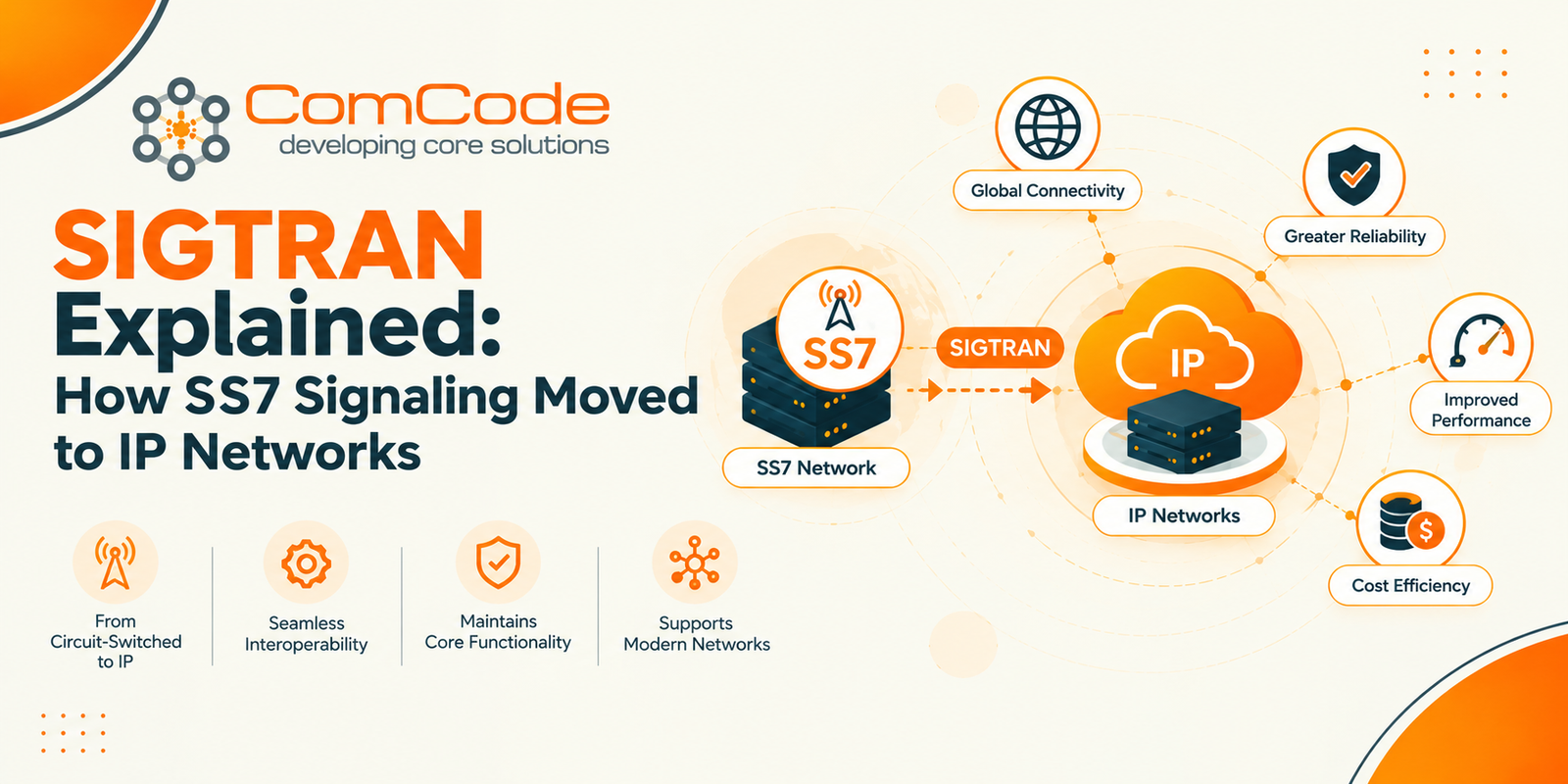
For decade’s, SS7 signaling has been the backbone of telecom signaling. It sets up call’s, deliver’s SMS, locates subscriber’s & enable’s roaming. But the TDM link’s that once carried SS7 are expensive, rigid & slowly disappearing. The answer to this problem is SIGTRAN, a family of protocol’s that carrie’s SS7 signaling over IP network’s.
In this guide, you will learn what SIGTRAN is, how its protocols work, where it is used in 3G & 4G/LTE core network’s & how to plan a smooth migration. We will also look at security risks & why MVNOs & operators still rely on SIGTRAN today.
What Is SS7 & Why Did It Need to Move to IP?
SS7 signaling basics
Signaling System No. 7 (SS7) is a set of protocols that telecom network’s use to exchange control message’s. Its main layer’s include:
- MTP (Message Transfer Part): Reliable transport & routing of signaling message’s between node’s.
- SCCP (Signaling Connection Control Part): Addressing & routing, including global title translation.
- TCAP (Transaction Capabilities Application Part): Transaction handling for higher-level application’s.
- MAP, CAP & ISUP: Application protocol’s for mobility, prepaid control & call setup.
Limits of TDM-based signaling
Traditional SS7 run’s over TDM link’s such as E1 or T1. These link’s are costly to lease, offer limited bandwidth & require dedicated hardware. Scaling means adding more physical circuit’s, which is slow & expensive. Equipment vendor’s are also phasing out TDM interface’s, making long-term maintenance harder.
The shift to all-IP networks
As operator’s moved voice, data & messaging onto IP infrastructure, keeping a separate TDM signaling network made little sense. They needed a way to keep the proven SS7 application layer’s while replacing the transport underneath. That is exactly what SIGTRAN does.
What Is SIGTRAN?
SIGTRAN, short for Signaling Transport, is a set of IETF-defined protocols that carry SS7 & related signaling message’s over IP. It is often described as SS7 over IP. The higher-layer applications, such as MAP & CAP, remain unchanged. Only the lower transport layers are replaced.
SIGTRAN protocol stack overview
The SIGTRAN stack has three main parts:
- IP as the network layer.
- SCTP as the transport protocol.
- Adaptation layer’s such as M3UA, M2PA, M2UA & SUA, which connect SS7 layer’s to SCTP.
SCTP: why it replaced TCP & UDP for signaling
The Stream Control Transmission Protocol was designed for signaling. Unlike TCP, it preserve’s message boundarie’s & support’s multiple independent stream’s, which avoid’s head-of-line blocking. It also support’s multi-homing, meaning an association can use several IP addresse’s so traffic fail’s over to another path if one link goes down. Compared with UDP, SCTP is reliable & ordered where needed.
How SIGTRAN differs from traditional SS7 links
Traditional SS7 use’s fixed point-to-point TDM link’s. SIGTRAN use’s SCTP associations over IP, which can share infrastructure with other traffic, scale more easily & be deployed on standard server’s or virtual machine’s.
SIGTRAN Adaptation Layers Explained
M3UA
M3UA is the most widely used layer. It replaces MTP3 & lets user parts such as SCCP communicate over SCTP. It is common for connecting nodes like HLRs, MSCs & SMSCs to signaling gateways or STPs.
M2PA & M2UA
M2PA lets two SS7 node’s exchange message’s as if connected by a traditional link, which suit’s STP-to-STP connection’s. M2UA is used when a signaling gateway carries MTP2 user traffic to a remote application server.
SUA
SUA (SCCP User Adaptation) carrie’s SCCP user message’s directly over SCTP, without MTP3. It is less common than M3UA but can simplify certain IP-only architecture’s.
Which layer to choose
For most operators & MVNO’s, M3UA is the practical choice because partner’s & vendor’s widely support it. M2PA is useful when building STP-to-STP link’s. Always confirm what your interconnect partners support before deciding.
Key SIGTRAN Components & Architecture
Signaling Gateway & Signal Transfer Point
A Signaling Gateway (SG) connect’s the traditional SS7 network with the IP network. It convert’s between TDM-based signaling & SIGTRAN. A Signal Transfer Point (STP) route’s signaling message’s between node’s & many modern STPs are IP-capable & support SIGTRAN natively.
Application Server & Application Server Process
In M3UA terms, an Application Server (AS) is a logical entity that handles signaling for a set of routing keys, such as a point code. It is served by one or more Application Server Processes (ASPs), which are the actual IP endpoints. Using multiple ASPs allows load sharing & redundancy.
Point codes, routing & gateway connection setup
Each signaling node is identified by a point code. A correct gateway connection setup involves defining SCTP associations, configuring M3UA parameters, assigning routing keys & setting up routes by point code or global title. Misconfigured point codes & routing tables are among the most common causes of failed connections.
Where SIGTRAN Is Used Today
Core network connectivity
In 3G & legacy core network’s, SIGTRAN carries signaling between the MSC, SMSC, HLR & other node’s. The Home Subscriber Server, which serves 4G/LTE & IMS network’s & the HLR often work together in combined setup’s, with SIGTRAN supporting the older MAP-based interface’s.
CAMEL Gateway & prepaid roaming
A CAMEL Gateway uses SS7 signaling, commonly over SIGTRAN, to control prepaid subscribers while they roam on other networks. This allow’s real-time charging & balance control for voice & SMS.
SMS & USSD signaling
SMS delivery between network’s relie’s on MAP message’s & USSD session’s use MAP as well. Both typically travel over SIGTRAN in modern deployment’s.
MVNO interconnect & roaming hubs
MVNO’s that run their own core need SIGTRAN connectivity to host network’s, roaming partner’s & signaling hub’s. Even light MVNO’s benefit when their provider offers modern IP-based interconnect.
SIGTRAN vs Diameter in 3G, 4G/LTE & 5G Core Network’s
SS7 & SIGTRAN in 3G & legacy network’s
The 3G core network depend’s heavily on SS7-based protocol’s such as MAP, CAP & ISUP. SIGTRAN let’s these network’s operate over IP without rewriting the application’s.
Diameter in 4G/LTE
The 4G/LTE core network replaced much of SS7 with Diameter for interfaces such as S6a between the MME & HSS. A Diameter Routing Agent (DRA) manages routing & load balancing of Diameter traffic. However, 4G networks still interwork with SS7 for roaming with older networks, SMS & legacy services.
Signaling in the 5G core network
The 5G core network use’s a service-based architecture built on HTTP/2 & REST-style API’s. It doe’s not use SS7 or Diameter natively, but interworking function’s are needed to connect to older network’s.
Why SIGTRAN still matters
Because 2G & 3G network’s remain active in many countrie’s & because roaming & SMS interconnect often rely on SS7, SIGTRAN will stay relevant during the long transition to 5G.
Benefit’s of Moving from TDM to SIGTRAN
- Lower cost: Fewer physical circuit’s & less specialized hardware.
- Scalability: Add capacity by adjusting IP bandwidth & association’s rather than ordering new link’s.
- Cloud & virtualization readines’s: SIGTRAN node’s can run on standard server’s or virtual platform’s.
- Better redundancy: SCTP multi-homing & multiple ASP’s improve resilience.
SS7 Security & SIGTRAN Challenges
SS7 vulnerabilities
SS7 was designed in an era of trusted operator’s, so it lack’s strong authentication. Attacker’s with access to the signaling network can attempt location tracking, SMS interception or call redirection. Moving to IP does not remove these risk’s & can widen exposure if network’s are not properly protected.
Role of an SMS firewall & signaling firewall
An SMS firewall inspects & filters SMS-related signaling traffic, blocking spoofing, spam & abuse. Operator’s often pair it with a broader signaling firewall that screens MAP & other SS7 message’s for suspiciou’s behavior. This protect’s subscriber’s & help’s meet regulatory expectation’s.
Common deployment issues
- SCTP tuning: Wrong timers or path settings can cause unstable associations.
- Point code conflict’s: Duplicate or misconfigured code’s break routing.
- Interoperability: Different vendor’s may implement optional parameter’s differently, so thorough testing is essential.
How to Plan a SIGTRAN Migration
A structured plan reduces risk & downtime:
- Audit existing link’s: Document current TDM link’s, point code’s, traffic volume’s & partner’s.
- Choose the adaptation layer: Usually M3UA with M2PA where STP-to-STP link’s are needed.
- Plan redundancy: Use multi-homing, multiple ASP’s & geographically separate paths.
- Test with partners: Run interconnect tests before cutover.
- Set up monitoring: Track association statu’s, traffic & error’s in real time.
Deployment can be on-premise’s, virtualized or fully managed, depending on your team’s skill’s & budget.
How Telecom Consulting Service’s Can Help
A SIGTRAN migration touche’s core node’s, interconnect agreement’s & security policie’s. Telecom consulting service’s can help by:
- Assessing your current signaling network & identifying risk’s.
- Designing the target architecture & migration roadmap.
- Supporting interconnect testing with partner’s & hub’s.
- Reviewing security & recommending firewall solution’s.
An experienced telecom consultancy can shorten project timeline’s & help you avoid costly outage’s.
Conclusion
SIGTRAN keep the proven SS7 application layer’s alive by moving them onto flexible, cost-effective IP network’s. It supports 3G & 4G/LTE core network’s, enable’s CAMEL-based prepaid roaming & gives MVNO’s reliable interconnect. As network’s evolve toward 5G, SIGTRAN will gradually decline but remain’s essential for year’s of legacy interworking. Planning your gateway connection with care & securing it with SMS firewall will keep your signaling dependable & safe.
FAQs
- What is SIGTRAN in telecom?
SIGTRAN is a set of protocol’s that transport’s SS7 signaling message’s over IP network’s using SCTP & adaptation layer’s such as M3UA.
- What is the difference between SS7 & SIGTRAN?
SS7 is the signaling system itself, traditionally carried over TDM link’s. SIGTRAN is the method for carrying SS7 message’s over IP instead.
- What is M3UA & why is it used?
M3UA is a SIGTRAN adaptation layer that replace’s MTP3 & let’s SCCP & other user part’s communicate over SCTP. It is widely used because it is broadly supported & simple to deploy.
- Why does SIGTRAN use SCTP?
SCTP provide’s reliable, message-oriented transport with multiple streams & multi-homing, which suit’s the reliability need’s of signaling better than TCP or UDP.
- Is SIGTRAN still used in 4G & 5G network’s?
Yes, mainly for interworking with legacy network’s, roaming, SMS & CAMEL service’s. 4G mostly uses Diameter & 5G uses a service-based architecture, but SS7 over IP remain’s in use for compatibility.
