


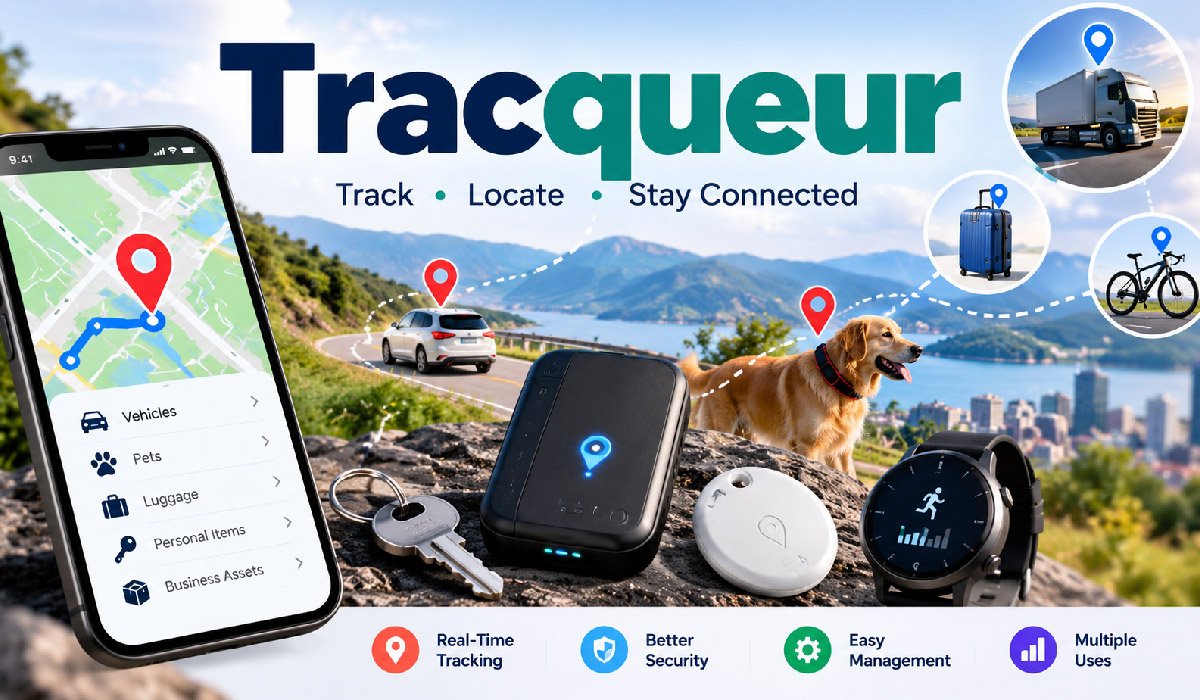
Have you ever wanted to find a missing bag, check where your car is parked, or locate an important piece of equipment? Modern tracking technology makes many of these tasks possible through small devices, wireless networks, satellites, and mobile applications.
The term tracqueur is often searched by people looking for information about trackers and location technology. However, it does not describe one specific product. Depending on the context, people may use it when discussing GPS trackers, Bluetooth tags, vehicle trackers, or asset-tracking systems.
This guide explains tracqueur in simple English, including its meaning, technology, common types, uses, accuracy, costs, advantages, limitations, privacy considerations, and important features. It will also help you understand what to consider before choosing a tracking solution.
What Is a Tracqueur?
A tracqueur can generally be understood as a tracker or tracking solution that helps determine the location, movement, or activity of an object. The term may be used when discussing devices for vehicles, luggage, pets, equipment, and other valuable belongings.
There is an important language detail behind the keyword. In standard French terminology, traceur is the established word for a tracking device. French dictionaries describe a traceur as a device capable of following the movements of a person, vehicle, or object using satellite geolocation.
Therefore, tracqueur should not be treated as the name of one universal technology or product category. When someone searches for this term, the useful question is what kind of tracker they need and which technology can perform the required tracking job.
How Does a Tracqueur Work?
A tracking device normally starts by collecting information about its position, movement, or proximity. A GPS model can receive satellite signals, while another type may detect nearby devices through Bluetooth or use radio-frequency technology to identify and monitor tagged items.
After collecting information, the system must make that data useful. Some trackers store information locally, while connected models can transmit it through cellular networks, Bluetooth, Wi-Fi, or another communication method. Software then processes the information for the user.
The final information normally appears in a mobile application, computer dashboard, or online account. Depending on the system, users may see a current position, last known location, movement history, battery status, notifications, or alerts when the tracked item changes location.
Main Types of Tracqueur Technology
GPS trackers are among the best-known tracking devices. GPS receivers calculate position using signals transmitted by satellites. They are commonly used when vehicles, equipment, or other assets may travel over considerable distances and their geographical position needs to be determined.
Bluetooth trackers solve a different problem. They are commonly attached to items such as keys, bags, wallets, and luggage. Their direct wireless range is limited compared with wide-area tracking, although some products can participate in larger networks of compatible nearby devices.
Other tracking technologies include RFID tags, Wi-Fi positioning, cellular location systems, connected sensors, and combinations of several technologies. For this reason, buyers should look beyond the word tracqueur and understand exactly how a particular tracking product detects and communicates location.
GPS Tracqueur for Cars and Vehicles
Vehicle tracking is one of the most common applications for GPS technology. A compatible GPS tracqueur can determine a vehicle’s position and, when connected to a communication service, send location information to a platform that the authorized user can access.
More advanced vehicle systems may provide route history, stops, movement alerts, travel information, and geofencing. A geofence is a virtual boundary around a selected area. Depending on the product, an alert may be generated when the tracked vehicle enters or leaves it.
Connectivity is an important consideration. GPS itself provides positioning information, but a remote tracker generally needs another method to send that information elsewhere. Many live vehicle trackers therefore use cellular connectivity and may require a SIM, data service, or recurring subscription.
Bluetooth Tracqueur for Personal Items
A Bluetooth tracqueur is usually designed for nearby personal belongings rather than traditional long-distance vehicle tracking. A small tag can be attached to keys, backpacks, wallets, luggage, or similar possessions and communicate wirelessly with a compatible phone or other nearby device.
Some modern item-finding systems go beyond the direct Bluetooth connection between the owner and tag. Compatible devices participating in a finding network may detect a lost tag and help update its approximate or last-seen location for its owner.
This makes Bluetooth tags useful for everyday objects, but they should not automatically be compared with cellular GPS trackers. Their location capabilities depend heavily on the product’s design, supported network, nearby compatible devices, and the environment in which the tracker is being used.
Tracqueur for Pets, Luggage, and Valuable Assets
Pet tracking is another popular use of location technology. A tracker attached safely to a collar can help an owner locate a pet when supported by suitable coverage. Some products also offer virtual boundaries and alerts when a pet leaves a predefined area.
Travelers may use compact trackers for luggage and bags. These devices can provide useful information when an item is misplaced or separated from its owner. However, users should understand whether the product provides GPS-based live tracking or relies on nearby compatible devices.
For expensive equipment and movable assets, businesses may require more robust solutions. Battery life, network coverage, weather resistance, installation method, update frequency, and tamper protection become particularly important when a tracqueur must operate outdoors or remain attached for long periods.
Tracqueur for Business and Fleet Management
Companies can use tracking systems to improve visibility across vehicles, equipment, tools, containers, and other assets. Instead of relying entirely on manual checks, authorized employees can use tracking information to understand where important business resources are located and how they move.
Fleet tracking can also support route planning and operational management. Depending on the system and the data collected, managers may review journeys, stops, vehicle locations, or operating patterns. This information can help businesses understand how their mobile assets are being used.
Tracking does not remove the need for good management practices. Businesses still need accurate records, appropriate maintenance, secure accounts, clear internal policies, and lawful data handling. Tracking information becomes most useful when it supports an organized process rather than operating as an isolated tool.
GPS Tracqueur vs Bluetooth Tracqueur
GPS and Bluetooth trackers are designed around different capabilities. GPS is particularly useful when a receiver needs geographical positioning over a wide area. A connected GPS tracker can therefore be suitable for vehicles, mobile equipment, and other assets that may travel long distances.
Bluetooth generally works across much shorter direct distances. This makes Bluetooth tags practical for small belongings such as keys and bags. Some modern finding networks can extend their usefulness by allowing compatible nearby devices to contribute location information when an item is separated from its owner.
Neither option is automatically better. Someone tracking a company vehicle may require GPS and cellular connectivity, while someone who regularly misplaces keys may only need a Bluetooth tag. The correct choice depends on range, environment, update requirements, battery expectations, and budget.
How Accurate Is a Tracqueur?
There is no single accuracy figure for every tracqueur. Accuracy depends on the technology, hardware, surroundings, signal conditions, and software. GPS-enabled consumer devices can perform well under open skies, but their results may become less accurate when environmental conditions interfere with signals.
Buildings, bridges, trees, indoor locations, and underground environments can reduce GPS performance. Signals can also reflect from structures before reaching a receiver. As a result, a location displayed by a tracking application should not always be interpreted as an exact physical point.
Bluetooth systems have different limitations because their operation depends on proximity and, in some cases, nearby devices participating in a finding network. Buyers should therefore read the manufacturer’s specifications and understand how the specific product determines location before relying on its accuracy claims.
Useful Features to Look for in a Tracqueur
Location updates are an important feature to examine. Some trackers provide frequent updates, while others report less often to conserve power. If near-real-time information is important, check the actual update interval instead of assuming that every product advertised as a tracker works continuously.
Battery life is equally important. Frequent communication and location updates can require more power. Some trackers use replaceable batteries, others are rechargeable, and vehicle models may connect to a power source. The ideal arrangement depends on how and where the device will operate.
Other useful features can include geofencing, movement notifications, location history, low-battery alerts, water resistance, multiple-user access, and account security. Rather than choosing the device with the longest feature list, focus on features that solve the actual tracking problem you have.
Benefits of Using a Tracqueur
One major benefit of tracking technology is improved visibility. A user may be able to check the location or last known position of a vehicle, bag, piece of equipment, or another tracked asset without physically searching every possible location.
Trackers can also improve convenience. A small tag may help find misplaced belongings, while a business tracking system can reduce time spent searching for tools or equipment. Fleet information may also help teams understand vehicle movements and coordinate daily operations more efficiently.
Tracking technology may also help with recovering lost or stolen property, although it cannot guarantee recovery or prevent theft. A tracqueur should therefore be considered one part of a broader security approach that can include locks, alarms, insurance, secure storage, and responsible procedures.
Limitations of Tracqueur Devices
Every tracking technology has limitations. GPS signals can be weaker or unavailable in some indoor, underground, or obstructed locations. Bluetooth has limited direct range. Cellular trackers depend on suitable network connectivity, while portable devices eventually require charging or battery replacement.
Another limitation is cost. Some products require only the initial purchase, while connected GPS trackers may involve monthly or annual service fees. Buyers should calculate the total cost of ownership rather than comparing devices based only on their advertised purchase prices.
A tracker can also report imperfect information. Location updates may be delayed, network service may fail, batteries may run out, or software may display outdated information. Users should understand these limitations before depending on a tracqueur for important operational or security decisions.
Tracqueur Privacy and Responsible Use
Location data can be highly sensitive because repeated tracking may reveal where a person lives, works, travels, or spends time. A tracking device should therefore be used for a legitimate purpose and with appropriate permission or authority when another person’s movements may be involved.
Modern Bluetooth tracking networks have increased attention on unwanted tracking. Technology organizations and standards groups have worked on methods that can help devices detect unfamiliar tracking accessories moving with a person. These protections are important because small tags can potentially be misused.
Laws differ between countries and circumstances, so users should not assume that owning a tracker gives them permission to monitor anyone they choose. Tracking your own belongings is fundamentally different from secretly following another person. Consent, lawful authority, data protection, and account security all matter.
How to Choose the Right Tracqueur
Begin by deciding exactly what you want to track. A vehicle, pet, suitcase, wallet, construction tool, and delivery fleet have very different requirements. Defining the purpose first prevents you from paying for technology that does not match the real problem.
Next, compare the underlying technology and operating requirements. Check whether the device uses GPS, Bluetooth, cellular service, Wi-Fi, RFID, or a combination. Also review coverage, location-update frequency, battery life, device size, installation requirements, water resistance, app compatibility, and subscription charges.
Finally, examine privacy and security. Find out what information the service collects, where possible, how the account is protected, and what controls are available to users. A useful tracqueur should provide suitable tracking features without requiring you to ignore security or responsible data handling.
Does a Tracqueur Need Internet or a SIM Card?
Not every tracqueur requires a SIM card. A Bluetooth item tracker, for example, can communicate with nearby compatible devices without operating like a conventional cellular GPS tracker. Different products use different communication systems, so their connectivity requirements can vary considerably.
GPS reception itself also should not be confused with internet access. A GPS receiver obtains positioning signals from satellites. However, if a remote tracker needs to send its calculated position to your phone from another location, it requires an appropriate communication path.
That communication may be provided by a cellular network, nearby connected device, Wi-Fi, or another system depending on the product. Consequently, some GPS trackers require SIM-based connectivity and subscription fees, while other tracking devices can operate without a traditional mobile-data plan.
Is Tracqueur the Correct French Word?
There is a useful distinction for readers researching this keyword. Authoritative French terminology uses traceur for a location-tracking device. Larousse describes a traceur as a small satellite-geolocation device associated with a digital interface for following the movements of a person, vehicle, or object.
The spelling traqueur has a different traditional meaning in French and is associated with the verb traquer, meaning to pursue or hunt. The Office québécois de la langue française specifically recommends traceur and lists traqueur as unsuitable for a technological tracking device.
The searched spelling tracqueur may still appear informally online, especially when users are trying to find information about trackers. For practical purposes, readers encountering it should examine the context rather than assume it identifies a specific technology, company, brand, or standardized product category.
The Future of Tracqueur Technology
Tracking systems are increasingly combining different technologies instead of depending on one signal source. GPS, Bluetooth, cellular communication, sensors, cloud software, and connected-device networks can work together to provide location information suited to different environments and tracking requirements.
Software is also making tracking data more useful. Instead of showing only a point on a map, modern systems can organize movement history, create alerts, identify operating patterns, and help businesses understand how vehicles or other assets are being used over time.
Privacy will remain just as important as technical progress. As tracking devices become smaller and easier to use, manufacturers and technology standards groups face continued pressure to reduce unwanted tracking. Future systems will need to balance useful location features with security, transparency, and user protection.
Final Thoughts
A tracqueur is best understood as a search term associated with tracking technology rather than one specific device. Depending on the user’s purpose, the right solution could be a GPS tracker, Bluetooth tag, vehicle tracking unit, pet tracker, or business asset system.
Understanding the technology is more important than the label. GPS, Bluetooth, cellular networks, Wi-Fi, and other systems have different strengths and limitations. Range, accuracy, battery life, coverage, update frequency, subscriptions, and software should all be considered before choosing a device.
Most importantly, tracking technology should be used responsibly. A good tracqueur can help locate belongings, manage vehicles, monitor authorized assets, and simplify everyday tasks. Its usefulness, however, depends on selecting suitable technology while respecting privacy, consent, security, and applicable laws.
(FAQs)
What does tracqueur mean?
Tracqueur is commonly used online in connection with trackers and tracking technology. It may refer broadly to a GPS device, Bluetooth tag, vehicle tracker, or asset-tracking solution. In standard French terminology, traceur is the established term for a technological tracking device.
Is a tracqueur the same as a GPS tracker?
Not necessarily. A GPS tracker can be considered one type of tracking device, but other trackers use Bluetooth, RFID, Wi-Fi, cellular technology, or connected finding networks. The underlying technology determines how the tracker works and where it can be useful.
Can a tracqueur work without a SIM card?
Yes. Not every tracker requires a SIM. Bluetooth tags normally use a different communication method. However, many GPS trackers that send their location remotely through cellular networks require SIM-based or equivalent mobile connectivity and may involve a recurring service fee.
How accurate is a tracqueur?
Accuracy depends on the device and technology. GPS can provide good positioning under open skies, but buildings, trees, bridges, indoor locations, reflected signals, and receiver quality can affect results. Bluetooth trackers have different limitations based on proximity and their supported finding network.
Can I use a tracqueur to track my car?
A suitable GPS vehicle tracker can be used to monitor an authorized vehicle. Depending on the product, it may provide current location, journey history, movement notifications, or geofencing. Check installation, connectivity, subscription, coverage, and legal requirements before using one.
Is using a tracqueur legal?
Legality depends on what is being tracked, who owns it, who is being monitored, and the laws of the relevant country or region. Tracking your own property is different from secretly tracking another person. Always consider consent, privacy rights, and applicable surveillance or data-protection rules.
