


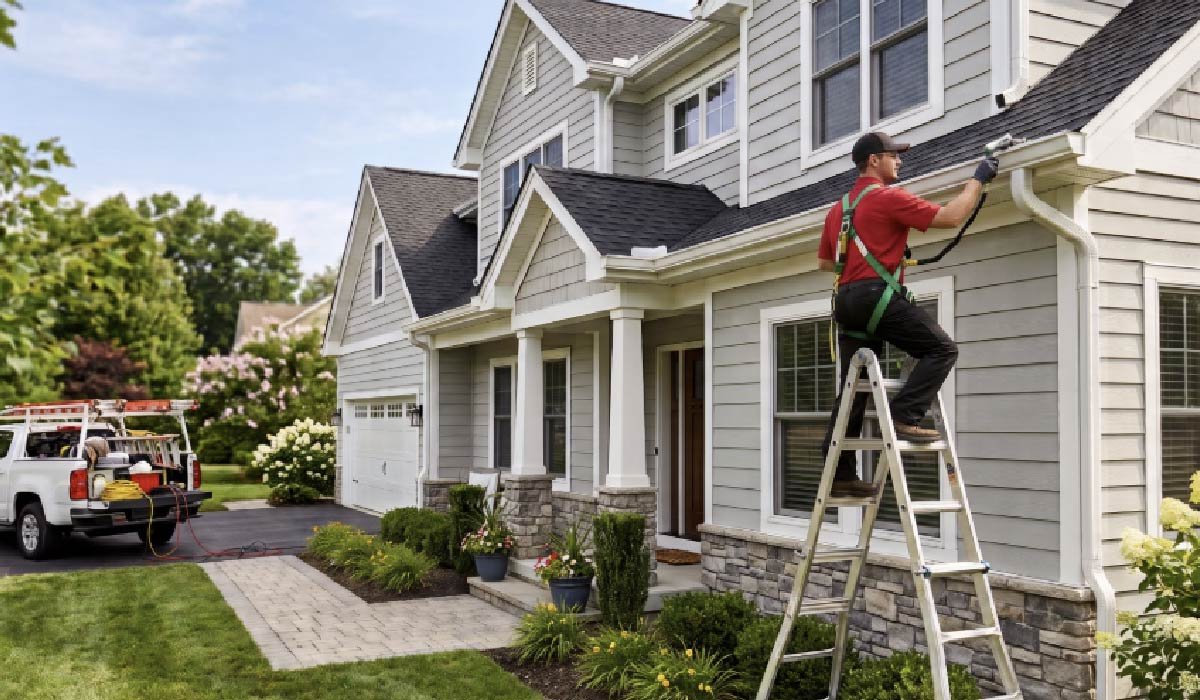
Siding doesn’t fail for the reasons you’d think. It’s the details that fail. Not the majority of the siding panels, but rather a single screw that may come loose at a corner. An improperly maintained opening such as a window or door can allow water to enter the siding as opposed to traveling through the vinyl itself. In evaluating services to perform work on the exterior of homes for contractors and property managers alike, the services can be listed in order of prevention of failure, then sequenced for cost, and finally, where the money is really being spent in each of the above services.
Diagnostic inspection that produces a defensible scope
Most surface problems can be found out during an exterior walk-through by a typical exterior inspection. But to determine if there is structural damage (as opposed to surface deterioration), an inspection that includes some type of moisture measurement (such as the use of a moisture meter) near the bottom of exterior walls, under windows and at deck ledgers is required to determine if the structural material (sheathing panels) behind the deteriorated siding has been saturated. It is worth comparing Toledo siding services before you commit to anything.
Infrared scanning, be wary of an inspector who jumps at the chance to open up your walls after viewing an image from an infrared scan taken on a hot day with good temperature differences between the warm exterior of the building and the cold interior. Find discoloration on your interior walls? Open up an inspection port and determine the cause and origin of the stain as opposed to speculating.
What to document before quoting
- Fastener type, spacing, and whether panels were nailed tight enough to prevent thermal movement
- Condition and continuity of the weather-resistive barrier at every opening
- Kickout flashing presence where a roof edge meets a sidewall
- Clearance between cladding and grade, roofing, and hard surfaces
- Sheathing moisture content at the lowest point of each elevation
Targeted repair versus replacement
Repair of a damaged wall makes sense only if the damage is minor, all structural components are sound and have not been saturated, and one can obtain the matching materials required for the repair work. As a rule, if more than 25% of the surface of an exterior wall is affected, or if the weather resistive barrier has deteriorated on the reverse side of the wall, repair is only a stepping stone to full replacement of the exterior wall(s).
The color of the repair area must be taken into account for vinyl siding and fiber cement siding as weathered siding never matches new siding. The patches on visible sides of the house will look even worse than the original damage within five years and could potentially cost even more to repair reverse side and side walls.
| Service | Primary risk addressed | Typical service life | Best used when |
| Spot repair | Wind-lifted or impact-damaged panels | Matches remaining cladding life | Damage is under 25% of an elevation, substrate dry |
| Joint sealing and caulk renewal | Water entry at trim and penetrations | 5 to 15 years by sealant class | Cladding sound, movement joints intact |
| Barrier replacement | Bulk water reaching sheathing | Life of the wall assembly | Cladding is being removed anyway |
| Full replacement | Systemic failure, rot, repeated leaks | 25 to 50 years by material | Barrier, flashing, or sheathing compromised |
Sealing, flashing, and the limits of caulk
Sealants are a secondary layer used to contain minor amounts of water that have penetrated a building through any envelope deficiencies. As part of the weatherproofing of the building envelope, sealants can be expected to fail long before the rest of the exterior weatherproofing barrier. Sealants must be maintained and inspected on a regular basis and replaced when required.
Flashing, There are three main types of flashing, head, sill and kickout. In general, the main function of flashing is to move large amounts of water through and between walls. In some cases, sealants are incorrectly used as an alternative to sections of flashing such as the sill pan. Often, these areas are subsequently left unrepaired to save money. As mentioned previously, sealants will fail prior to the siding, however, poorly installed or replaced flashing will result in failure of the entire wall within five years.
Specification notes worth enforcing
- Butt joints in fiber cement need flashing behind them, not sealant in them
- Sealant joints require backer rod to achieve correct depth-to-width ratio
- Penetrations for lights, hose bibs, and vents need a mounting block integrated with the barrier
- Maintain manufacturer clearances, commonly six inches to grade and two inches to roofing
Weather barriers and drainage planes
A house’s weather barrier is the layer of protective sheeting that is behind the house’s cladding. This is typically a roll of house wrap which is tucked behind the bottom of upper courses to create a roof like joint. The house wrap is typically taped at the joints between sheets but in a rain assault the seal between the tapes can be breached allowing water to flow down behind the wrap entering the house’s sheathing. In many instances a self-adhered membrane such as a self-adhered weather resistant barrier can be a better option for these openings than trying to open up a house wrap and tape it back up again. However the self-adhered membrane must be applied to a clean, dry surface and adequately primed.
Leaving a 3/8” rainscreen gap (7-10 mm) using furring strips or a drainage mat allows for occasional rainfall to run down the building and dry out between the cladding and the building envelope. In high-exposure locations such as coastal and mountainous regions, detailing this rainscreen space is far more valuable than upgrading the weather-resistant barrier behind new cladding.
Complete installation as a system
Replacing exterior siding components affords an opportunity to repair a house’s weatherproofing barrier, seal gaps between siding components, inspect and repair/replace fasteners, restore sealed weatherproofing around openings, and identify and repair problems with wall ventilation as well as check sheathing for damage. Furthermore, many problems found in exterior walls will include damage to structural components. Replacing the exterior skin of a house in a single phase of work is most cost effective when considered in relation to repairing damaged wall components and installing a suitable, compatible weatherproofing barrier behind new exterior siding.
Material selection against exposure
Fiber cement siding is a good choice for hail prone areas as well as for fire prone areas. Be sure to caulk the cut edges as specified in the installation instructions. Insulated vinyl siding makes a great barrier against impact. The siding also raises the R-value of the exterior walls. Engineered wood siding is the best choice for very cold weather. Be sure to detail the lap and the flashing exactly as specified for the siding that you choose. Material and catalog illustration are NOT the same thing.
