


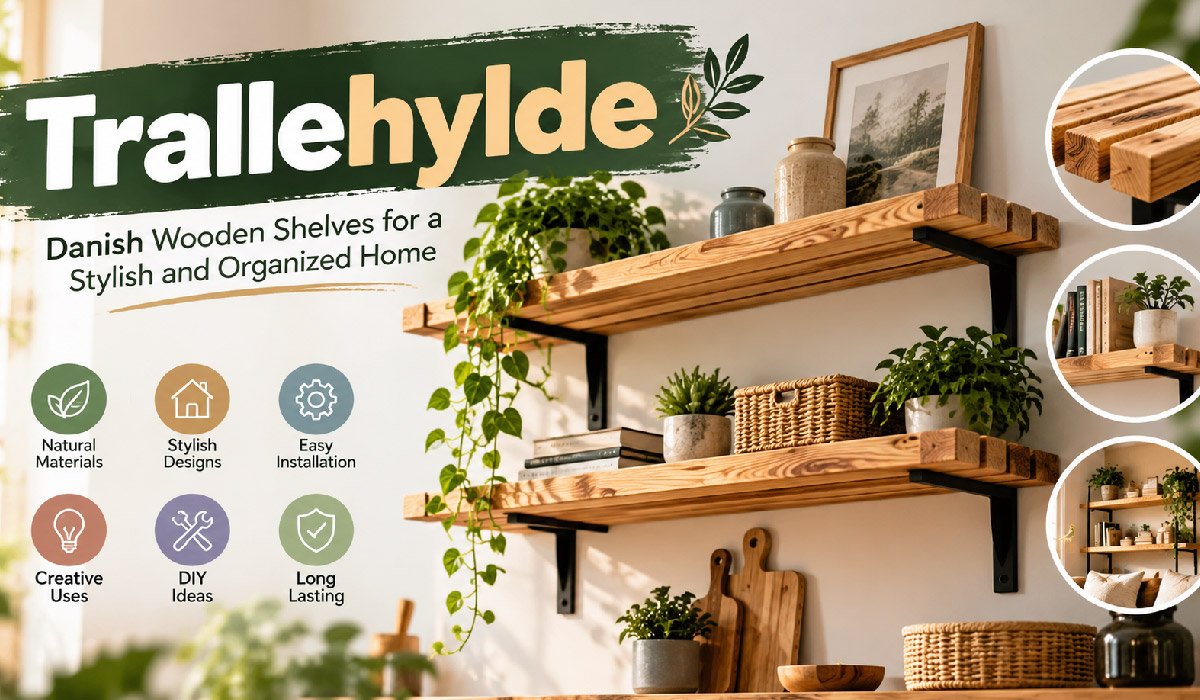
A trallehylde is a practical shelving style that brings together natural wood, simple construction, and useful storage. Its slatted appearance gives ordinary walls and storage areas more character while offering a flexible place for household items, decorations, plants, and everyday essentials.
The idea has strong Danish roots. A tralle traditionally refers to a long, narrow platform made from connected wooden battens, while hylde means a shelf. Today, the word is often associated with shelves influenced by this practical slatted wooden construction.
Choosing a trallehylde requires more thought than simply finding an attractive design. Wood quality, shelf dimensions, slat spacing, mounting hardware, moisture exposure, and expected load all matter. This guide explains these factors so you can choose, use, and maintain one confidently.
What Is a Trallehylde?
A trallehylde is generally understood as a shelf made from, or designed to resemble, a Danish wooden tralle. Traditional traller have parallel wooden battens that form an open platform, so shelving inspired by them often features visible slats and straightforward construction.
The term does not describe one standardized furniture product. Some trallehylde designs use reclaimed tralle boards, while others are newly manufactured from pine, oak, or similar timber. You may also find products combining wooden slats with steel frames or wall brackets.
This distinction is important when shopping. Two products carrying the same name may have completely different dimensions, finishes, strength, and intended applications. Instead of relying on the product title alone, examine its materials, construction, mounting method, and stated load capacity carefully.
Why Has Trallehylde Become Popular?
One reason for its appeal is the combination of storage and visual texture. Instead of presenting one completely flat wooden surface, slats introduce lines, gaps, shadows, and natural grain, allowing a relatively simple shelf to become part of a room’s overall design.
Trallehylde also works comfortably with several popular interior styles. Light timber can complement Scandinavian spaces, weathered boards fit rustic rooms, and darker wood combined with exposed metal can support an industrial appearance without requiring a large or visually heavy furniture piece.
Practicality is equally important. Wall-mounted shelves can use otherwise empty vertical space, while freestanding versions can create organized storage without built-in cabinetry. Their usefulness ultimately depends on dimensions and construction, making careful product selection more important than following a particular design trend.
Common Materials Used for Trallehylde
Solid wood is one of the most familiar choices. Pine is relatively easy to cut, drill, sand, and finish, making it attractive for straightforward DIY projects. Oak generally offers a harder surface and distinctive grain but often comes at a higher price.
Reclaimed timber can provide weathering, fixing marks, colour differences, and other characteristics that make individual shelves visually unique. However, unknown timber requires careful inspection because previous coatings, chemical exposure, moisture damage, embedded fasteners, rot, or insects may make some reclaimed boards unsuitable.
Some modern designs combine wood with powder-coated or other metal components. Others may use engineered boards or veneers to achieve a more consistent finish. Each construction has advantages, so buyers should compare durability, repairability, moisture tolerance, weight, maintenance requirements, and cost.
Slatted Shelves vs Solid Wooden Shelves
The most obvious difference is the storage surface. A solid shelf provides continuous support, making it convenient for books, bottles, small containers, and objects with narrow bases. A slatted trallehylde intentionally leaves spaces between separate boards or battens.
Those openings can create a lighter appearance and allow air to move more freely around suitable objects. However, small accessories may sit unevenly or fall between wide gaps. A removable tray or appropriate solid insert can make certain slatted shelves more versatile.
Neither construction is automatically stronger. Shelf capacity depends on timber quality, dimensions, unsupported span, joints, brackets, anchors, and wall construction. A thick-looking shelf can still perform poorly if its supports or fasteners are inadequate for the load placed upon it.
Best Places to Use a Trallehylde
Living rooms are well suited to decorative trallehylde installations. A shelf can display framed photographs, ceramics, plants, candles, or selected books while adding natural texture to a plain wall. Leaving some open space usually prevents the arrangement from appearing unnecessarily crowded.
In bedrooms and home offices, a shelf can organize stationery, accessories, small storage boxes, or decorative objects without occupying valuable floor or desk space. Narrow designs can be particularly helpful where a full bookcase or cabinet would make the room feel cramped.
Hallways, kitchens, bathrooms, utility rooms, and sheltered outdoor spaces can also accommodate suitable models. Conditions differ considerably between these locations, however. Heat, humidity, water, grease, weather exposure, and heavy equipment require materials and finishes specifically appropriate for the intended environment.
Using Trallehylde in Kitchens and Bathrooms
A kitchen trallehylde can provide convenient storage for mugs, cookbooks, selected containers, or decorative kitchenware. Before installation, consider grease, cooking heat, spills, and cleaning. Open gaps may also collect residue, making some slatted designs less convenient for frequently handled food products.
Bathrooms require even greater attention to moisture. Wood naturally exchanges moisture with surrounding air, and changes in moisture content can contribute to dimensional movement. A suitable protective finish can reduce exposure effects, but a coating does not make every wooden shelf waterproof.
Choose properly finished materials, suitable corrosion-resistant fittings, and a location protected from regular splashing. Good ventilation remains important. A wooden shelf designed for a dry bedroom should not automatically be considered suitable beside a shower, bath, sink, or another persistently wet location.
Choosing the Right Size and Slat Spacing
Begin by measuring the intended installation area rather than estimating visually. Record the maximum width, practical depth, available height, nearby furniture, switches, windows, and doors. Also make sure people can walk comfortably past the shelf once it projects from the wall.
Next, consider what will actually sit on the shelf. Large baskets require greater depth, while photographs and small decorative objects may need much less. Frequently used items should remain comfortably accessible rather than being placed at an inconvenient height merely for visual effect.
Slat spacing deserves particular attention. Measure the base of the smallest objects you expect to store. If their feet or edges could enter the openings, select narrower spacing or use a suitable insert. Appearance should never make everyday storage unnecessarily awkward.
Understanding Weight Capacity and Shelf Safety
There is no universal weight limit for a trallehylde. Capacity changes according to timber species, board dimensions, shelf length, joints, supporting frame, bracket spacing, wall construction, anchors, screws, and whether the load is evenly distributed across the available surface.
Whenever possible, follow the manufacturer’s stated load rating for the complete installed product. Do not assume that reclaimed timber, thick boards, or large metal brackets automatically mean heavy-duty performance. Decorative components can appear substantial while having relatively modest structural capabilities.
Heavy objects also need thoughtful positioning. Avoid concentrating excessive weight at unsupported edges or in one small area. If the manufacturer provides no reliable capacity information, use the shelf conservatively and obtain appropriate professional advice before installing unusually heavy or valuable belongings.
How to Install a Trallehylde Safely
First identify the wall construction. Solid masonry, concrete, timber framing, and plasterboard require different fixing strategies. Hardware suitable for one surface may be inappropriate for another, particularly when the shelf is expected to support a substantial or concentrated load.
Carefully measure and mark mounting positions, then use a spirit level to keep the installation straight. Before drilling, consider concealed electrical wiring and plumbing. Install brackets, anchors, screws, or proprietary fittings according to the shelf and hardware manufacturer’s instructions.
Once installed, inspect every connection before adding belongings. Look for movement, loose hardware, damaged wall material, or uneven supports. Add appropriate items carefully rather than testing strength by pulling or hanging from the shelf, which is unsafe and proves little about rated capacity.
Can You Build a DIY Trallehylde?
A simple trallehylde can make an approachable woodworking project for someone with suitable tools and basic skills. Building your own version provides control over its length, depth, number of slats, spacing, wood species, surface finish, brackets, and final appearance.
Start with dry, sound timber and reject boards showing significant rot, deep structural cracks, or serious damage. Reclaimed wood requires additional care. Remove hidden nails or screws and investigate its previous use before sanding material that may carry unknown coatings or contamination.
Plan dimensions before cutting, smooth exposed edges, space the slats consistently, and use appropriate fasteners. Apply a finish designed for the intended environment and allow it to cure properly. Finally, use mounting hardware capable of supporting the completed shelf and expected contents.
Choosing the Best Wood Finish
Oil is often chosen when the goal is to emphasize natural grain and maintain a relatively understated wooden appearance. Depending on the specific product, an oiled surface may require periodic maintenance, so always follow its application and re-coating instructions rather than assuming universal intervals.
Wax can produce an attractive tactile surface, while suitable varnishes and lacquers may create a more protective film. Paint provides another option when colour matters more than visible grain. Outdoor installations require finishes specifically intended for the conditions the wood will experience.
Remember that surface treatment does not eliminate normal wood behaviour. Timber responds to environmental moisture, and protective coatings generally slow moisture exchange rather than completely preventing it. Material selection, room conditions, good construction, and ongoing maintenance therefore remain important alongside the chosen finish.
How to Style a Trallehylde
Natural timber can work particularly well with white, cream, beige, grey, muted green, and black, although the best palette depends on the wood itself. Pale boards often support Scandinavian interiors, while darker or visibly weathered timber can introduce stronger rustic character.
Avoid filling every centimetre with decorative objects. Combine a few different heights and textures, perhaps using a plant, framed picture, books, ceramic piece, or storage basket. Leaving visible timber and open space helps the construction remain an intentional part of the display.
Function should still guide styling. Keep frequently used objects easy to reach, place unstable decorations away from vulnerable edges, and avoid positioning heavy items purely for visual balance. In kitchens, offices, and entryways, accessibility should normally take priority over decorative arrangements.
Cleaning and Maintaining a Trallehylde
Routine cleaning is usually straightforward. Remove dust using a soft cloth or suitable brush, paying attention to the edges and spaces between individual slats. For marks and spills, follow the cleaning recommendations provided for the particular wood finish rather than using harsh products.
Moisture should not remain on wooden surfaces unnecessarily. Wipe spills promptly and allow damp areas to dry. This is particularly important in kitchens, bathrooms, and utility areas because wood exchanges moisture with its environment and can swell, shrink, stain, or deteriorate under unsuitable conditions.
Inspect the shelf periodically as well. Loose screws, movement at mounting points, worn finishes, cracks, sagging, corrosion, or damaged brackets deserve attention. Remove the stored load if structural movement appears, and correct the underlying problem before returning the shelf to normal use.
Is Reclaimed Trallehylde a Sustainable Choice?
Reusing suitable timber can extend the service life of material that already exists, making reclaimed wood attractive to people trying to reduce unnecessary material consumption. It can also preserve marks and textures that would be difficult to reproduce convincingly with newly manufactured boards.
However, reclaimed does not automatically mean environmentally superior. Transportation, cleaning, restoration, chemical treatment, wastage, and product lifespan can all affect environmental impact. Timber with an uncertain history may also require substantial processing before it becomes appropriate for household furniture.
When purchasing new timber, look for clear sourcing information rather than relying on vague environmental claims. Credible forest-certification systems can provide useful sourcing information. Durability matters too: a well-made shelf kept in service for years can reduce unnecessary replacement and material consumption.
What to Check Before Buying Trallehylde
Start with the basics: overall dimensions, shelf depth, wood type, slat spacing, finish, mounting system, and intended environment. Compare these specifications with the objects you need to store rather than choosing a shelf because it looks attractive in carefully staged product photographs.
Then investigate practical details. Check whether brackets and fasteners are included, whether a load rating is provided, what assembly is required, and how the surface should be maintained. Delivery charges, warranty terms, replacement components, and return conditions may also influence overall value.
Price should be considered alongside construction quality and expected lifespan. An inexpensive shelf can be perfectly adequate for light decoration, while demanding storage may justify better materials and hardware. The best purchase is the shelf that reliably performs its intended job over time.
Is Trallehylde Worth It?
A trallehylde can be a worthwhile choice when you want practical storage with visible wooden character. It is particularly appealing for homes where natural materials, Scandinavian simplicity, rustic details, or industrial combinations already form part of the interior design.
It is less suitable when you require a perfectly continuous surface, verified heavy-duty storage, or a shelf exposed constantly to water unless the specific product was engineered for those conditions. The slatted structure should provide a practical benefit rather than create inconvenience.
Ultimately, the name matters less than construction quality. A carefully selected shelf with suitable dimensions, materials, spacing, finish, supports, and mounting hardware can remain useful for years. Choose according to the room and storage requirement first, then consider appearance and decorative style.
Final Thoughts
Trallehylde demonstrates how a straightforward shelving idea can combine practical storage with natural character. Its distinctive slatted construction can suit Scandinavian, rustic, industrial, and contemporary interiors while helping homeowners make productive use of walls and other underused areas around the home.
Successful use depends on matching the shelf to its environment. Timber type, slat spacing, dimensions, moisture exposure, load capacity, brackets, and wall fixings all deserve attention. These practical considerations matter considerably more than choosing a product simply because its surface looks appealing.
Whether you purchase a finished trallehylde or build one yourself, focus on safe construction, appropriate materials, and realistic storage needs. With sensible installation and maintenance, a well-chosen shelf can provide an attractive, adaptable, and long-lasting addition to everyday living spaces.
FAQs
What does trallehylde mean?
Trallehylde is a Danish compound term. Tralle can describe a long, narrow slatted platform made from connected battens, traditionally used with scaffolding, while hylde means shelf. In furniture contexts, the term is commonly associated with shelving influenced by that slatted construction.
Is trallehylde always made from reclaimed wood?
No. Some designs reuse old tralle or scaffold-style timber, while others are produced from new pine, oak, engineered wood, or combinations of wood and metal. Check the manufacturer’s material description if reclaimed timber is particularly important to you.
Can I use a trallehylde in a bathroom?
Possibly, but the timber, finish, hardware, and placement must suit humid conditions. Avoid regular direct water exposure unless the product is designed for it. Good ventilation and prompt removal of standing water can also help protect wooden shelving.
How much weight can a trallehylde hold?
There is no standard capacity. Safe loading depends on dimensions, timber quality, joints, span, brackets, anchors, wall construction, and installation. Follow the manufacturer’s load rating and never estimate strength simply from the thickness or appearance of the shelf.
Can I make a trallehylde myself?
Yes. A basic slatted version can be a manageable woodworking project. Use structurally sound timber, plan the slat spacing and dimensions carefully, smooth exposed edges, choose suitable fasteners and finishes, and use mounting hardware appropriate for the expected load.
How should I clean a trallehylde?
Dust it regularly with a soft cloth or brush and remove spills promptly. Use cleaners recommended for its particular finish and avoid unnecessarily soaking the wood. Periodically inspect the surface, joints, brackets, screws, and wall fixings for wear or movement.
